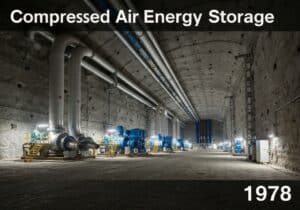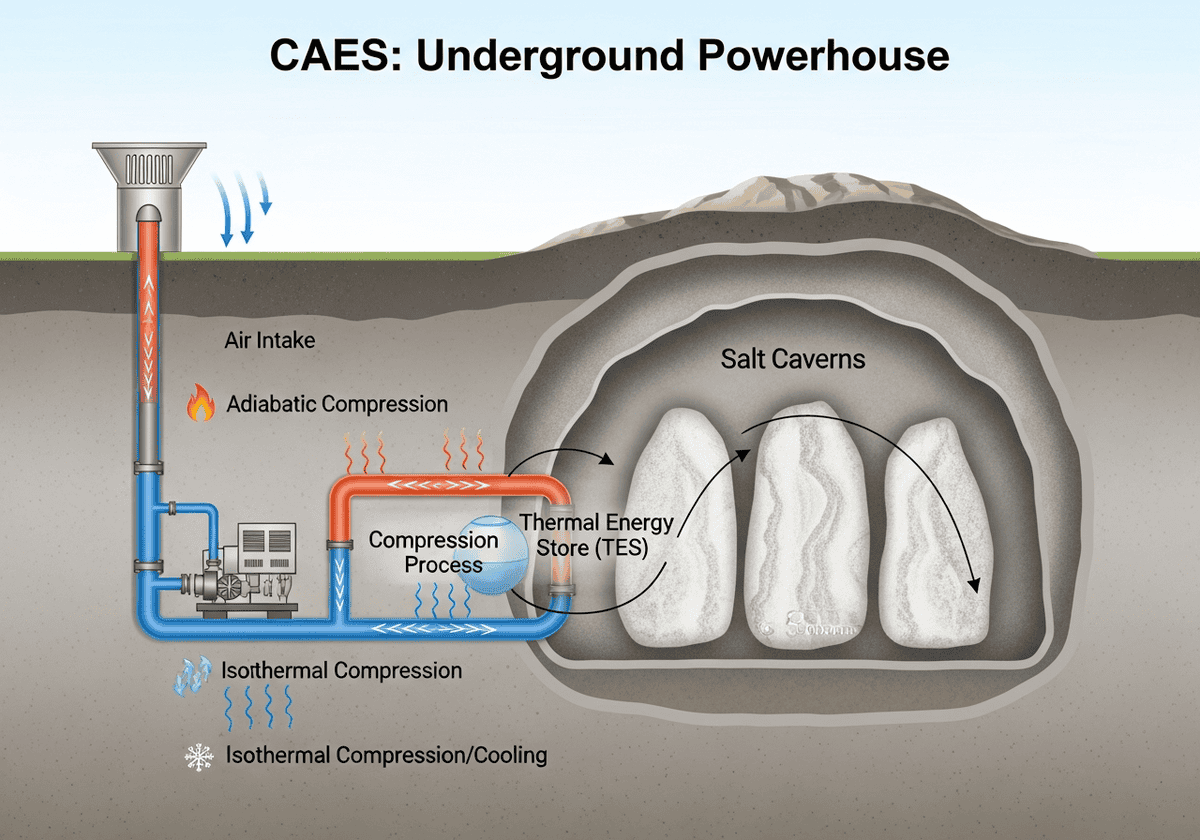

Le stockage d'énergie par air comprimé (CAES) convertit l'énergie électrique excédentaire en potentiel mécanique en comprimant l'air dans des formations géologiques souterraines — cavernes de sel, aquifères ou réservoirs de roches poreuses — et en le récupérant grâce à des turbines d'expansion lors des pics de demande.
Les performances thermodynamiques dépendent de l'étagement de la compression et de la détente, du refroidissement intermédiaire, de la récupération d'énergie et de l'intégration du stockage thermique, ce qui distingue les variantes diabatiques, adiabatiques et isothermes présentant des rendements de cycle très différents. L'intégrité géomécanique du milieu de stockage, l'étanchéité du puits et les processus de lixiviation de la caverne conditionnent la viabilité opérationnelle à long terme. Les recherches actuelles portent sur des configurations adiabatiques avancées éliminant totalement la combustion, des approches isothermes réduisant les pertes d'exergie et l'optimisation de la répartition sur le réseau.
Cette page regroupe les publications les plus récentes évaluées par des pairs et les brevets accordés couvrant l'ensemble du spectre technique de la recherche sur la CAES.
Le stockage d'énergie par air comprimé (CAES) permet de stocker l'électricité sous forme d'air comprimé, généralement dans des cavernes souterraines. La gestion de la chaleur représente le principal défi ; lisez donc attentivement la suite. stockage d'énergie thermique et thermodynamiqueLe stockage de grille concurrent apparaît sur batteries à flux redox et super condensateursLa planification de sa production en fonction des énergies renouvelables est prise en charge par réseaux intelligents.
Voici notre dernière sélection de publications et de brevets internationaux en anglais sur le stockage d'énergie par air comprimé (CAES), issus de nombreuses revues scientifiques en ligne, classés et axés sur la compression adiabatique, la compression isotherme, le rendement polytropique, le stockage en caverne, les cavernes de sel, le stockage en aquifère, le CAES diabatique, le CAES adiabatique, le CAES isotherme, le CAES adiabatique avancé, le stockage d'énergie thermique, le récupérateur, la turbine d'expansion, le train de compresseurs, le taux de compression, le rendement aller-retour, l'analyse exergétique, l'intégrité du stockage géologique, l'intégrité du puits, l'étanchéité à l'air, la combustion avec réchauffage, le refroidissement intermédiaire, les pertes par étranglement, l'exergie de l'air comprimé, les réservoirs sous pression souterrains, les réservoirs de roche poreuse, le lessivage des cavernes, la stabilité géomécanique, la répartition du stockage à l'échelle du réseau, la mise en service des turbines d'expansion, le stockage d'énergie par air comprimé et le CAES.
Vapor header heat exchanger for residential evaporator coil
Patent published on the 2026-11-19 in US under Ref US20260366781 by CARRIER CORP [US] (Amick James [us], Farraj Abdelrahman [us], Ranka Amrat Arvind [us])
Abstract: A fluid conditioning system includes a compressor, a first heat exchanger, an expansion device, and a second heat exchanger fluidly connected to form a vapor compression loop through which a working fluid is configured to circulate. A recuperator heat exchanger is fluidly connected to the vapor compression loop. The recuperator heat exchanger includes a first pass fluidly connected to the vapor compression loop downstream from the first heat exchanger and upstream from the expansion device relat[...]
Our summary: A fluid conditioning system incorporates a vapor compression loop with a compressor and two heat exchangers. A recuperator heat exchanger is integrated to enhance efficiency. The system is designed for residential evaporator coil applications.
vapor compression, heat exchanger, fluid conditioning, residential system
Patent
Methods, systems and apparatus for processing gaseous streams including carbon dioxide
Patent published on the 2026-11-19 in US under Ref US20260364483 by ABARR MILES L LINDSEY [US] (Abarr Miles L Lindsey [us], Bence Christopher Stephen [us], Markey Ethan James [us], Young Jeffrey Michael [us])
Abstract: Apparatus, systems, and methods for processing gaseous streams including COare disclosed. A method for performing a hot compression on a gaseous input stream including carbon dioxide (CO) involves mixing the gaseous input stream with at least a portion of a COdepleted gaseous stream to generate a gaseous input stream having a COconcentration that meets a target COconcentration. Another method involves compressing the gaseous input stream in a hot compressor to generate a hot compressed gaseous s[...]
Our summary: The content describes methods and systems for processing gaseous streams that include carbon dioxide. It details a method for hot compression of a gaseous input stream mixed with a CO-depleted stream. Additionally, it discusses an apparatus for cooling and compressing the hot gaseous stream to remove carbon dioxide.
carbon dioxide, gaseous streams, hot compression, CO separator
Patent
Control method for refrigeration cycle system, and refrigeration cycle system
Patent published on the 2026-11-19 in WO under Ref WO2026237251 by QINGDAO HISENSE HITACHI AIR CONDITIONING SYS CO LTD [CN] (Zhu Haitao [cn], Chen Jianxing [cn])
Abstract: Disclosed in the present application are a control method for a refrigeration cycle system, and a refrigeration cycle system. The refrigeration cycle system comprises a compressor, a condenser, a flash economizer and an evaporator, which are sequentially distributed in series, wherein the flash economizer is further configured to perform vapor injection to the compressor. The control method comprises: acquiring a turning-on signal of a compressor; after acquiring the turning-on signal, regulatin[...]
Our summary: The document describes a control method for a refrigeration cycle system that includes a compressor, condenser, flash economizer, and evaporator. The method involves acquiring a compressor turning-on signal and regulating its rotational speed. It further includes regulating the discharge superheat, vapor injection pressure, and pressure ratio of the compressor to target ranges.
refrigeration cycle, compressor control, vapor injection, superheat regulation
Patent
Method for controlling an ejector using steam-turbine exhaust in a cogeneration unit
Patent published on the 2026-11-19 in US under Ref US20260366438 by UNIV TAIYUAN TECHNOLOGY [CN] (Ma Suxia [cn], Zhang Yingwen [cn], Zhang Jingxian [cn], Zhang Jiajie [cn], Zhao Guanjia [cn], Xu Jing [cn], Feng Yuchuan [cn])
Abstract: Disclosed is a control method for a steam ejector that utilizes steam-turbine exhaust in a cogeneration unit. The method includes: (i) determining whether to place the ejector into service; (ii) computing the ejector motive-steam flow Dand turbine exhaust pressure punder varying motive-steam pressure, based on nozzle design pressure ratio and condenser heat balance; and (iii) coordinated control of pand D. In operation, turbine backpressure and Dare adjusted in real time according to primary net[...]
Our summary: The method controls a steam ejector using steam-turbine exhaust in a cogeneration unit. It involves determining service status, computing motive-steam flow and turbine exhaust pressure, and coordinating control in real-time. This approach enhances ejector performance and maximizes recoverable exhaust-steam heat supply.
ejector control, steam-turbine exhaust, cogeneration unit, thermal power plants
Patent
Preignition determination method and preignition determination device
Patent published on the 2026-11-18 in EP under Ref EP4841088 by MITSUBISHI HEAVY IND ENGINE & TURBOCHARGER LTD [JP] (Ando Junnosuke [jp], Yoshizumi Hiroshi [jp], Kawai Kazuhiro [jp], Furukawa Yuta [jp])
Abstract: A preignition determination method for an internal combustion engine includes: an in-cylinder pressure information acquisition step of acquiring at least a first pressure that is a pressure before a compression top dead center in a determination target combustion cycle of a target cylinder for which presence or absence of preignition in the internal combustion engine is to be determined, a second pressure that is a pressure after the compression top dead center in the determination target combus[...]
Our summary: The method involves acquiring in-cylinder pressure data before and after compression top dead center. It calculates a pressure ratio to assess preignition state. The detection criteria are based on comparisons with standard pressure data.
preignition, internal combustion engine, pressure ratio, detection method
Patent
Compressed air energy storage and distribution pipeline for air cooling system and method
Patent published on the 2026-11-12 in US under Ref US20260357786 by BREEZE INC [US] (Connors Christopher Edward [us], Orshan Michael Steven [us], Wiart Denis Raymond [ca])
Abstract: The present invention involves storage of energy with compressed air into a compressed air microgrid enabling localized energy systems to be deployed without straining conventional existing electrical grids. A network of powerhoods may be established for supporting a plurality of buildings, with the network having a source of compressed air; a piping system; and powerhoods coupled to the piping. Buildings are coupled to each powerhood, each powerhood having a compressed air turbine for generatin[...]
Our summary: The invention describes a compressed air energy storage system for localized energy distribution. It utilizes a microgrid to support multiple buildings without overloading existing electrical grids. Each building connects to a powerhood with a turbine and heat exchanger for electricity generation and air conditioning.
compressed air, energy storage, microgrid, heat exchanger
Patent
A CFD–DEM Numerical Study
Published on 2026-01-29 by Weiqiang Zhao, Xijie Song, Ning Wang, Yongyao Luo, Ling Ma @MDPI
Abstract: During the discharge process of a salt cavern compressed air energy storage (CAES) system, high-speed air flow may entrain salt slag from the cavern floor, posing a threat to pipeline safety. Currently, there is a lack of in-depth research into the transient mechanisms of the entrainment process, particularly the influence of particle shape. This study employs a CFD-DEM coupling approach to conduct, for the first time, a high-fidelity simulation of slag entrainment dynamics during the initial di[...]
Our summary: This study investigates the transient mechanisms of particle entrainment during the discharge of a salt cavern compressed air energy storage system. A CFD-DEM coupling approach simulates the dynamics of different particle shapes, revealing that spherical particles are most easily entrained. The findings highlight the influence of particle shape on entrainment efficiency and provide insights for improving operational safety in CAES systems.
CFD, DEM, particle entrainment, salt cavern
Publication
Normal Shock Wave Approximations for Flight at Hypersonic Mach Numbers
Published on 2026-01-24 by Pasquale M. Sforza @MDPI
Abstract: Normal shock pressure ratios in equilibrium air for Mach numbers up to 30 and altitudes to 300,000 feet are shown to be correlated by a simple power law which provides an accuracy of ±2%, thereby permitting direct calculation of corresponding enthalpy ratios accurate to ±1% without iteration; a slight change in power-law coefficients extends this capability to Mach 65. Temperature, density, and compressibility may be then found directly from tables for high temperat[...]
Our summary: The study presents a power law correlation for normal shock pressure ratios in equilibrium air at hypersonic Mach numbers. It enables accurate calculations of enthalpy ratios and other state variables without iteration. This method is beneficial for design and analysis of vehicles operating in low to moderate hypersonic regimes.
Shock Wave, Hypersonic, Power Law, Enthalpy
Publication