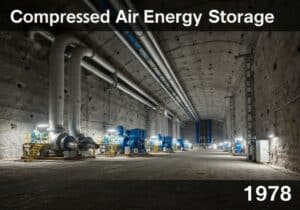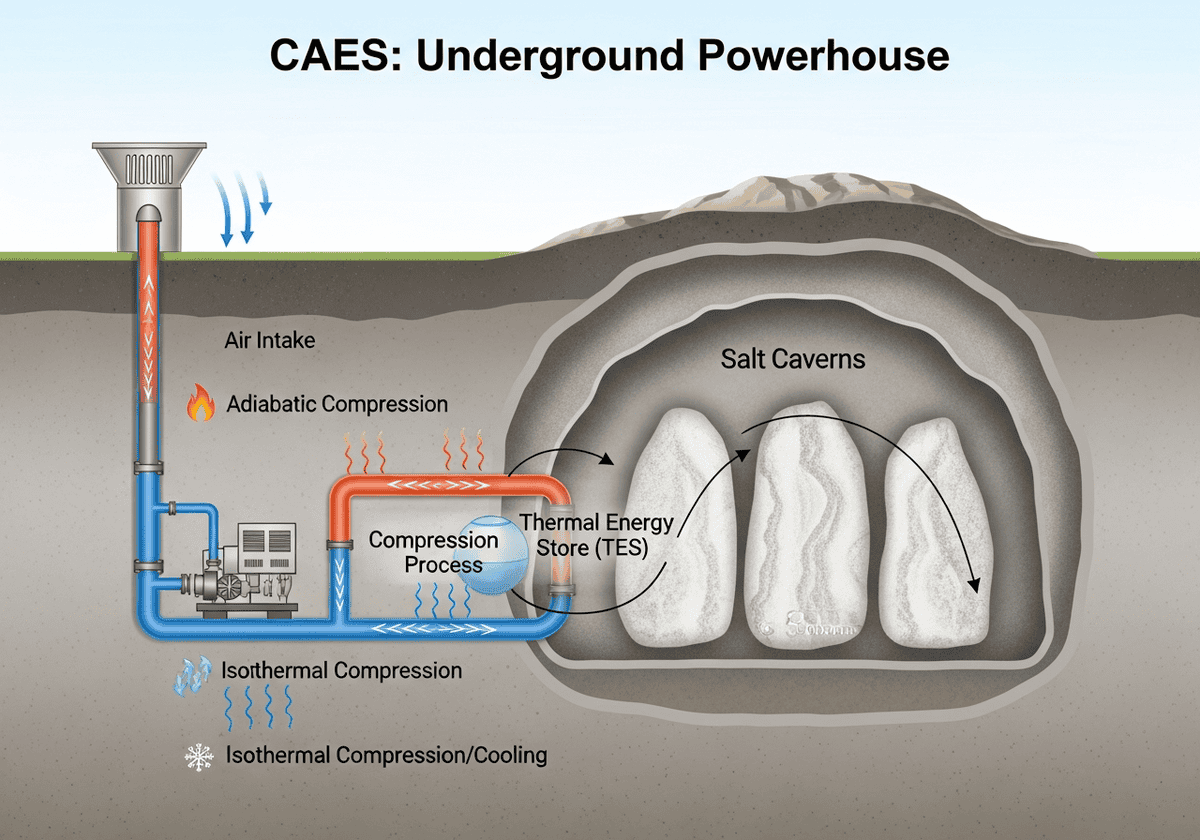

El almacenamiento de energía mediante aire comprimido (CAES, por sus siglas en inglés) convierte el excedente de energía eléctrica en energía mecánica comprimiendo el aire en formaciones geológicas subterráneas (cavernas de sal, acuíferos o depósitos de roca porosa) y recuperándolo a través de turbinas de expansión durante los períodos de máxima demanda.
Termodinámica El rendimiento depende de la etapa de compresión y expansión, el enfriamiento intermedio, la recuperación y la integración del almacenamiento térmico, distinguiendo variantes diabáticas, adiabáticas e isotérmicas con eficiencias de ciclo completo sustancialmente diferentes. La integridad geomecánica del medio de almacenamiento, el sellado del pozo y los procesos de lixiviación de la caverna determinan la viabilidad operativa a largo plazo. La investigación actual se centra en configuraciones adiabáticas avanzadas que eliminan la combustión por completo, enfoques isotérmicos que reducen las pérdidas de exergía y la optimización del despacho de la red.
Esta página recopila las publicaciones revisadas por pares más recientes y las patentes concedidas en todo el espectro técnico de la investigación en CAES.
Esta es nuestra selección más reciente de publicaciones y patentes mundiales en inglés sobre almacenamiento de energía de aire comprimido (CAES), entre muchas revistas científicas en línea, clasificadas y enfocadas en compresión adiabática, compresión isotérmica, eficiencia politrópica, almacenamiento en cavernas, cavernas de sal, almacenamiento en acuíferos, CAES diabático, CAES adiabático, CAES isotérmico, CAES adiabático avanzado, almacenamiento de energía térmica, recuperador, turbina expansora, tren de compresores, relación de presión, eficiencia de ida y vuelta, análisis de exergía, integridad del almacenamiento geológico, integridad del pozo, hermeticidad, combustión de recalentamiento, enfriamiento intermedio, pérdidas por estrangulamiento, exergía del aire comprimido, recipiente a presión subterráneo, yacimiento de roca porosa, lixiviación de cavernas, estabilidad geomecánica, despacho de almacenamiento a escala de red, etapas de turbina de expansión, almacenamiento de energía de aire comprimido y CAES.
Power generation system
Patent published on the 2026-05-20 in GB under Ref GB2701973 by ROLLS ROYCE SUBMARINES LTD [GB] (Jacob Diffey [gb])
Abstract: A power generation system 100 for a microreactor comprising: a reactor core 10; a first turbomachinery system 20 comprising a turbine 22 and a compressor 24; a first heat-rejection sub-system 40; and a first recuperator 30 comprising a hot flow inlet flange 31, a hot flow outlet flange 32, a cool flow inlet flange 33, a cool flow outlet flange 34, and a matrix 35 comprising hot flow channels 36 and cool flow channels 37 arranged as part of a loop such that a working fluid can flow around the loo[...]
Our summary: The power generation system includes a microreactor with a reactor core and a turbomachinery system. It features a closed Brayton cycle with a first recuperator and heat-rejection subsystem. The system is designed for efficient fluid flow through specified channels and components.
Microreactor, Turbomachinery, Heat-rejection, Brayton cycle
Patent
Heat recovery air handling unit
Patent published on the 2026-05-11 in LT under Ref LT2025536 by LIMITED LIABILITY CO VENTILATION SYSTEMS [UA] (Klapishevskyi Oleksandr Stanislavovych [ua], Tsiomyk Anatolii Mykhailovych [ua], Kyshchuk Viktor Pavlovych [ua])
Abstract: The invention relates to ventilation equipment, specifically to intake-exhaust units with heat recovery, and can be used for installation in residential and special-purpose premises. According to the presented invention, an intake-exhaust unit with heat recovery is created, ensuring high heat exchange efficiency and air circulation. The unit consists of an indoor module, an outdoor module, a central module with a plate recuperator, fans, an exhaust duct inlet chamber, an exhaust duct outlet cham[...]
Our summary: The invention describes a heat recovery air handling unit designed for efficient ventilation in residential and special-purpose spaces. It features an indoor and outdoor module, a central module with a plate recuperator, and fans for air circulation. The system includes a condensate removal mechanism and various configurations for fan placement to optimize airflow.
heat recovery, air handling unit, ventilation equipment, heat exchange efficiency
Patent
A hot water supply system
Patent published on the 2026-05-06 in GB under Ref GB2701725 by OCTOPUS ENERGY HEATING LTD [GB] (Jessica Grace Hunter [gb], Elvin Michael Nagamootoo [gb], Sam Gerard Bailey [gb])
Abstract: A domestic hot water supply system 1 comprises a housing 40. A thermal energy store 2, first heat exchanger 3 and second heat exchanger 4 are contained and supported within the housing. The thermal energy store comprises an unpressurised tank to store 40-290 litres of an energy storage fluid (e.g. water). The first heat exchanger has a first inlet to receive hot working fluid from a heat source (e.g. heat pump 35) and a first outlet to return the cooled working fluid to the heat source, and a se[...]
Our summary: A domestic hot water supply system includes a housing containing a thermal energy store and two heat exchangers. The thermal energy store holds 40-290 litres of energy storage fluid. The heat exchangers facilitate the transfer of heat between a heat source and mains water.
hot water supply, thermal energy store, heat exchanger, domestic system
Patent
A hot water supply system
Patent published on the 2026-05-06 in GB under Ref GB2701625 by OCTOPUS ENERGY HEATING LTD [GB] (Jessica Grace Hunter [gb], Elvin Michael Nagamootoo [gb], Sam Gerard Bailey [gb])
Abstract: A hot water supply system 1 comprises a thermal energy store 2 containing an energy storage fluid, with a first inlet 18, a first outlet 16, a second inlet 21, and a second outlet 20. A first heat exchanger 3 receives heated working fluid from a heat source and receives and returns energy storage fluid from the thermal energy store. A second heat exchanger 4 receives cold water and returns heated water and receives and returns energy storage fluid from the thermal energy store. The system is swi[...]
Our summary: A hot water supply system includes a thermal energy store with inlets and outlets for energy storage fluid. It features two heat exchangers for heating water and returning energy storage fluid. The system can switch between two configurations for optimal fluid flow management.
hot water supply, thermal energy store, heat exchanger, energy storage fluid
Patent
A hot water supply system
Patent published on the 2026-05-06 in GB under Ref GB2701566 by OCTOPUS ENERGY HEATING LTD [GB] (Jessica Grace Hunter [gb], Elvin Michael Nagamootoo [gb], Sam Gerard Bailey [gb])
Abstract: A method of providing a quantity of hot water suitable for domestic washing or bathing, the method comprising providing a heating appliance having an unpressurised thermal energy store 2 for storing energy storage fluid, the heating appliance further being provided with a first heat exchanger 3 that is coupled between the heating appliance and a heat source and a second heat exchanger 4 that is coupled between the heating appliance and the incoming cold water to be heated, the first and second h[...]
Our summary: The method provides a hot water supply suitable for domestic use. It utilizes a heating appliance with a thermal energy store and two heat exchangers. A processor controls the system based on flow rate and sensor data to manage the heat source activation.
hot water system, thermal energy store, heat exchangers, flow rate sensor
Patent
A hot water supply system
Patent published on the 2026-05-06 in GB under Ref GB2701575 by OCTOPUS ENERGY HEATING LTD [GB] (Jessica Grace Hunter [gb], Elvin Michael Nagamootoo [gb], Sam Gerard Bailey [gb])
Abstract: Fig 6 A method of controlling an appliance for providing a quantity of hot water suitable for domestic washing or bathing, the appliance comprising: a thermal energy store 2 for storing substantially unpressurised energy storage fluid, the appliance further being provided with a first heat exchanger 3 that is coupled between the appliance and a heat source and a second heat exchanger 4 that is coupled between the appliance and the incoming cold water to be heated, the first and second heat excha[...]
Our summary: The appliance provides hot water for domestic use through a thermal energy store. It utilizes two heat exchangers to heat incoming cold water. A circulation pump and valves manage the flow paths of the energy storage fluid.
hot water system, thermal energy store, heat exchangers, fluid circulation
Patent
A CFD–DEM Numerical Study
Published on 2026-01-29 by Weiqiang Zhao, Xijie Song, Ning Wang, Yongyao Luo, Ling Ma @MDPI
Abstract: During the discharge process of a salt cavern compressed air energy storage (CAES) system, high-speed air flow may entrain salt slag from the cavern floor, posing a threat to pipeline safety. Currently, there is a lack of in-depth research into the transient mechanisms of the entrainment process, particularly the influence of particle shape. This study employs a CFD-DEM coupling approach to conduct, for the first time, a high-fidelity simulation of slag entrainment dynamics during the initial di[...]
Our summary: This study investigates the transient mechanisms of particle entrainment during the discharge of a salt cavern compressed air energy storage system. A CFD-DEM coupling approach simulates the dynamics of different particle shapes, revealing that spherical particles are most easily entrained. The findings highlight the influence of particle shape on entrainment efficiency and provide insights for improving operational safety in CAES systems.
CFD, DEM, particle entrainment, salt cavern
Publication
Normal Shock Wave Approximations for Flight at Hypersonic Mach Numbers
Published on 2026-01-24 by Pasquale M. Sforza @MDPI
Abstract: Normal shock pressure ratios in equilibrium air for Mach numbers up to 30 and altitudes to 300,000 feet are shown to be correlated by a simple power law which provides an accuracy of ±2%, thereby permitting direct calculation of corresponding enthalpy ratios accurate to ±1% without iteration; a slight change in power-law coefficients extends this capability to Mach 65. Temperature, density, and compressibility may be then found directly from tables for high temperat[...]
Our summary: The study presents a power law correlation for normal shock pressure ratios in equilibrium air at hypersonic Mach numbers. It enables accurate calculations of enthalpy ratios and other state variables without iteration. This method is beneficial for design and analysis of vehicles operating in low to moderate hypersonic regimes.
Shock Wave, Hypersonic, Power Law, Enthalpy
Publication