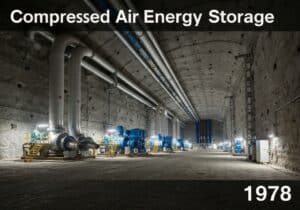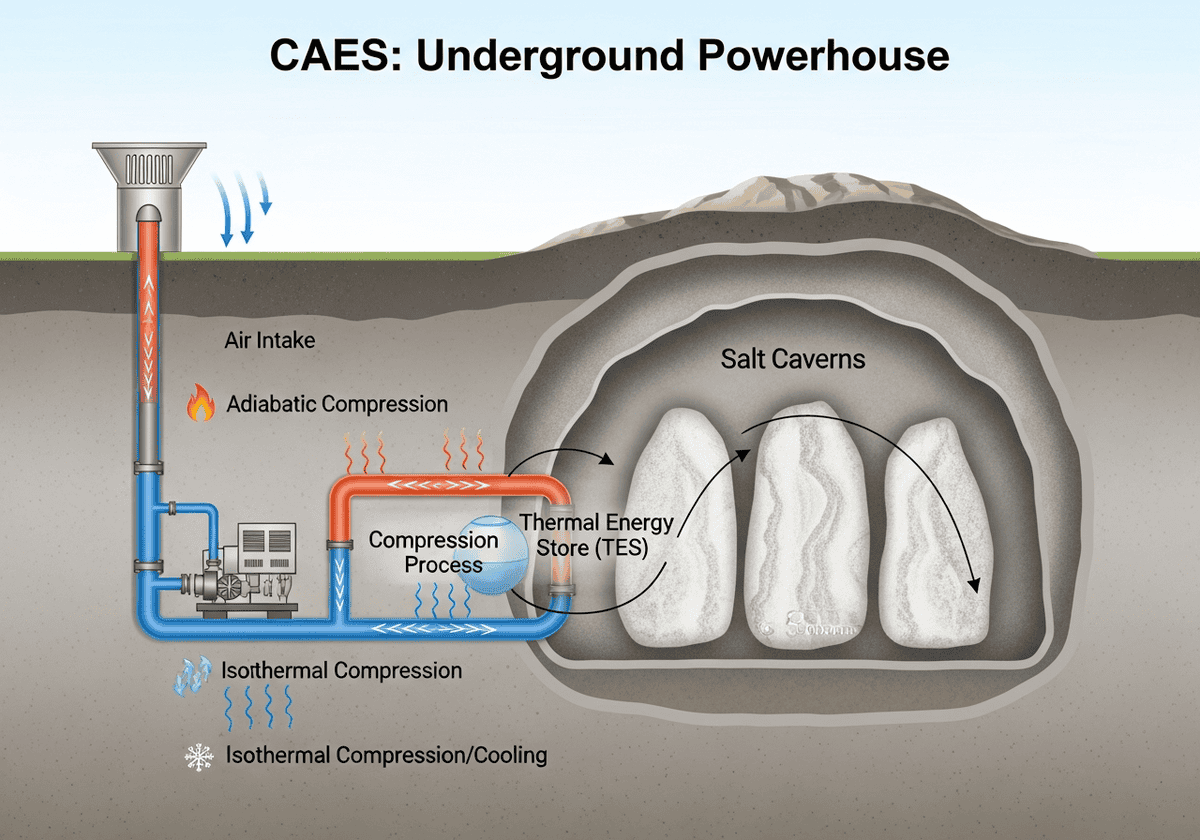

圧縮空気エネルギー貯蔵(CAES)は、余剰の電気エネルギーを機械的な位置エネルギーに変換する技術であり、地下の地質構造(塩洞窟、帯水層、多孔質岩石貯留層など)に空気を圧縮して蓄え、需要のピーク時に膨張タービンを通して回収する。
熱力学的性能は、圧縮・膨張段階、中間冷却、熱回収、蓄熱システムの統合に依存し、往復効率が大きく異なる断熱、非断熱、等温の各方式を区別する。貯蔵媒体の地質力学的健全性、坑井の密閉性、空洞からの浸出プロセスが、長期的な運用可能性を左右する。現在の研究では、燃焼を完全に排除する高度な断熱構成、エクセルギー損失を低減する等温方式、および系統運用最適化を目指している。
このページでは、CAES研究のあらゆる技術分野における最新の査読済み論文と取得済み特許を集約しています。
CAESは、電気を加圧空気として、通常は地下空洞に貯蔵します。熱管理が重要な課題なので、以下をお読みください。 熱エネルギー貯蔵 そして 熱力学競合するグリッドストレージは レドックスフロー電池 そして スーパーキャパシタ再生可能エネルギーとのスケジュール設定については、 スマートグリッド.
これは、圧縮空気エネルギー貯蔵 (CAES) に関する英語の世界中の出版物と特許の最新のセレクションです。多数の科学オンラインジャーナルの中から、断熱圧縮、等温圧縮、ポリトロピック効率、空洞貯蔵、塩空洞、帯水層貯蔵、非断熱 CAES、断熱 CAES、等温 CAES、高度断熱 CAES、熱エネルギー貯蔵、再生器、膨張タービン、圧縮機列、圧力比、往復効率、エクセルギー解析、地質貯蔵の完全性、坑井の完全性、気密性、再加熱燃焼、中間冷却、絞り損失、圧縮空気エクセルギー、地下圧力容器、多孔質岩貯留層、空洞浸出、地質力学的安定性、グリッドスケール貯蔵ディスパッチ、膨張タービンステージング、圧縮空気エネルギー貯蔵、および CAES に分類され、焦点を絞っています。
Vapor header heat exchanger for residential evaporator coil
Patent published on the 2026-11-19 in US under Ref US20260366781 by CARRIER CORP [US] (Amick James [us], Farraj Abdelrahman [us], Ranka Amrat Arvind [us])
Abstract: A fluid conditioning system includes a compressor, a first heat exchanger, an expansion device, and a second heat exchanger fluidly connected to form a vapor compression loop through which a working fluid is configured to circulate. A recuperator heat exchanger is fluidly connected to the vapor compression loop. The recuperator heat exchanger includes a first pass fluidly connected to the vapor compression loop downstream from the first heat exchanger and upstream from the expansion device relat[...]
Our summary: A fluid conditioning system incorporates a vapor compression loop with a compressor and two heat exchangers. A recuperator heat exchanger is integrated to enhance efficiency. The system is designed for residential evaporator coil applications.
vapor compression, heat exchanger, fluid conditioning, residential system
Patent
Methods, systems and apparatus for processing gaseous streams including carbon dioxide
Patent published on the 2026-11-19 in US under Ref US20260364483 by ABARR MILES L LINDSEY [US] (Abarr Miles L Lindsey [us], Bence Christopher Stephen [us], Markey Ethan James [us], Young Jeffrey Michael [us])
Abstract: Apparatus, systems, and methods for processing gaseous streams including COare disclosed. A method for performing a hot compression on a gaseous input stream including carbon dioxide (CO) involves mixing the gaseous input stream with at least a portion of a COdepleted gaseous stream to generate a gaseous input stream having a COconcentration that meets a target COconcentration. Another method involves compressing the gaseous input stream in a hot compressor to generate a hot compressed gaseous s[...]
Our summary: The content describes methods and systems for processing gaseous streams that include carbon dioxide. It details a method for hot compression of a gaseous input stream mixed with a CO-depleted stream. Additionally, it discusses an apparatus for cooling and compressing the hot gaseous stream to remove carbon dioxide.
carbon dioxide, gaseous streams, hot compression, CO separator
Patent
Control method for refrigeration cycle system, and refrigeration cycle system
Patent published on the 2026-11-19 in WO under Ref WO2026237251 by QINGDAO HISENSE HITACHI AIR CONDITIONING SYS CO LTD [CN] (Zhu Haitao [cn], Chen Jianxing [cn])
Abstract: Disclosed in the present application are a control method for a refrigeration cycle system, and a refrigeration cycle system. The refrigeration cycle system comprises a compressor, a condenser, a flash economizer and an evaporator, which are sequentially distributed in series, wherein the flash economizer is further configured to perform vapor injection to the compressor. The control method comprises: acquiring a turning-on signal of a compressor; after acquiring the turning-on signal, regulatin[...]
Our summary: The document describes a control method for a refrigeration cycle system that includes a compressor, condenser, flash economizer, and evaporator. The method involves acquiring a compressor turning-on signal and regulating its rotational speed. It further includes regulating the discharge superheat, vapor injection pressure, and pressure ratio of the compressor to target ranges.
refrigeration cycle, compressor control, vapor injection, superheat regulation
Patent
Method for controlling an ejector using steam-turbine exhaust in a cogeneration unit
Patent published on the 2026-11-19 in US under Ref US20260366438 by UNIV TAIYUAN TECHNOLOGY [CN] (Ma Suxia [cn], Zhang Yingwen [cn], Zhang Jingxian [cn], Zhang Jiajie [cn], Zhao Guanjia [cn], Xu Jing [cn], Feng Yuchuan [cn])
Abstract: Disclosed is a control method for a steam ejector that utilizes steam-turbine exhaust in a cogeneration unit. The method includes: (i) determining whether to place the ejector into service; (ii) computing the ejector motive-steam flow Dand turbine exhaust pressure punder varying motive-steam pressure, based on nozzle design pressure ratio and condenser heat balance; and (iii) coordinated control of pand D. In operation, turbine backpressure and Dare adjusted in real time according to primary net[...]
Our summary: The method controls a steam ejector using steam-turbine exhaust in a cogeneration unit. It involves determining service status, computing motive-steam flow and turbine exhaust pressure, and coordinating control in real-time. This approach enhances ejector performance and maximizes recoverable exhaust-steam heat supply.
ejector control, steam-turbine exhaust, cogeneration unit, thermal power plants
Patent
Preignition determination method and preignition determination device
Patent published on the 2026-11-18 in EP under Ref EP4841088 by MITSUBISHI HEAVY IND ENGINE & TURBOCHARGER LTD [JP] (Ando Junnosuke [jp], Yoshizumi Hiroshi [jp], Kawai Kazuhiro [jp], Furukawa Yuta [jp])
Abstract: A preignition determination method for an internal combustion engine includes: an in-cylinder pressure information acquisition step of acquiring at least a first pressure that is a pressure before a compression top dead center in a determination target combustion cycle of a target cylinder for which presence or absence of preignition in the internal combustion engine is to be determined, a second pressure that is a pressure after the compression top dead center in the determination target combus[...]
Our summary: The method involves acquiring in-cylinder pressure data before and after compression top dead center. It calculates a pressure ratio to assess preignition state. The detection criteria are based on comparisons with standard pressure data.
preignition, internal combustion engine, pressure ratio, detection method
Patent
Compressed air energy storage and distribution pipeline for air cooling system and method
Patent published on the 2026-11-12 in US under Ref US20260357786 by BREEZE INC [US] (Connors Christopher Edward [us], Orshan Michael Steven [us], Wiart Denis Raymond [ca])
Abstract: The present invention involves storage of energy with compressed air into a compressed air microgrid enabling localized energy systems to be deployed without straining conventional existing electrical grids. A network of powerhoods may be established for supporting a plurality of buildings, with the network having a source of compressed air; a piping system; and powerhoods coupled to the piping. Buildings are coupled to each powerhood, each powerhood having a compressed air turbine for generatin[...]
Our summary: The invention describes a compressed air energy storage system for localized energy distribution. It utilizes a microgrid to support multiple buildings without overloading existing electrical grids. Each building connects to a powerhood with a turbine and heat exchanger for electricity generation and air conditioning.
compressed air, energy storage, microgrid, heat exchanger
Patent
A CFD–DEM Numerical Study
Published on 2026-01-29 by Weiqiang Zhao, Xijie Song, Ning Wang, Yongyao Luo, Ling Ma @MDPI
Abstract: During the discharge process of a salt cavern compressed air energy storage (CAES) system, high-speed air flow may entrain salt slag from the cavern floor, posing a threat to pipeline safety. Currently, there is a lack of in-depth research into the transient mechanisms of the entrainment process, particularly the influence of particle shape. This study employs a CFD-DEM coupling approach to conduct, for the first time, a high-fidelity simulation of slag entrainment dynamics during the initial di[...]
Our summary: This study investigates the transient mechanisms of particle entrainment during the discharge of a salt cavern compressed air energy storage system. A CFD-DEM coupling approach simulates the dynamics of different particle shapes, revealing that spherical particles are most easily entrained. The findings highlight the influence of particle shape on entrainment efficiency and provide insights for improving operational safety in CAES systems.
CFD, DEM, particle entrainment, salt cavern
Publication
Normal Shock Wave Approximations for Flight at Hypersonic Mach Numbers
Published on 2026-01-24 by Pasquale M. Sforza @MDPI
Abstract: Normal shock pressure ratios in equilibrium air for Mach numbers up to 30 and altitudes to 300,000 feet are shown to be correlated by a simple power law which provides an accuracy of ±2%, thereby permitting direct calculation of corresponding enthalpy ratios accurate to ±1% without iteration; a slight change in power-law coefficients extends this capability to Mach 65. Temperature, density, and compressibility may be then found directly from tables for high temperat[...]
Our summary: The study presents a power law correlation for normal shock pressure ratios in equilibrium air at hypersonic Mach numbers. It enables accurate calculations of enthalpy ratios and other state variables without iteration. This method is beneficial for design and analysis of vehicles operating in low to moderate hypersonic regimes.
Shock Wave, Hypersonic, Power Law, Enthalpy
Publication