Product Design, Manufacturing & Innovation Resources
Maison » Conception pour X (DFX)

Conception pour X (DFX)

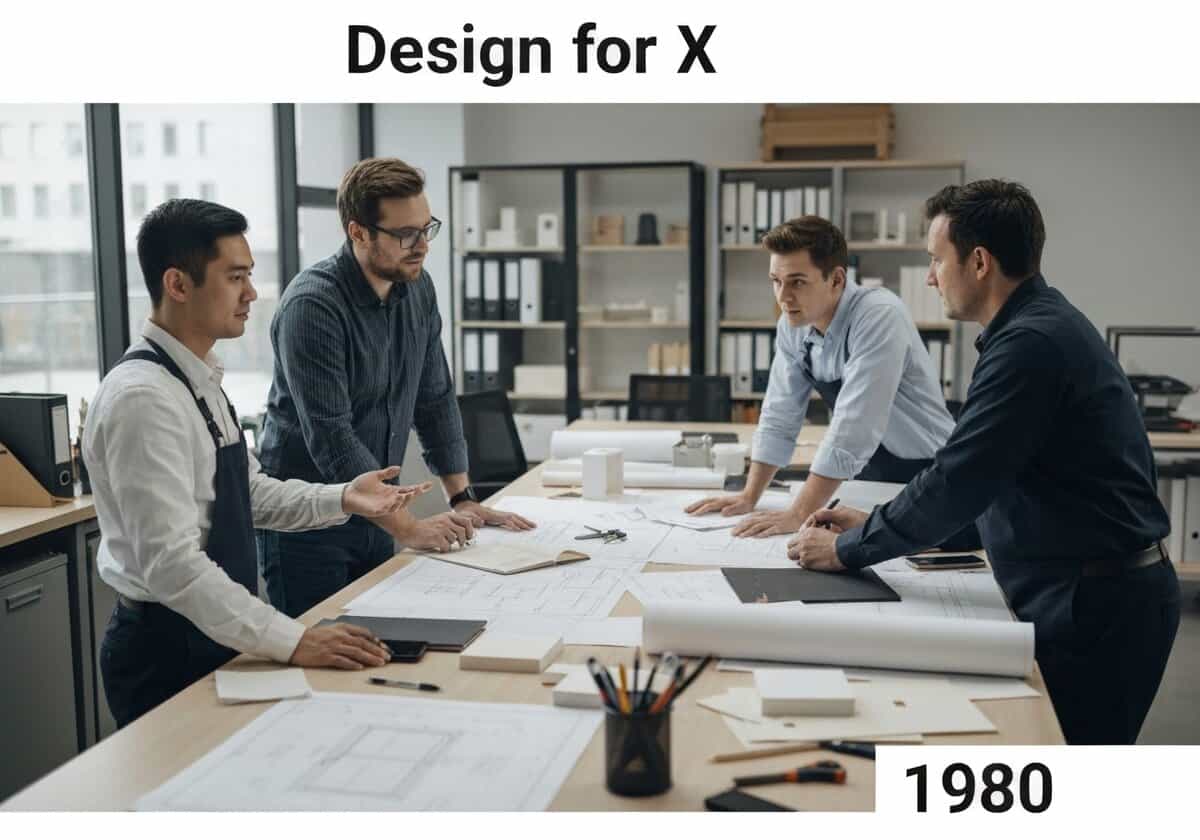
1980
Bureau d'études en technologie industrielle avec ingénieurs optimisant les meubles en kit pour le montage.

(Image générée à titre d'illustration uniquement)

Une méthodologie de conception où ‘X’ représente un produit spécifique cycle de vie objective. DFX encompasses a collection of guidelines and techniques aimed at optimizing a product’s design for a particular goal, such as manufacturability (DFM), assembly (DFA), reliability (DFR), or sustainability (DfS). This proactive approach addresses potential issues early in the design phase, reducing costs and improving quality. DFX is itself one of the most used design acronyms, and each X stands for a different life cycle objective. Applying DFX to a new product under the clean sheet design meaning, that is without legacy parts, gives the most freedom to optimize.


Design for X (DFX), also known as Design for Excellence, is a systematic approach that integrates downstream life cycle considerations into the early stages of product design. The ‘X’ is a variable that can stand for numerous objectives. For instance, Design for Manufacturability (DFM) focuses on simplifying the design to make it easier and more cost-effective to produce, often by minimizing part count, using standard components, and designing parts that are easy to handle and process. Design for Assembly (DFA) is closely related, concentrating on reducing assembly time and errors by designing for top-down assembly, minimizing fixations, and incorporating self-locating features. Other common ‘X’s include Reliability (DFR), which involves selecting robust components and incorporating redundancy; Serviceability (DFS), which ensures parts that are likely to fail are easily accessible for repair or replacement; and Sustainability (also DfS), which considers the environmental impact throughout the product’s life, from material sourcing to end-of-life disposal. By considering these factors upfront, companies can avoid costly redesigns, shorten time-to-market, and deliver a higher quality, more competitive product. It represents a shift from a sequential, ‘over-the-wall’ engineering process to a more concurrent and integrated one.

UNESCO Nomenclature: 3305
- Technologie industrielle

Taper

Système abstrait

Perturbation

Substantiel

Usage

Utilisation généralisée

Précurseurs

  • les principes de la production de masse mis au point par Henry Ford
  • techniques d'ingénierie de la valeur développées dans les années 1940
  • contrôle statistique des processus and quality management movements
  • l'essor des méthodologies d'ingénierie concurrentes

Applications

  • flat-pack furniture design (ikea) for ease of assembly (dfa)
  • Boîtiers à encliquetage dans l'électronique grand public pour réduire le nombre de vis et le temps d'assemblage (dfa)
  • utiliser des composants communs à différents modèles de voitures pour rationaliser la fabrication (DFM)
  • designing products with recycled materials and for easy démontage (dfs)

Brevets:

NA

Idées d'innovations potentielles

  • an ai-powered cad plugin that automatically analyzes a design and suggests modifications for multiple ‘x’ criteria simultaneously
  • ‘design for adaptation’ guidelines for creating products that can be easily upgraded or modified by the user over time
  • un blockchain ledger for ‘design for traceability’ to track materials and components from source to disposal
  • ‘design for resilience’ frameworks for critical infrastructure that can withstand and recover from disruptions
  • a consumer-facing app that scores products on their ‘design for repairability’ to inform purchasing decisions
  • ‘design for mental well-being’ principles for software and devices to reduce digital stress
  • a modular construction system based on ‘design for disassembly’ principles for creating reusable buildings
  • ‘design for microbial health’ in consumer products, using materials that support a healthy microbiome
Lié à : conception pour x, dfx, dfm, dfa, conception pour la fabrication, conception pour l'assemblage, ingénierie simultanée, cycle de vie du produit.

Contexte historique

Conception pour X (DFX)

1972
1974
1975-06-01
1980
1980
1980
1980
1970
1974
1974
1978
1980
1980
1980
1980

(si la date est inconnue ou non pertinente, par exemple « mécanique des fluides », une estimation arrondie de son émergence notable est fournie)

10e année anniversaire

Les images en pleine résolution et les téléchargements sont uniquement disponibles, et 100% gratuits, pour les membres inscrits.