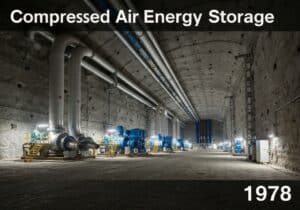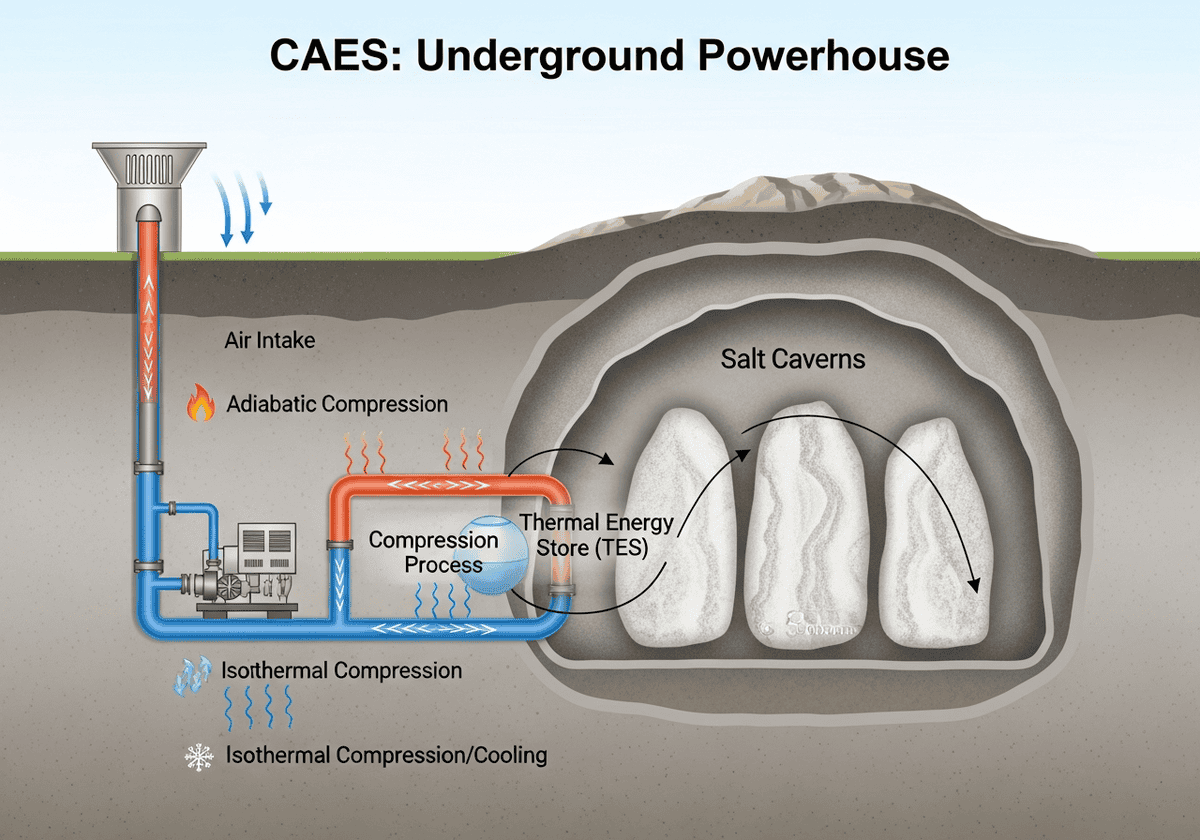

I sistemi di accumulo di energia ad aria compressa (CAES) convertono l'energia elettrica in eccesso in energia meccanica comprimendo l'aria in formazioni geologiche sotterranee – caverne di sale, falde acquifere o serbatoi di roccia porosa – e recuperandola tramite turbine ad espansione durante i picchi di domanda.
Thermodynamic performance hinges on compression and expansion staging, intercooling, recuperation, and thermal store integration, distinguishing diabatic, adiabatic, and isothermal variants with substantially different round-trip efficiencies. Geomechanical integrity of the storage medium, wellbore sealing, and cavern leaching processes govern long-term operational viability. Current research targets advanced adiabatic configurations eliminating combustion entirely, isothermal approaches reducing exergy losses, and grid-dispatch optimization.
Questa pagina raccoglie le pubblicazioni più recenti sottoposte a revisione paritaria e i brevetti concessi nell'intero spettro tecnico della ricerca CAES.
Questa è la nostra ultima selezione di pubblicazioni e brevetti mondiali in inglese sull'accumulo di energia ad aria compressa (CAES), tra numerose riviste scientifiche online, classificate e focalizzate su compressione adiabatica, compressione isotermica, efficienza politropica, accumulo in caverna, caverna salina, accumulo in acquifero, CAES diabatico, CAES adiabatico, CAES isotermico, CAES adiabatico avanzato, accumulo di energia termica, recuperatore, turbina espandibile, treno di compressori, rapporto di pressione, efficienza di andata e ritorno, analisi dell'exergia, integrità dell'accumulo geologico, integrità del pozzo, tenuta all'aria, combustione con riscaldamento intermedio, interraffreddamento, perdite di strozzamento, exergia dell'aria compressa, recipiente a pressione sotterraneo, serbatoio in roccia porosa, lisciviazione in caverna, stabilità geomeccanica, dispacciamento dell'accumulo su scala di rete, stadi della turbina espandibile, accumulo di energia ad aria compressa e CAES.
Scroll compressor
Patent published on the 2026-09-10 in WO under Ref WO2026186952 by LG ELECTRONICS INC [KR] (Park Sangbaek [kr], Jung Seongmun [kr], Kim Cheolhwan [kr])
Abstract: A scroll compressor is provided. The scroll compressor is configured such that a fixed wrap comprises a fixed wrap portion and an extension wrap portion extending from a discharge end of the fixed wrap portion and having a wrap height lower than a wrap height of the fixed wrap portion, wherein a wrap accommodation groove in which the extension wrap portion is rotatably accommodated is formed between the outer circumference of a rotary shaft insertion portion and the inner circumference of an orb[...]
Our summary: A scroll compressor features a fixed wrap with an extension wrap that has a lower height. This design improves wrap strength and reduces tipping moments while minimizing leakage between compression chambers. The variation in wrap heights also mitigates inter-wrap frictional loss and abrasion from corner protrusions.
Scroll compressor, wrap accommodation groove, compression chambers, leakage suppression
Patent
Nuclear fission reactor
Patent published on the 2026-08-19 in GB under Ref GB2704004 by ROLLS ROYCE SUBMARINES LTD [GB] (Alex A Pynn [gb], Jorge Martinez Dominguez [gb], William Smith [gb])
Abstract: A shrouded power system 150 for a nuclear power plant, preferably operating according to a closed Brayton cycle, wherein a turbine 30, recuperator 40, heat exchanger 50, and compressor 60 are arranged in flow series with a reactor core 20 housed within a pressure vessel 10. A working fluid flows from the compressor into a cool flow channel of the recuperator via a shrouding system 70, the shrouding system being configured to encompass and be in thermal contact with the reactor core so as to cool[...]
Our summary: The described system is a nuclear power plant utilizing a closed Brayton cycle. It features a shrouded power system that cools the reactor core using a working fluid. The arrangement includes a turbine, recuperator, heat exchanger, and compressor in a flow series.
Nuclear fission, Brayton cycle, heat exchanger, thermal management
Patent
Solar turbine hybrid heat pump energy system
Patent published on the 2026-08-13 in WO under Ref WO2026169785 by POERIO WAYNE [US] (Poerio Wayne [us])
Abstract: An air conditioning/heating/energy system includes a plurality of subsystems wherein a first subsystem includes a condenser, a low global warming potential liquid refrigerant, a liquid pump, a recuperator, a collector and an expander. The liquid pump receives liquid refrigerant from the condenser and pumps the liquid refrigerant to the recuperator, the recuperator heats the liquid refrigerant that flows to the collector, the collector heats the liquid refrigerant a second time resulting in chang[...]
Our summary: The system integrates multiple subsystems for efficient heating and cooling. It utilizes a low global warming potential refrigerant for environmental sustainability. Energy is recovered and reused through a cycle involving condensation and vaporization.
heat pump, solar energy, refrigerant cycle, energy system
Patent
Shrouded power system
Patent published on the 2026-08-12 in GB under Ref GB2703906 by ROLLS ROYCE SUBMARINES LTD [GB] (Jacob Diffey [gb], Jorge Martinez Dominguez [gb], William Smith [gb])
Abstract: A shrouded power system 150 for a nuclear power plant, preferably operating according to a closed Brayton cycle, wherein a turbine 30, recuperator 40, heat exchanger 50, and compressor 60 are arranged in flow series with a reactor core 20 housed within a pressure vessel 10. A working fluid flows from a cool flow channel of the recuperator back into the pressure vessel via a shrouding system 70, such that the shrouding system creates a continuous pressure boundary enclosing the working fluid flow[...]
Our summary: The shrouded power system for a nuclear plant operates on a closed Brayton cycle. It includes a turbine, recuperator, heat exchanger, and compressor arranged in series with a reactor core. The shrouding system maintains a continuous pressure boundary for the working fluid from the pressure vessel to the turbine.
nuclear power, Brayton cycle, turbomachinery, pressure vessel
Patent
Anaerobically curable adhesive compositions
Patent published on the 2026-07-30 in WO under Ref WO2026159267 by HENKEL AG & CO KGAA [DE] (Deegan Brian [ie], Burns Barry [ie], Sweeney Nigel [ie], Vennard Emer [ie], Dukalska Monika [ie], Loane Mark [ie], Doherty Michael [ie])
Abstract: An anaerobically curable composition comprising: (i) an anaerobically curable component; (ii) an anaerobic cure inducing component; and (iii) a metal (meth)acrylate where the metal is selected from the group comprising: zinc, caesium, neodymium, zirconium, aluminium, yttrium, titanium, cobalt and nickel; and/or (iv) a chelator for a metal where the metal is selected from the group comprising: zinc, caesium, neodymium, zirconium, aluminium, yttrium, titanium, cobalt and nickel. A method of curing[...]
Our summary: The composition includes anaerobically curable and cure inducing components along with metal (meth)acrylates and chelators. It offers storage stability and achieves bond strengths comparable to or exceeding control compositions. The method also describes an assembly of bonded substrates with enhanced high-temperature performance.
anaerobically curable, adhesive compositions, metal (meth)acrylate, chelator
Patent
Energy handling of dc electrical energy sources
Patent published on the 2026-07-29 in EP under Ref EP4783399 by KILIANNRGS [BE] (De Lille Kilian [be])
Abstract: [0001] An energy handling system comprises a DC motor/generator for converting between DC electrical energy and mechanical energy, and a compressed air energy storage equipment for converting between mechanical energy and compressed air using energy exchange units based on a flexible fluid container in a vessel. A controller is configured for converting DC electrical energy into mechanical energy using the DC motor/generator and for converting the mechanical energy into compressed air using the [...]
Our summary: The energy handling system converts DC electrical energy to mechanical energy using a DC motor/generator. It employs compressed air energy storage to facilitate energy exchange between mechanical energy and compressed air. Additionally, the system includes a DC-AC converter to provide AC electrical energy from the stored energy.
DC motor/generator, energy storage, compressed air, DC-AC converter
Patent
A CFD–DEM Numerical Study
Published on 2026-01-29 by Weiqiang Zhao, Xijie Song, Ning Wang, Yongyao Luo, Ling Ma @MDPI
Abstract: During the discharge process of a salt cavern compressed air energy storage (CAES) system, high-speed air flow may entrain salt slag from the cavern floor, posing a threat to pipeline safety. Currently, there is a lack of in-depth research into the transient mechanisms of the entrainment process, particularly the influence of particle shape. This study employs a CFD-DEM coupling approach to conduct, for the first time, a high-fidelity simulation of slag entrainment dynamics during the initial di[...]
Our summary: This study investigates the transient mechanisms of particle entrainment during the discharge of a salt cavern compressed air energy storage system. A CFD-DEM coupling approach simulates the dynamics of different particle shapes, revealing that spherical particles are most easily entrained. The findings highlight the influence of particle shape on entrainment efficiency and provide insights for improving operational safety in CAES systems.
CFD, DEM, particle entrainment, salt cavern
Normal Shock Wave Approximations for Flight at Hypersonic Mach Numbers
Published on 2026-01-24 by Pasquale M. Sforza @MDPI
Abstract: Normal shock pressure ratios in equilibrium air for Mach numbers up to 30 and altitudes to 300,000 feet are shown to be correlated by a simple power law which provides an accuracy of ±2%, thereby permitting direct calculation of corresponding enthalpy ratios accurate to ±1% without iteration; a slight change in power-law coefficients extends this capability to Mach 65. Temperature, density, and compressibility may be then found directly from tables for high temperat[...]
Our summary: The study presents a power law correlation for normal shock pressure ratios in equilibrium air at hypersonic Mach numbers. It enables accurate calculations of enthalpy ratios and other state variables without iteration. This method is beneficial for design and analysis of vehicles operating in low to moderate hypersonic regimes.
Shock Wave, Hypersonic, Power Law, Enthalpy
Publication