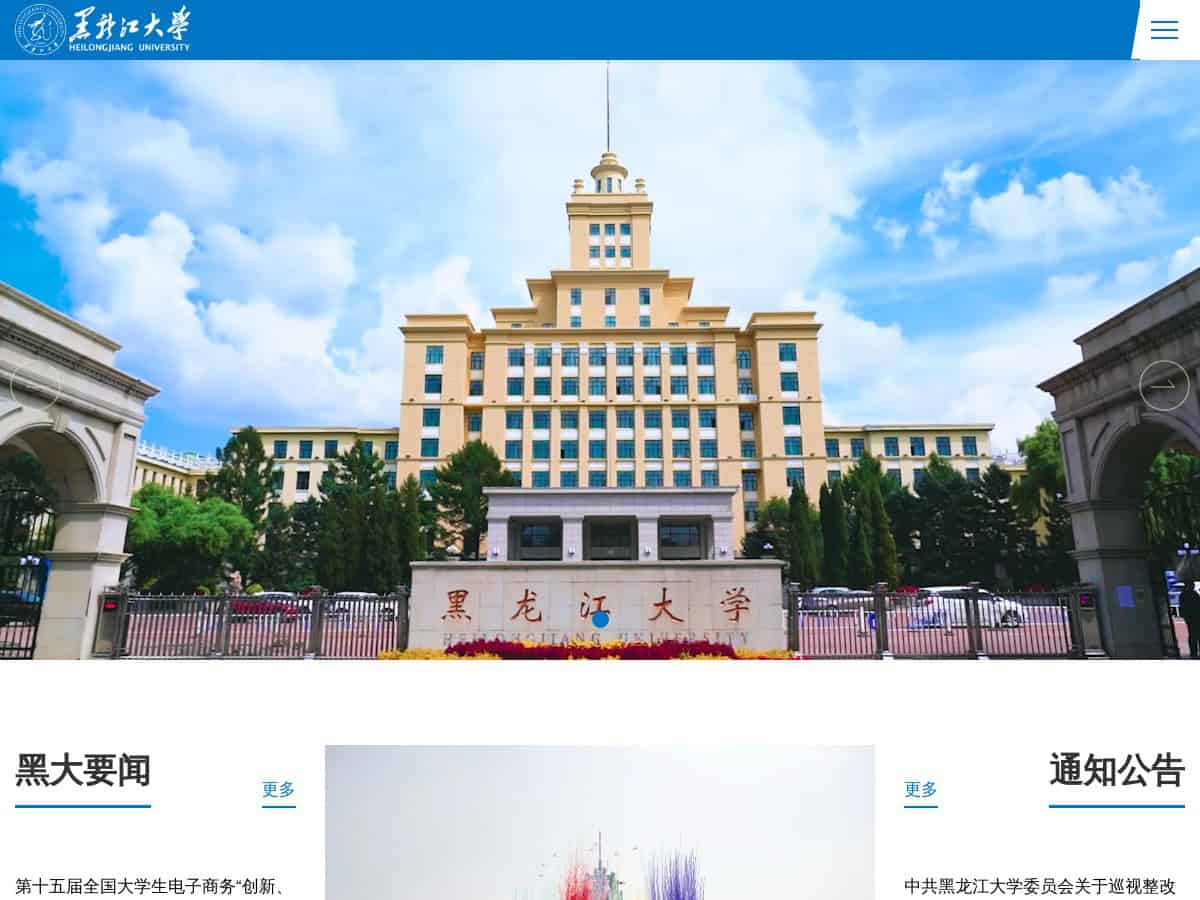
Address: 74 Xuefu Road, Nangang District, 150080 Harbin, Heilongjiang, China
Chemistry & Materials Science, Life Sciences & Biotechnology, Computer Science & Information Technology
Heilongjiang University is a university in Harbin, the capital of Heilongjiang Province in north-eastern China. It was founded in 1941 in Yan’an, and its predecessor was the Russian-language unit of the Third Branch of the Anti-Japanese Military and Political University.
Its academic range includes philosophy, law, literature, management and engineering, among other fields. It teaches at undergraduate and postgraduate level.
Published student numbers differ between sources, so applicants should check current figures with the university. Programme lists, entry requirements and information for international applicants are published on its official pages.
Domains taught:
AI and Machine Learning, Bioengineering, Bioinformatics, Chemistry, Computer Vision, Data Analytics, Ecology and Sustainability, Electrical and Electronics, Life Sciences, Materials, Mathematics, Microbiology and Genetics, Optics, Physics, Software Engineering, Statistics, Telecommunications
Diplomas*:
Bachelor, Doctor, Master
Status:
Public
Partnerships:
Key comprehensive university in Heilongjiang.
Research:
Functional Materials Chemistry, Molecular Biology & Genetics, AI & Big Data Applications, Russian Language & Technical Translation (borderline for tech list, but relevant for regional tech exchange).
Famous Alumnis:
N/A
International recognition**:
Number of staff***:
1800
Current students***:
30000
Foreign students***:
N/A%
Cumulative former students***:
N/A
Pros
Comprehensive university serving Heilongjiang province, strengths in basic sciences and Russian studies.
Cons
More known for humanities and Russian studies, engineering is less prominent.
Best For
Comprehensive university in Heilongjiang with programs in chemistry, life sciences, and IT.
Northeast Normal University: a Changchun university with life sciences and ecology, chemistry, and physics and information technology.
Anhui University: offers computer science, materials science and physics in Hefei.
Shanxi University: lists physics and optoelectronics, chemistry and materials science, and life sciences.
Shaanxi Normal University: covers chemistry and materials science, life sciences and biotechnology, and computer science.
South China Normal University: records physics and optoelectronics, chemistry, and computer science and artificial intelligence in Guangzhou.
Most Similar Schools Abroad
Universität Konstanz (Germany): combines chemistry and nanoscience, physics and materials science, and computer science.
Università degli Studi di Verona (Italy): lists computer science, biotechnology and life sciences.
Okayama University (Japan): covers engineering, life sciences and biotechnology, and environmental science.
Université de Neuchâtel (Switzerland): offers biology, computer science and hydrogeology.
Universität Bielefeld (Germany): focuses on computer science and intelligent systems, physics and nanoscience, and molecular and cell biology.
*our own picks (our criteria: a mix between domains, diploma delivered, reputation and size), but obviously too many criteria for an apple-to-apple ranking.
FAQ
When and where was Heilongjiang University founded?
It was founded in 1941 in Yan'an. Its predecessor was a Russian-language unit of the Anti-Japanese Military and Political University.
Where is the university located?
It is in Harbin, the capital of Heilongjiang Province in north-eastern China. Its official pages describe the campuses in the city.
Which subjects does it teach?
Programmes include philosophy, law, literature, management and engineering, among other fields.
How large is the student body?
Published profiles give different totals, so check the official site for the current figure.
What degree levels are offered?
The university teaches at undergraduate and postgraduate level. Programme lists are published on the official website.
Where can international applicants find information?
The university's official pages carry admission rules and contact points for international students. Requirements and scholarships can change from year to year.
*: without any judgment of the quality, readers are strongly encouraged to check the official status of the exact diploma envisioned as many universities have a mix of recognized diplomas, not recognized, “co-delivered,” “equivalent to”, “some pathways” (…), can change over time, and can be named differently from one country to another.
**: international reputation: is based on some criteria that do not mean much in some domains or specialties (number of researchers, of scientific publications, on budget ….). Our approximate 1-4 scale:
known locally
known locally and internationally
is listed in some of the world university’s classifications
is listed among the 20 firsts in some of world university’s classifications
***: estimated numbers, based on online sources and/or feedbacks. The numbers can vary greatly depending on school organisation (ex.: school is part of a group, it employs internal staff or external consultants or has public staff without employing them …). Refer to all the links provided to have accurate and updated numbers.
Innovation.world is not affiliated with this school/university. We recommend to contact them directly on their website for any special request.
To complete or correct any information here or share your opinion, please comment below or > send us a direct message <.