Heim / Produktdesign / Ecodesign
Ökodesign: Nachhaltiges Produktdesign für Ingenieure
Ökodesign, oder nachhaltiges Produktdesign, bezeichnet die Auswahl von Materialien, Strukturen, Verbindungen und Prozessen, um die Umweltbelastung eines Produkts über seinen gesamten Lebenszyklus so gering wie möglich zu halten und gleichzeitig Funktionalität, Sicherheit und Kosten zu gewährleisten. Diese Seite bietet Ingenieuren Informationen zum Thema Ökodesign: Ökodesign-Prinzipien, -Werkzeuge, -Standards und -Anforderungen sowie Leitfäden für nachhaltiges Design – sortiert nach Ihren Fragen.
Search guides, methods, tools and standards
Type a topic, a material, a standard or a tool name. Results appear below the search box.
Suche versuchen: LCA, carbon footprint, circular economy, recycling, REACH, RoHS
Sprache
Loading…
Kategorien
Loading…
What do you need to do?
Pick a task. Each card jumps to the matching section of this page.
Umweltauswirkungen messen
Ökobilanz, CO2-Fußabdruck, Systemgrenzen und Datenbanken.
Konstruktion im Hinblick auf Reparatur und Entsorgung
Demontage, Modernisierung, Wiederaufbereitung, Recycling und Upcycling.
Wählen Sie nachhaltige Materialien
Bio-based and recycled plastics, chemical recycling, microplastics.
Prüfen Sie die Normen und EU-Vorschriften
ISO 14040, ISO 14067, EN 45554, the EU ESPR, RoHS and REACH.
Energie- und CO₂-Einsparungen
Storage, solar, hydrogen, carbon capture and climate technologies.
Experten, Labore und Lieferanten finden
LCA consultants, material suppliers, universities and patents.
Schritt für Schritt lernen
A free course with checklists and a final exam.
Erhalten Sie eine schnelle Antwort
Definitions, LCA versus PCF, bio-based plastics, ESPR basics.
Where to begin
New to ecodesign
Applying it to a product
Specialist topics
New to ecodesign
- Design for the Environment (DfE): the definition of ecodesign and the labels linked to it, such as EPEAT.
- Lebenszyklusanalyse (LCA): Eine praktische Anleitung: the method that measures impact across the whole life cycle.
- Kreislaufwirtschaft und Produktdesignpraktiken: the main principles and how they translate into design choices.
- Die 3 Säulen der Nachhaltigkeit: the balance between environmental, social and economic needs.
- Greenwashing: a satirical guide to the tactics, useful for spotting vague claims.
Applying it to a product
- Ökobilanz (LCA) im Produktdesign: goal and scope, inventory, impact assessment and interpretation, with standardized data sources.
- Grenzen des LCA-Systems: choose between cradle-to-grave and cradle-to-gate.
- Datenbanken zur Lebenszyklusanalyse: where to find inventory data.
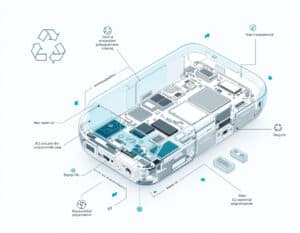
- Demontagefreundliches Design bei Unterhaltungselektronik aus Kunststoff: snap-fit architecture, mono-material housings and adhesive-free joining.
- Kurs „Nachhaltiges und kreislauffähiges Produktdesign“: a free course with checklists and a final exam.
Specialist topics
- Chemische Prozesse zum Recycling von Kunststoffen: technologies, feedstock needs and readiness levels.
- Cradle-to-Cradle (C2C): materials treated as nutrients in closed loops.
- Emissionsbereiche des Treibhausgasprotokolls: scope 1, 2 and 3 in carbon accounting.
- Direkte Kohlenstoffabscheidung aus der Luft: principles, energy needs, cost and common misconceptions.
- Pumpspeicherkraftwerke: the physics and use of gravitational energy storage.
Ökodesign-Instrumente: Messung der Umweltauswirkungen
Measure before you optimize. A screening life cycle assessment shows which stage of the life cycle dominates a product’s impact, so design effort goes where it pays off. Fix the functional unit and the system boundaries first. Then take inventory data from recognized databases.
- Lebenszyklusanalyse (LCA): Eine praktische Anleitung: purpose, scope, environmental impact analysis and applications.
- Ökobilanz (LCA) im Produktdesign: goal and scope, inventory, impact assessment and interpretation.
- LCA vs. PCF: scope, method and regulatory use of a full LCA compared with a product carbon footprint.
- Grenzen des Ökobilanzsystems: Cradle-to-Grave vs. Cradle-to-Gate: which life cycle stages each scope includes.
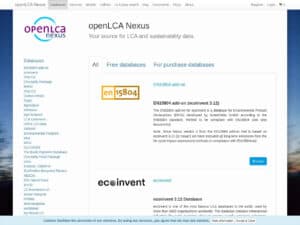
- Datenbanken zur Lebenszyklusanalyse: free and paid inventory databases, including the openLCA Nexus service.
- Emissionsbereiche des Treibhausgasprotokolls: Scope 1 direkte, Scope 2 eingekaufte Energie und Scope 3 Wertschöpfungskettenemissionen.
- Lebenszyklusanalyse (LCA): the definition, as used for EPDs and carbon footprints.
- Ökologischer Fußabdruck: a resource accounting metric of human demand on nature.
- Neueste Veröffentlichungen & Patente zu Ökobilanzen (LCA): a weekly selection of papers and patents.
- Unternehmen für Ökobilanzierung und Nachhaltigkeitsplanung in the suppliers directory.
Design for circularity, repair and end of life
Extend life first, recover material second. Durability, modularity and repairability rank above recycling in the waste hierarchy. When a product does reach end of life, its joints, materials and markings decide whether recovery is practical or only theoretical.
- Kreislaufwirtschaft und Produktdesignpraktiken: definition, main principles and circular design principles such as eliminating waste and pollution.
- Design für die Demontage (DfD): designing products so components and materials separate easily at end of life.
- Demontagefreundliches Design bei Unterhaltungselektronik aus Kunststoff: snap-fit architecture, mono-material housings and adhesive-free joining under EU repair rules.
- Cradle-to-Cradle (C2C): materials treated as nutrients in closed loops.
- Design for the Environment (DfE): Ökodesign über den gesamten Produktlebenszyklus hinweg, mit Labels wie EPEAT.
- Design für Montage (DfA): designing for ease of assembly, the counterpart of disassembly.
- Recycling vs. Upcycling: Gemeinsamkeiten und Unterschiede: process, examples and impact of each.
- Upcycling: the definition, the difference from downcycling and the role in circular design.
- Reverse Engineering für Ökologie, Wartung, Recycling und Upcycling: repair and reuse strategies with examples.
- Neueste Veröffentlichungen und Patente zur Kreislaufwirtschaft: a weekly selection of papers and patents.
Select materials with recovery in mind
Material choice sets the ceiling for recovery. One polymer family or one alloy family per assembly avoids separation later. A bio-based origin does not by itself mean lower impact or biodegradability, so check every candidate against data.
- Woraus werden biobasierte Kunststoffe hergestellt?: plant-based polymers, microbial production and other sources.
- Chemische Prozesse zum Recycling von Kunststoffen: major technologies, feedstock needs, output products and readiness levels.
- Vergleich zwischen Thermoplasten und Duroplasten: properties, applications, advantages and disadvantages.
- Mikroplastik: Herkunft, Auswirkungen und technische Lösungen: definition, sources and mitigation.
- Matweb-Materialeigenschaftendatenbank: free property data for metals, plastics, ceramics and composites.
- Neueste Veröffentlichungen und Patente zu biologisch abbaubarer Elektronik: transient electronics and bioresorbable substrates.
- Anbieter von nachhaltigen und biobasierten Materialien: recycled polymers and mycelium-based solids.
- Berater für Materialwissenschaften: expert selection of alloys, polymers or ceramics.
- Laboratorien für Chemie- und Materialanalytik: spectroscopy, chromatography and SEM.
Energy and climate technologies
Some products are part of the energy system, and every product depends on it. These pages cover storage, generation and carbon management technologies, with their physics and their limits.
- Pumpspeicherkraftwerke: history, the physics of gravitational energy storage and global distribution.
- Alterungsfaktoren von Solarmodulen: Wichtigste Einflussfaktoren: climate, coastal conditions and temperature effects.
- Solarpanel-Rechner: power produced by location, mounting style and orientation.
- Direct Air Carbon Capture (DAC & DACC) Prozesse und Illusionen: Prinzipien, Energiebedarf, Kosten und Missverständnisse.
- Bioenergie mit Kohlenstoffabscheidung und -speicherung (BECCS): a negative emissions technology.
- Geologische Kohlenstoffbindung: capturing CO2 and injecting it into deep rock formations.
- Latest Publications & Patents on Carbon Capture & Sequestration (CCS)
- Latest Publications & Patents on Green Hydrogen
- Neueste Veröffentlichungen und Patente zur thermischen Energiespeicherung (TES)
- Neueste Veröffentlichungen und Patente zum Klimawandel
Ökodesign-Standards, Anforderungen und Ansprüche
Ecodesign work is checked against a small set of standards and, in the EU, against a regulation that is being rolled out product group by product group. The table lists the references engineers meet most often.
| Reference | What it covers | Use it to |
|---|---|---|
| ISO 14040 and ISO 14044 | Principles, framework, requirements and guidelines for life cycle assessment | Structure an LCA: goal and scope, inventory, impact assessment, interpretation |
| ISO 14067 | Quantification and reporting of the carbon footprint of products | Calculate a product carbon footprint (PCF) |
| ISO 14025 | Type III environmental declarations, known as EPDs | Read or publish verified product environmental data |
| ISO 14021 | Self-declared environmental claims | Check the wording of claims such as recyclable or recycled content |
| ISO 14006 | Guidelines for integrating ecodesign into an environmental management system | Organize ecodesign work inside a company |
| IEC 62430 | Environmentally conscious design for electrical and electronic products | Set up an ecodesign process for electronics |
| EN 45554 | General methods to assess the ability to repair, reuse and upgrade energy-related products | Score repairability and upgradeability |
| ISO 14001 | Requirements for an environmental management system | Certify how an organization manages its environmental impact |
| Regulation (EU) 2024/1781 (ESPR) | EU framework for ecodesign requirements by product group, with a Digital Product Passport. In force since 18 July 2024, it replaces Directive 2009/125/EC | Find the delegated act and the timeline that apply to your product group |
| RoHS, REACH, WEEE | Restricted substances in electrical equipment, chemical registration and authorization, and take-back of waste electrical equipment | Überprüfen Sie Materialien und planen Sie Verpflichtungen am Lebensende |
Requirements and dates change. Check the current text, and the delegated act for your product group, before you rely on a threshold or a deadline. Last reviewed: November 2026.
- ISO-Normensuche: search the ISO catalog by topic and document type.
- Artikel zu Normen: engineering standards, norms and regulations by country and domain.
- Konformitätsprüfung: testing a product against prescribed standards and regulations.
- Greenwashing: a satirical guide to vague environmental claims.
- Berater für Regulierungs- und Compliance-Fragen in the suppliers directory.
- Prüflabore für Zuverlässigkeits- und Lebensdauertests in the suppliers directory.
- Verordnung über die umweltgerechte Gestaltung nachhaltiger Produkte: the European Commission’s official overview and timeline.
Ökodesign-Prinzipien: Gestaltungsregeln, die in der Praxis gelten
- Fix the function and the target lifetime first. A lighter part that fails earlier often loses on total impact.
- Run a screening LCA on the first concept, then repeat it at design freeze with real masses and processes. Ökobilanz im Produktdesign shows the method.
- Rank components by their share of embodied energy and carbon, then work on the top few.
- Extend life before you plan recovery. Durability, modularity and repairability come first.
- Use one polymer family or one alloy family per assembly so that recovery needs no separation. Thermoplastics vs thermosets explains why the choice matters.
- Design joints for tool-free, non-destructive disassembly: snap fits and accessible fasteners instead of permanent adhesives. Add material codes, and a data carrier such as a QR code where traceability pays off. See Demontagefreundliches Design in der Kunststoffelektronik.
- Remove or replace hazardous substances early. Screen every material against RoHS, REACH and your customers’ restricted-substance lists.
- Qualify suppliers on environmental data and recovery routes. Ask for EPDs or LCA datasets, and look for LCA-Spezialisten im Lieferantenverzeichnis.
- Talk to recyclers and repair networks during concept design. Their constraints are cheap to design in and expensive to retrofit.
- Write environmental claims only when you can document them, in precise terms. ISO 14021 sets the rules for self-declared claims.
- Re-run the numbers after every material or supplier change, because a substitution can move the impact to another life cycle stage.
Find experts, labs, universities and open positions
Suppliers and consultants
- Unternehmen für Ökobilanzierung und Nachhaltigkeitsplanung
- Anbieter von nachhaltigen und biobasierten Materialien: recycled polymers and mycelium-based solids
- Berater für Materialwissenschaften
- Berater für Regulierungs- und Compliance-Fragen
- Das vollständige Lieferantenverzeichnis: search by map, keyword and category
Universities, research and jobs
- Hochschulen, die sich mit Ökologie und Nachhaltigkeit befassen
- Universitäten mit Schwerpunkt auf Werkstoffwissenschaften
- Kostenlose Suche nach aktuellen PatentenDie neuesten englischsprachigen Patente des Europäischen Patentamts
- Kostenlose Suche nach den neuesten wissenschaftlichen Publikationen: articles of leading peer-reviewed journals
- Ingenieurstellen weltweit: product design, R&D, quality and manufacturing
Learn it step by step
The Sustainable & Circular Product Design course covers the evaluation and reduction of a product’s environmental footprint across its life cycle. Like every course on the site, it comes with checklists and a final exam for registered users. Related courses cover quality and compliance systems, product development and design for manufacturing.
Latest research and patents by topic
Each page below lists recent papers and patents on its topic. The selection is refreshed weekly.
- Neueste Veröffentlichungen und Patente zu ökologischem Design
- Neueste Veröffentlichungen und Patente zur Kreislaufwirtschaft
- Neueste Veröffentlichungen & Patente zu Ökobilanzen (LCA)
- Neueste Veröffentlichungen und Patente zu biologisch abbaubarer Elektronik
- Latest Publications & Patents on Carbon Capture & Sequestration (CCS)
- Neueste Veröffentlichungen und Patente zum Klimawandel
- Latest Publications & Patents on Green Hydrogen
- Neueste Veröffentlichungen und Patente zur thermischen Energiespeicherung (TES)
Um Ihre eigene Abfrage auszuführen, verwenden Sie die Kostenlose Suche nach aktuellen Patenten or the Kostenlose Suche nach den neuesten wissenschaftlichen Publikationen. Both need a free registration for the full filters.
Editor's top picks
Nine pages selected by the editor for this topic.






Ecodesign questions, answered
What is ecodesign?
Ecodesign integrates environmental aspects into product design and development to reduce impacts over the whole life cycle, from raw materials to end of life. It is also called Design for the Environment (DfE). It is a working method, not a label: you measure impacts, set targets, then change materials, structures and processes accordingly. See Design for the Environment (DfE).
What is the difference between an LCA and a product carbon footprint?
A life cycle assessment covers several impact categories, such as climate change, resource use, acidification and water use. A product carbon footprint (PCF) quantifies greenhouse gas emissions only. ISO 14040 and ISO 14044 frame LCA, and ISO 14067 covers the carbon footprint of products. The PCF is therefore a subset, and often the first step. Details are in LCA vs. PCF.
Where do I start on an existing product?
List the materials and masses, the manufacturing steps, the expected use and the end-of-life route. Run a screening LCA with generic data to find the stages that dominate the impact, then work on those first. The Leitfaden zur Ökobilanz (LCA) and the LCA-Datenbanken page cover method and data.
Is recycling better than repair or reuse?
Usually not. The waste hierarchy ranks prevention, reuse and repair above recycling, because keeping a product in use preserves the material and energy already invested in it. Recycling stays essential for what cannot be repaired, which is why mono-material design and easy disassembly matter. See Kreislaufwirtschaft und Produktdesignpraktiken.
Is a bio-based plastic automatically more sustainable?
No. Bio-based means that the carbon comes from biomass. It says nothing about biodegradability, recyclability or total impact, which depend on the polymer, the process and the end-of-life route. Compare options with an LCA that includes land use and end of life. See Woraus werden biobasierte Kunststoffe hergestellt?
What does the EU Ecodesign for Sustainable Products Regulation change for engineers?
Regulation (EU) 2024/1781, in force since 18 July 2024, replaces Directive 2009/125/EC. It is a framework: binding requirements on aspects such as durability, reparability, recyclability and substance information are set per product group through delegated acts, and covered products will carry a Digital Product Passport. The Commission adopted a working plan for 2025 to 2030 that lists priority product groups. Check the current status for your product on the Seite der Europäischen Kommission.
How do I check an environmental claim?
Look for a specific attribute, a stated scope and evidence you can obtain. Terms such as eco-friendly without a basis are weak. ISO 14021 sets requirements for self-declared claims, and third-party declarations such as EPDs follow ISO 14025. For a satirical view of the tricks to watch for, read the Leitfaden zum Thema „Greenwashing“.
Where can I find LCA data and experts?
Start with the Datenbanken zur Lebenszyklusanalyse page for free and paid inventory sources. For consultants, browse the LCA and sustainability engineering firms in the Lieferantenverzeichnis, and see the universities active in Ökologie und Nachhaltigkeit.
Was sind die wichtigsten Ökodesign-Prinzipien?
Gängige Ökodesign-Prinzipien sind die Konstruktion auf Langlebigkeit und Reparierbarkeit, die Verwendung von weniger und umweltschonenderen Materialien, die Reduzierung des Energieverbrauchs, die Ermöglichung von Wiederverwendung, Wiederaufbereitung und Recycling sowie die Berücksichtigung von Lebenszyklusanalysen bei Entscheidungen. Siehe Kreislaufwirtschaft und Produktdesignpraktiken Und Lebenszyklusanalyse (LCA): Eine praktische Anleitung.
Related topics
Ecodesign connects with waste reduction in production, cost and value engineering, emerging technologies and external partners.