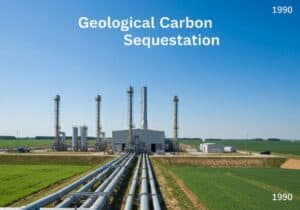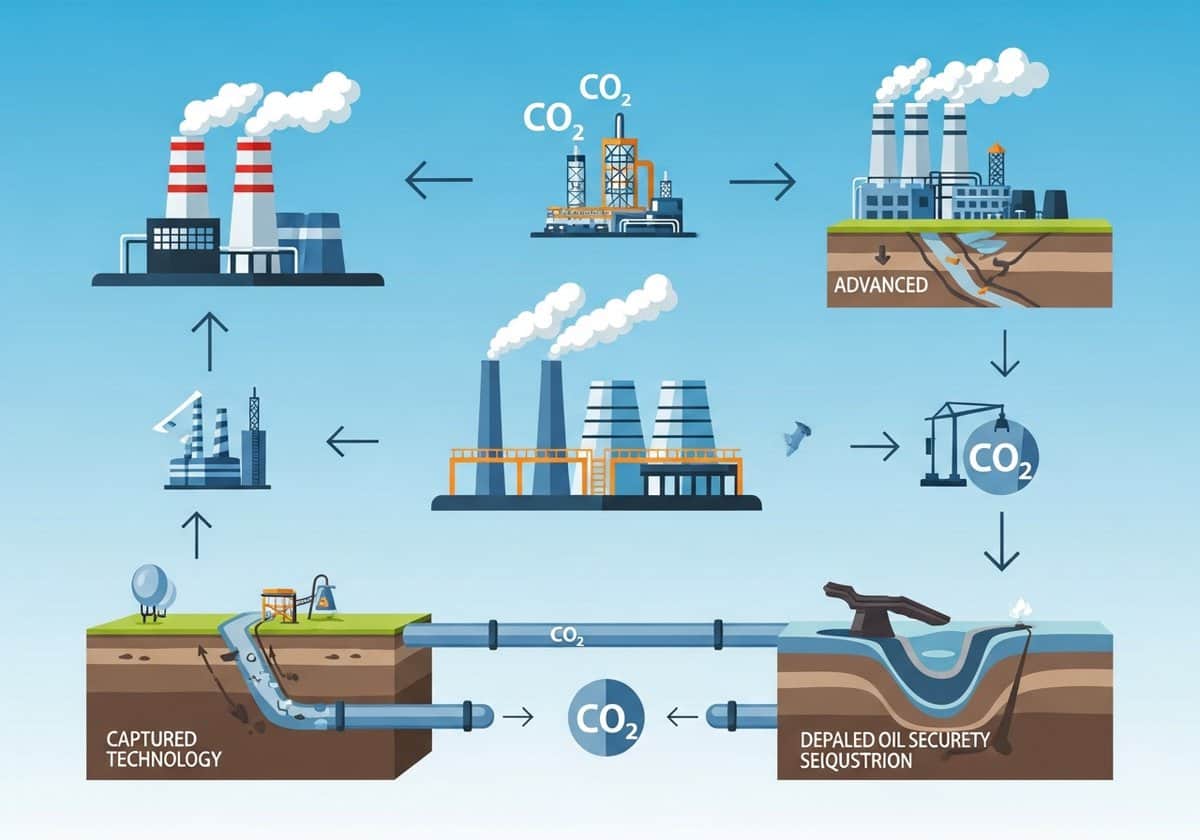
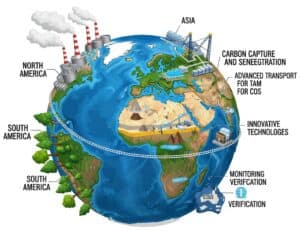
Die CO₂-Abscheidung und -Speicherung (CCS) konzentriert sich auf die Abtrennung von Kohlendioxid aus industriellen und energiebezogenen Quellen, dessen Transport und langfristige Speicherung in geologischen Formationen zur Minderung von Emissionen in die Atmosphäre. Dieses Forschungsfeld integriert Fortschritte bei Abscheidungstechnologien, darunter Nachverbrennungs-, Vorverbrennungs- und Oxyfuel-Verfahren, sowie Innovationen in der CO₂-Transportinfrastruktur und sicheren Untergrundspeichermethoden wie salinen Grundwasserleitern, erschöpften Öl- und Gaslagerstätten und der mineralischen Karbonatisierung. Überwachungs-, Verifizierungs- und Risikobewertungsprotokolle gewährleisten die Integrität der Speicherung und die Umweltsicherheit. Die folgende Sammlung fasst die neuesten wissenschaftlichen Publikationen und patentierten Technologien zu Abscheidungsmaterialien, Prozessoptimierung, Scale-up-Strategien und regulatorischen Rahmenbedingungen zusammen, die für die Weiterentwicklung des CCS-Einsatzes und die Klimaschutzbemühungen entscheidend sind:
CCS umfasst die Abscheidung an der Quelle, den Transport und die dauerhafte Speicherung unter der Erde. Die atmosphärische Entfernung ist Teil des Prozesses. Direkte LuftabscheidungDie Absorptionsmittel befinden sich auf MOFsDer Klimakontext ist am Klimawandel Und Klimamodellierungwährend die Produktbuchhaltung läuft Lebenszyklusanalyse.
Dies ist unsere neueste Auswahl an weltweiten Veröffentlichungen und Patenten in englischer Sprache zum Thema Carbon Capture & Sequestration (CCS), die in zahlreichen wissenschaftlichen Online-Zeitschriften zu den Themen Kohlenstoffabscheidung, Kohlenstoffsequestrierung, CO2-Speicherung, geologische Sequestrierung, Kohlendioxid-Injektion, verbesserte Ölgewinnung, Carbon Capture Techno, Post-Combustion Capture, Pre-Combustion Capture, Oxy-Fuel-Verbrennung, Kohlenstoffmineralisierung, Lösungsmittel für die Kohlenstoffabscheidung, CO2-Pipeline-Transport, CO2-Speicherung, Membranen für die Kohlenstoffabscheidung, Sorptionsmittel für die Kohlenstoffabscheidung, Adsorptionsmittel für die Kohlenstoffabscheidung, Katalysatoren für die Kohlenstoffabscheidung, Verfahren für die Kohlenstoffabscheidung, Nachrüstung für die Kohlenstoffabscheidung, Rechtsrahmen für die Kohlenstoffabscheidung und Umweltauswirkungen der Kohlenstoffabscheidung.
Production of synthetic fuels from co2 with partial oxy-fuel combustion of by-products and separation of co2
Patent published on the 2026-11-19 in US under Ref US20260365592 by IFP ENERGIES NOW [FR] (Laroche Catherine [fr], Joly Jean-Francois [fr], Dehlinger Marie [fr], Heraud Jean-Philippe [fr])
Abstract: A device/process for capturing/converting CO2, comprises/uses a CO2 capture unit that produces CO2, a water electrolysis unit that converts water into oxygen and hydrogen, an RWGS unit that treats the CO2 with hydrogen and produces an RWGS gas enriched in CO and water, an FT unit that converts the RWGS gas and produces an FT effluent, a first separation unit that treats the FT effluent and produces a hydrocarbon effluent and a gaseous effluent, a second separation unit that separates the effluen[...]
Our summary: The process captures CO2 and converts it into synthetic fuels using partial oxy-fuel combustion. It includes a series of units for CO2 capture, water electrolysis, RWGS gas production, and FT conversion. The system separates hydrocarbon effluents and recycles CO2 for continuous operation.
CO2 capture, synthetic fuels, oxy-fuel combustion, water electrolysis
Patent
Sub-sediment biomass injection system for coastal uplift and long-term carbon sequestration
Patent published on the 2026-11-19 in WO under Ref WO2026241733 by C/O SINKCO LABS PBC [US] (Choquet Victor [fr], Thomas Viji [fr], Raymond Jonathan [us])
Abstract: A sub-sediment biomass injection system and associated method enable long-term carbon sequestration and controlled coastal uplift by depositing organic biomass into marine sediments. The sub-sediment biomass injection system includes an injection shaft assembly having a feed tube string with a distal spike tip and a lateral discharge port array, a helical auger screw driven by a drive motor unit for conveying low-moisture particulate biomass without high-pressure slurry pumping, and a y-connecto[...]
Our summary: The system enables long-term carbon sequestration by injecting organic biomass into marine sediments. It features a helical auger for conveying biomass and a penetration assistance system to facilitate sediment penetration. The method includes multi-level discharges and post-injection monitoring to ensure effectiveness and safety.
biomass injection, carbon sequestration, coastal uplift, sediment penetration
Patent
Active carbon capture system with a distributed control architecture and methods of control
Patent published on the 2026-11-19 in US under Ref US20260364519 by PROVOCATIVE SCIENCE HOLDINGS INC [US] (Meyer Nicholas [us], Xhuti Indrid [us], Bouma Andrew [us])
Abstract: An active carbon capture system with a distributed control architecture and methods of control. The system includes at least a system component configured to receive a control signal and perform a carbon capture action as a function of the control signal; at least a first level control circuit communicatively connected to the at least one system component, the at least a first level control circuit configured to receive a command signal and transmit the control signal to the at least one system [...]
Our summary: The system features an active carbon capture mechanism with a distributed control architecture. It includes a component that executes carbon capture based on received control signals. A unit controller detects system parameters and generates command signals for the control circuit.
carbon capture, distributed control, control architecture, system parameters
Patent
Systems, devices and methods for controlling carbon dioxide capture state transition cycles in a carbon capture system
Patent published on the 2026-11-19 in US under Ref US20260364520 by PROVOCATIVE SCIENCE HOLDINGS INC [US] (Fisher Robert [us], Xhuti Indrid [us], Bouma Andrew [us])
Abstract: Methods of and systems for controlling carbon dioxide capture state transition cycles. One method comprises receiving, by a control circuit communicatively connected to a carbon capture system, an environmental parameter from at least a sensor located within the carbon capture system, wherein the environmental parameter comprises first environmental parameter data associated with an inflow of the carbon capture system and second environmental parameter data associated with an outflow of the carb[...]
Our summary: This content discusses systems and methods for managing carbon dioxide capture state transitions. It involves receiving environmental data from sensors within the carbon capture system. The control circuit generates operational commands to adjust the system s state based on this data.
carbon capture, state transition, control circuit, environmental parameters
Patent
Verifiable and repairable preserved biolandfill for biological carbon sequestration and compositions for biological carbon preservation
Patent published on the 2026-11-19 in US under Ref US20260364653 by GRAPHYTE INC [US] (Deckman Harry William [us])
Abstract: The present invention is directed to a dry tomb biolandfill for biological carbon sequestration, and more particularly compositions of a biolandfill containing a salt biomass composite. The dry tomb biolandfill that preserves sequestered biomass comprises a biomass salt composite with a water activity less than about 0.85 enveloped with top and bottom seal structures forming a dry tomb structure. The biomass salt composite having an average salt content of at least about 0.0001 wt. % of the dry [...]
Our summary: The invention describes a dry tomb biolandfill designed for biological carbon sequestration. It features a biomass salt composite with controlled water activity and specific salt content. The structure is sealed at the top and bottom to enhance preservation.
biolandfill, carbon sequestration, biomass composite, dry tomb structure
Patent
Method for production of blue ammonia
Patent published on the 2026-11-19 in US under Ref US20260365528 by TOPSOE AS [DK] (Krøll Jensen Annette E [dk], Sørensen Per Aggerholm [dk])
Abstract: The present invention provides a method and system for producing blue ammonia, providing for a higher percentage of carbon capture. The method and system of the invention may be used in any ammonia plant.[...]
Our summary: The invention presents a method and system for producing blue ammonia. It emphasizes a higher percentage of carbon capture. This method is applicable in any ammonia production facility.
blue ammonia, carbon capture, ammonia production, sustainable technology
Patent
Exploring the effects of accelerated carbonation synergy on fly ash cement-based materials
Published on 2026-11-14 by @OXFORD
Abstract: AbstractThe construction sector is being pressured toward achieving carbon neutrality, which requires novel ways of carbon capture, utilization, and storage. Fly ash (FA) is often used as a substitute to lower the clinker factor but its low reactivity makes it difficult to be used in high-volume substitution. Carbonation curing is one of the promising methods to accelerate the strength development and to avoid CO2 emission, but synergistic effect between binder precarbonation and matrix curing i[...]
Our summary: This study investigates a dual carbonation process for fly ash cement-based materials to enhance strength and CO2 capture. Precarbonation creates nucleation seeds that improve hydration, but excessive processing can lead to microcracking. The method offers a scalable solution for precast concrete producers to utilize industrial waste effectively.
carbonation, fly ash, cement, microstructure
Publication
A systematic review of supervised machine learning for CO2 storage performance prediction in deep saline sandstone formations
Published on 2026-09-26 by @OXFORD
Abstract: AbstractCarbon capture and storage (CCS) is a key mitigation strategy for industrial CO2 emissions, with deep saline sandstone formations widely investigated because of their large storage capacity and multiple trapping mechanisms. Captured CO2 streams often contain impurities such as N2, CH4, H2S, SO2, NOx, Ar, and CO, which can affect density, viscosity, interfacial tension, geochemical reactions, injectivity, plume migration, and trapping behavior. This systematic literature review followed a[...]
Our summary: This systematic review analyzes the use of supervised machine learning for predicting CO2 storage performance in deep saline sandstone formations. It highlights the impact of impurities on various physical properties and identifies common machine learning models used in the field. The review emphasizes the need for improved datasets and methodologies to enhance the applicability of these models in real-world scenarios.
machine learning, CO2 storage, sandstone formations, systematic review
Publication