Product Design, Manufacturing & Innovation Resources
Heim » Ökologischer Fußabdruck

Ökologischer Fußabdruck

1990
  • Mathis Wackernagel
  • William E. Rees
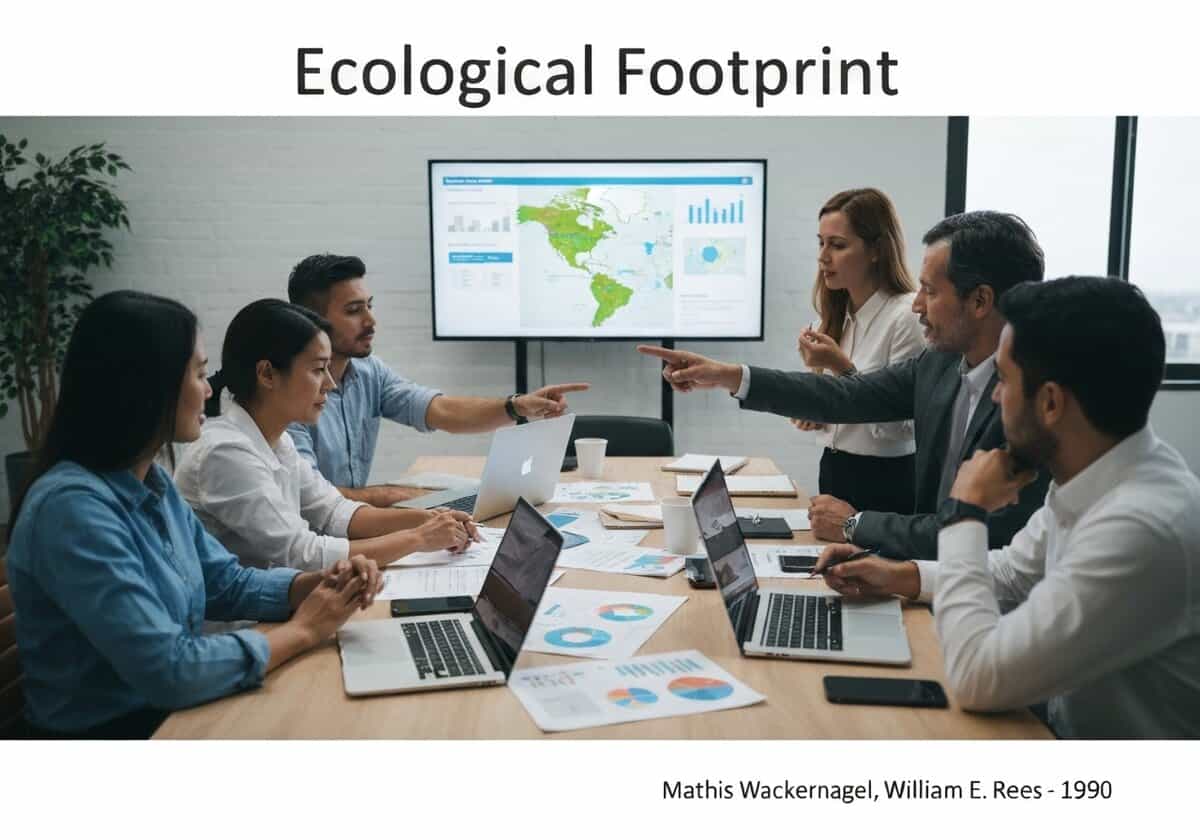
Stadtplanungstreffen zur Erörterung der Metrik des ökologischen Fußabdrucks im Umweltmanagement.

(Abbildung dient nur zur Veranschaulichung)

The Ecological Footprint is a resource accounting metric that measures human demand on nature. It quantifies the amount of biologically productive land and sea area required to produce the resources a population consumes (like food, fiber, and timber), and to absorb its waste, especially carbon emissions. It is the ‘demand’ side of the Earth Overshoot Day (EOD) calculation.

Developed in the early 1990s by Mathis Wackernagel during his PhD research under William E. Rees at the University of British Columbia, the Ecological Footprint concept was designed to be a comprehensive indicator of human pressure on the environment. It translates various types of consumption and waste generation into a single, understandable unit: the global hectare (gha). The methodology categorizes consumption into several major areas: food, shelter, mobility, goods, and services. It also accounts for the six main land use types: cropland, grazing land, fishing grounds, forest land for timber and fiber, built-up land for infrastructure, and forest land required to absorb carbon dioxide emissions not absorbed by the ocean (the CO2-FußabdruckDer CO₂-Fußabdruck ist in den meisten Industrienationen oft der größte Bestandteil des gesamten ökologischen Fußabdrucks. Durch die Addition dieser Bereiche liefert die Kennzahl ein aggregiertes Maß für die Nachfrage, das direkt mit den verfügbaren Ressourcen verglichen werden kann. BiokapazitätDamit ist es ein leistungsstarkes Instrument zur Bewertung der Nachhaltigkeit auf verschiedenen Ebenen, vom Individuum bis zum gesamten Planeten.

UNESCO Nomenclature: 2511
Umweltmanagement

Typ

Metrisch

Störung

Grundlegendes

Verwendung

Weitverbreitete Verwendung

Vorläufer

  • Konzept der Tragfähigkeit
  • Georg Borgströms Konzept der „Geisterflächen“
  • Methoden der Energiebilanzierung
  • Input-Output-Modelle aus der Ökonomie
  • life-cycle Bewertung (Ökobilanz) Rahmenwerke

Anwendungen

  • nationale Umweltverträglichkeitsprüfung
  • Stadtplanung und kommunale Nachhaltigkeitsstrategien
  • Unternehmensberichterstattung zu Umwelt, Sozialem und Unternehmensführung (ESG)
  • Rechner für den persönlichen CO2- und Ressourcen-Fußabdruck
  • Lehrplanmaterial für die Umwelterziehung

Patente:

NA

Potenzielle Innovationsideen

  • a footprint calculator for specific industrial processes or products
  • integrating footprint analysis into building information modeling (bim) Software
  • a ‘footprint-neutral’ certification for events and organizations
  • using footprint data to design more effective consumption taxes
  • a personalized dietary planning app that minimizes a user’s food footprint
  • ai tools that analyze satellite imagery to provide more accurate and timely land use data for footprint calculations
  • a global trade model that tracks the embodied footprint of imported and exported goods
  • a ‘digital footprint’ metric to quantify the ecological cost of data storage and Internet usage
  • a stock market index that weights companies based on their ecological footprint efficiency
  • a municipal planning tool that simulates the footprint impact of different zoning and transportation policies
Verwandte Themen: ökologischer Fußabdruck, Mathis Wackernagel, William Rees, Ressourcenverbrauch, CO2-Fußabdruck, Nachhaltigkeit, globaler Hektar, Umweltbuchhaltung, menschlicher Bedarf, Landnutzung.

Historischer Kontext

Ökologischer Fußabdruck

1982
1990
1990
1990
1993
2001-09-01
1982
1990
1990
1990
1990
2000
2006

(wenn das Datum unbekannt oder nicht relevant ist, z. B. „Strömungsmechanik“, wird eine gerundete Schätzung seines bemerkenswerten Auftretens bereitgestellt)

10. Jahr Jubiläum

Bilder in voller Größe und Downloads sind ausschließlich für registrierte Mitglieder kostenlos verfügbar.

> Login <