Product Design, Manufacturing & Innovation Resources
Heim » Stirlingmotor-Regeneratorökonom

Stirlingmotor-Regeneratorökonom

1816-11-16
  • Robert Stirling
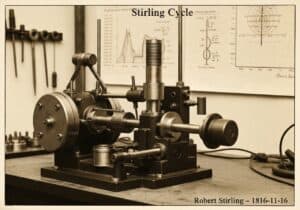
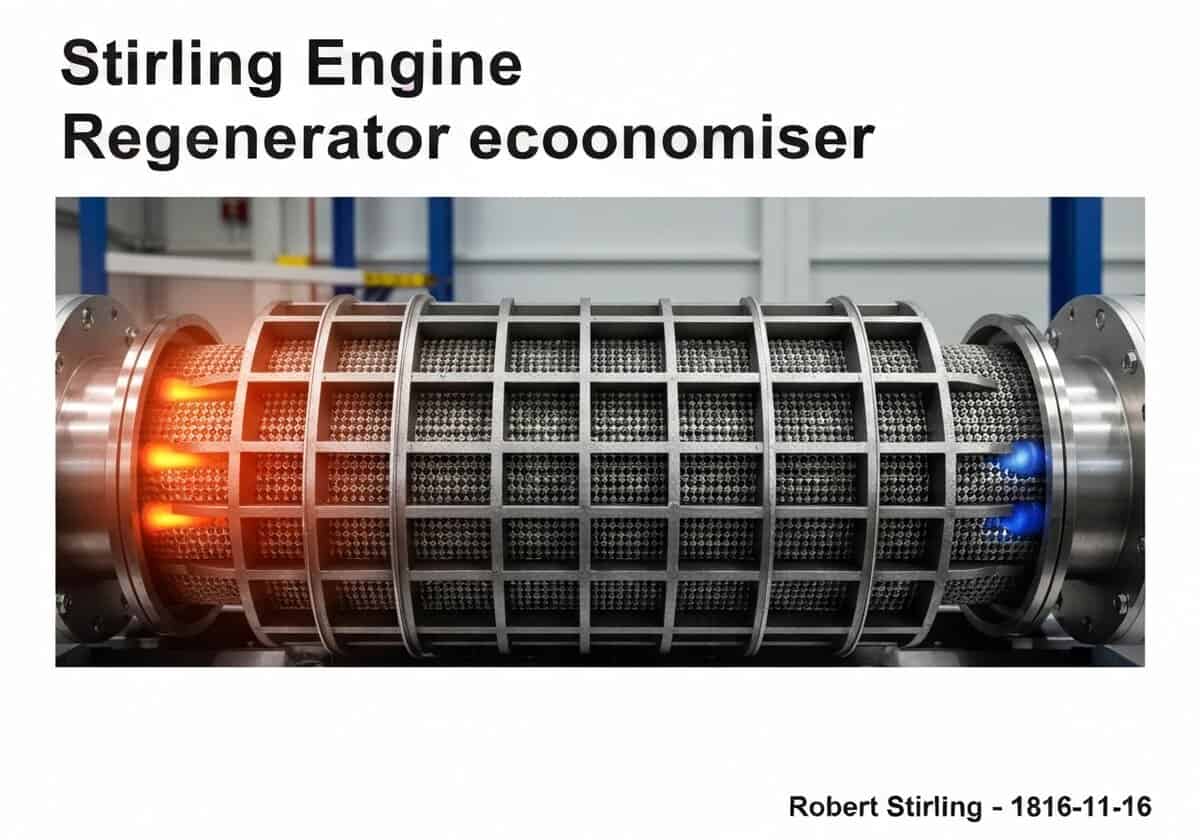
Regeneratormatrix eines Stirlingmotors, die die thermische Energiespeicherung in der Thermodynamik veranschaulicht.

(Abbildung dient nur zur Veranschaulichung)

Der Regenerator, auch „Ökonomisator“ genannt, ist Robert Stirlings bedeutendster Beitrag und der Schlüssel zum hohen Wirkungsgrad der Maschine. Er ist ein interner Wärmetauscher, der während des Zyklus thermische Energie speichert und wieder abgibt. Wenn heißes Gas zur kalten Seite strömt, gibt es Wärme an die Regeneratormatrix ab, die dann vom kalten Gas auf seinem Rückweg zur heißen Seite aufgenommen wird.
The regenerator’s function is to pre-cool the working gas before it enters the main cooler and pre-heat it before it enters the main heater. This dramatically reduces the amount of heat that must be added from the external source and rejected to the external sink during the isochoric (constant volume) phases of the cycle. In an ideal regenerator, the heat transferred from the gas to the matrix during the isochoric cooling process is exactly equal to the heat transferred back to the gas during the isochoric heating process. This internal heat recycling is what allows the ideal Stirling cycle’s efficiency to match the Carnot efficiency.

Designing an effective regenerator involves a careful balance of competing factors. It must have a high heat capacity to store sufficient energy, a large internal surface area for rapid heat transfer, and high thermal conductivity perpendicular to the gas flow to facilitate this transfer. However, it must also have low thermal conductivity parallel to the gas flow to prevent heat from simply bypassing the cycle and conducting from the hot to the cold end. Furthermore, it must have low aerodynamic resistance to minimize the work needed to pump the gas through it, and it must contain a minimal volume of gas (dead volume) to maximize the engine’s compression ratio. Common materials include stacks of fine metal wire mesh, metal foams, or ceramic matrices.

UNESCO Nomenclature: 2212
- Thermodynamik

Typ

Physikalisches Gerät

Störung

Revolutionär

Verwendung

Weitverbreitete Verwendung

Vorläufer

  • Grundprinzipien der Wärmeübertragung (Wärmeleitung, Konvektion)
  • Verständnis der Wärmekapazität von Materialien
  • Frühe Konstruktionen von Wärmetauschern und Rekuperatoren in Industrieöfen

Anwendungen

  • Hocheffiziente Stirlingmotoren für Solarenergie und Kraft-Wärme-Kopplung
  • Kryokühler und Pulsschlauchkühlschränke, bei denen die Regeneration für das Erreichen kryogener Temperaturen entscheidend ist.
  • thermoakustische Motoren und Kühler
  • Gastrennverfahren
  • Giromill-Kryokühler
  • bestimmte Arten von Gas-Kreislauf-Wärmepumpen

Patente:

  • GB 4081 of 1816

Potenzielle Innovationsideen

Aufgrund des hohen Datenverkehrs durch Web-Scraping-Bots, der derzeit mehr als 40.000 Anfragen pro Tag umfasst, ist dieser Inhalt ausschließlich Community-Mitgliedern vorbehalten.
> Anmelden < oder > Registrieren < (100% kostenlos) Zugriff darauf sowie auf alle anderen eingeschränkten Inhalte und Tools.

Related to: regenerator, heat exchanger, thermal efficiency, stirling engine, isochoric process, heat storage, working fluid, Carnot efficiency, pumping loss, dead volume.

Historischer Kontext

Stirlingmotor-Regeneratorökonom

1802
1810
1816
1816-11-16
1820
1820
1822
1802
1808
1811
1816-11-16
1820
1820
1821
1822

(wenn das Datum unbekannt oder nicht relevant ist, z. B. „Strömungsmechanik“, wird eine gerundete Schätzung seines bemerkenswerten Auftretens bereitgestellt)

Verwandte Erfindungen, Innovationen und technische Prinzipien

Bilder in voller Größe und Downloads sind nur für registrierte Mitglieder 100% kostenlos verfügbar.

> Login <