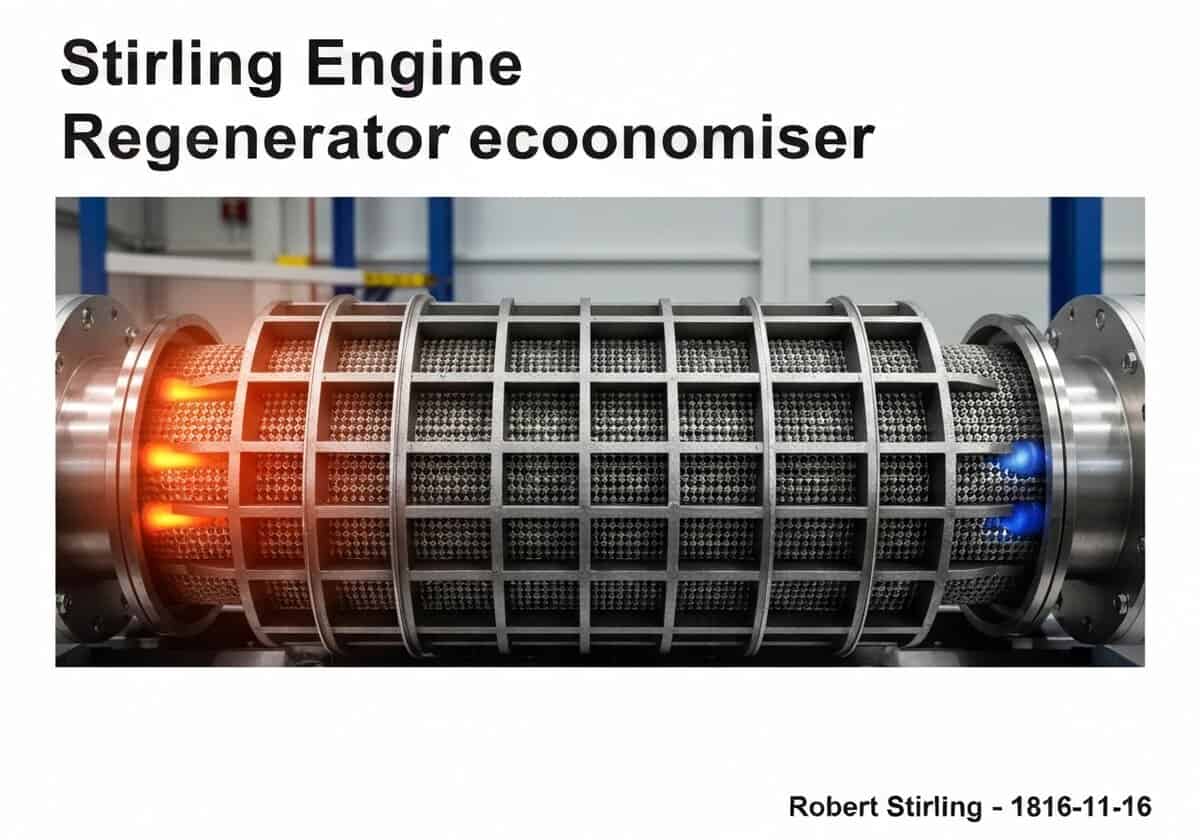
再生器、または「エコノマイザー」は、ロバート・スターリングの最も重要な貢献であり、エンジンの高効率の鍵となる部分です。これは、サイクル中に熱エネルギーを一時的に蓄積および放出する内部熱交換器です。高温ガスが低温側に移動する際に、再生器マトリックスに熱を蓄積し、その熱は低温ガスが高温側に戻る際に再び取り込まれます。
(画像はイメージです)
再生器、または「エコノマイザー」は、ロバート・スターリングの最も重要な貢献であり、エンジンの高効率の鍵となる部分です。これは、サイクル中に熱エネルギーを一時的に蓄積および放出する内部熱交換器です。高温ガスが低温側に移動する際に、再生器マトリックスに熱を蓄積し、その熱は低温ガスが高温側に戻る際に再び取り込まれます。
The regenerator’s function is to pre-cool the working gas before it enters the main cooler and pre-heat it before it enters the main heater. This dramatically reduces the amount of heat that must be added from the external source and rejected to the external sink during the isochoric (constant volume) phases of the cycle. In an ideal regenerator, the heat transferred from the gas to the matrix during the isochoric cooling process is exactly equal to the heat transferred back to the gas during the isochoric heating process. This internal heat recycling is what allows the ideal Stirling cycle’s efficiency to match the Carnot efficiency.
Designing an effective regenerator involves a careful balance of competing factors. It must have a high heat capacity to store sufficient energy, a large internal surface area for rapid heat transfer, and high thermal conductivity perpendicular to the gas flow to facilitate this transfer. However, it must also have low thermal conductivity parallel to the gas flow to prevent heat from simply bypassing the cycle and conducting from the hot to the cold end. Furthermore, it must have low aerodynamic resistance to minimize the work needed to pump the gas through it, and it must contain a minimal volume of gas (dead volume) to maximize the engine’s compression ratio. Common materials include stacks of fine metal wire mesh, metal foams, or ceramic matrices.
ボットによるトラフィック(現在1日あたり4万件以上)を排除するため、このコンテンツはコミュニティメンバー限定となっています。
> ログイン < または > 登録 < (100%無料)でこれにアクセスできます。他のすべての制限付きコンテンツとツールも同様です。
スターリングエンジン再生器エコノマイザー
(日付が不明または関連性がない場合、例えば「流体力学」などでは、その注目すべき出現時期の概算値が提示されます。)

フルサイズの画像とダウンロードは、登録会員のみが100%無料で利用できます。
> ログイン <