Green Fluorescent Protein (GFP) as a Wavelength Shifter
1990
- Osamu Shimomura
- Martin Chalfie
- Roger Y. Tsien
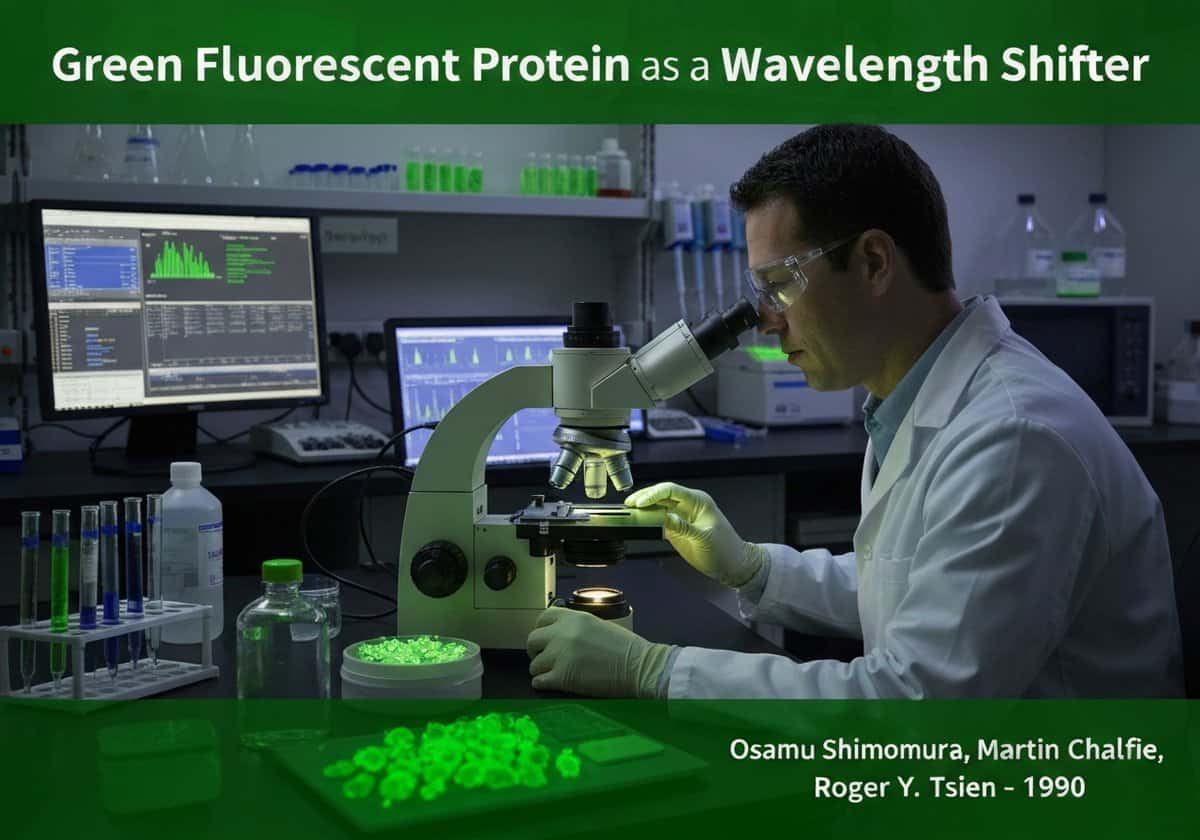
In some organisms like the jellyfish Aequorea victoria, the initial bioluminescent reaction produces blue light. This energy is then transferred to a secondary protein, the Green Fluorescent Protein (GFP), via Förster resonance energy transfer (FRET). GFP absorbs the blue light and re-emits it as green light, effectively shifting the color of the luminescence.
Die Entdeckung und Anwendung von GFP revolutionierte die Zellbiologie. Osamu Shimomura isolierte GFP erstmals in den 1960er Jahren aus *Aequorea victoria*, als er das biolumineszente Photoprotein Aequorin untersuchte. Aequorin emittiert blaues Licht nach der Bindung von Ca²⁺-Ionen. Shimomura bemerkte, dass die Qualle grün und nicht blau leuchtete, was ihn zur Entdeckung des Energietransfers zu GFP führte. Das Hauptmerkmal von GFP ist sein Chromophor, das autokatalytisch aus einer Ser-Tyr-Gly-Sequenz innerhalb der Primärstruktur des Proteins gebildet wird. Dieses Chromophor ist in einer Beta-Fass-Struktur eingeschlossen, die es vor der Umgebung schützt und seine helle Fluoreszenz ermöglicht.
Martin Chalfie zeigte später, dass das Gen für GFP auch in anderen Organismen (E. coli und C. elegans) exprimiert werden kann, wo es als Fluoreszenzmarker ohne artspezifische Kofaktoren fungiert. Roger Tsiens Arbeit war entscheidend für das Verständnis des Mechanismus der Chromophorbildung und die Entwicklung einer Vielzahl von GFP-Varianten (BFPs, CFPs, YFPs, RFPs) mit unterschiedlichen Farben, verbesserter Helligkeit und Photostabilität. Dieses Instrumentarium ermöglicht es Forschern, mehrere Proteine oder Prozesse gleichzeitig in einer einzelnen lebenden Zelle zu verfolgen – eine Technik, die als Mehrfarben-Bildgebung bekannt ist. Für diese Arbeit wurde Shimomura, Chalfie und Tsien der Nobelpreis für Chemie 2008 verliehen.
UNESCO Nomenclature: 2401
- Biochemie
Verwendung
Weitverbreitete Verwendung
Vorläufer
- discovery of bioluminescence in aequorea victoria
- understanding of protein structure and function
- development of recombinant DNA technology
- discovery of Förster resonance energy transfer (FRET)
Anwendungen
- reporter gene in molecular biology to visualize gene expression
- tagging proteins to study their location and movement within cells
- calcium imaging (with variants like gcamp)
- high-throughput screening in drug discovery
- creating transgenic glowing pets (e.g., glofish)
Potenzielle Innovationsideen
Aufgrund des hohen Datenverkehrs durch Web-Scraping-Bots, der derzeit mehr als 40.000 Anfragen pro Tag umfasst, ist dieser Inhalt ausschließlich Community-Mitgliedern vorbehalten.
> Anmelden < oder > Registrieren < (100% kostenlos) Zugriff darauf sowie auf alle anderen eingeschränkten Inhalte und Tools.
Verwandt mit: GFP, grün fluoreszierendes Protein, Aequorea victoria, Fluoreszenz, FRET, Reportergen, Proteinmarkierung, Chromophor, Osamu Shimomura, Roger Tsien.