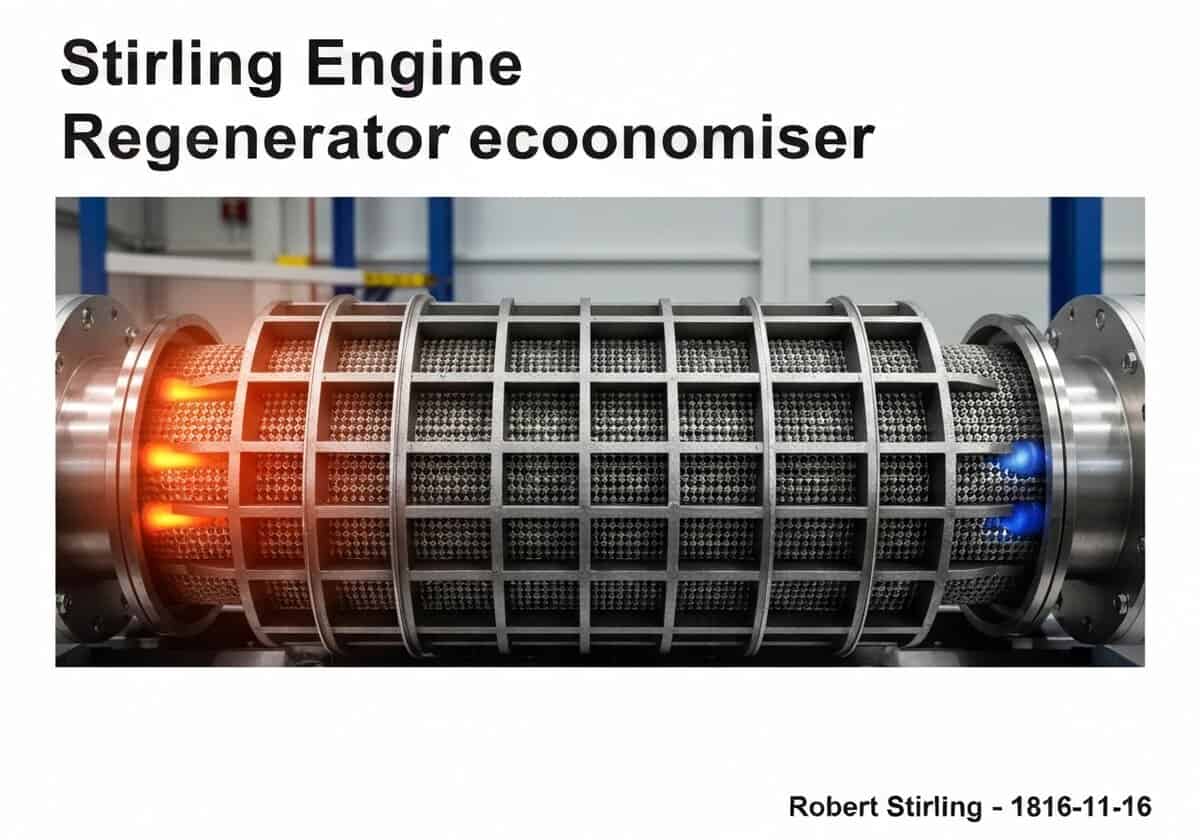
The regenerator’s function is to pre-cool the working gas before it enters the main cooler and pre-heat it before it enters the main heater. This dramatically reduces the amount of heat that must be added from the external source and rejected to the external sink during the isochoric (constant volume) phases of the cycle. In an ideal regenerator, the heat transferred from the gas to the matrix during the isochoric cooling process is exactly equal to the heat transferred back to the gas during the isochoric heating process. This internal heat recycling is what allows the ideal Stirling cycle’s efficiency to match the Carnot efficiency.
Designing an effective regenerator involves a careful balance of competing factors. It must have a high heat capacity to store sufficient energy, a large internal surface area for rapid heat transfer, and high thermal conductivity perpendicular to the gas flow to facilitate this transfer. However, it must also have low thermal conductivity parallel to the gas flow to prevent heat from simply bypassing the cycle and conducting from the hot to the cold end. Furthermore, it must have low aerodynamic resistance to minimize the work needed to pump the gas through it, and it must contain a minimal volume of gas (dead volume) to maximize the engine’s compression ratio. Common materials include stacks of fine metal wire mesh, metal foams, or ceramic matrices.