Product Design, Manufacturing & Innovation Resources
Lar » Regenerador/economizador de motor Stirling

Regenerador/economizador de motor Stirling

1816-11-16
  • Robert Stirling
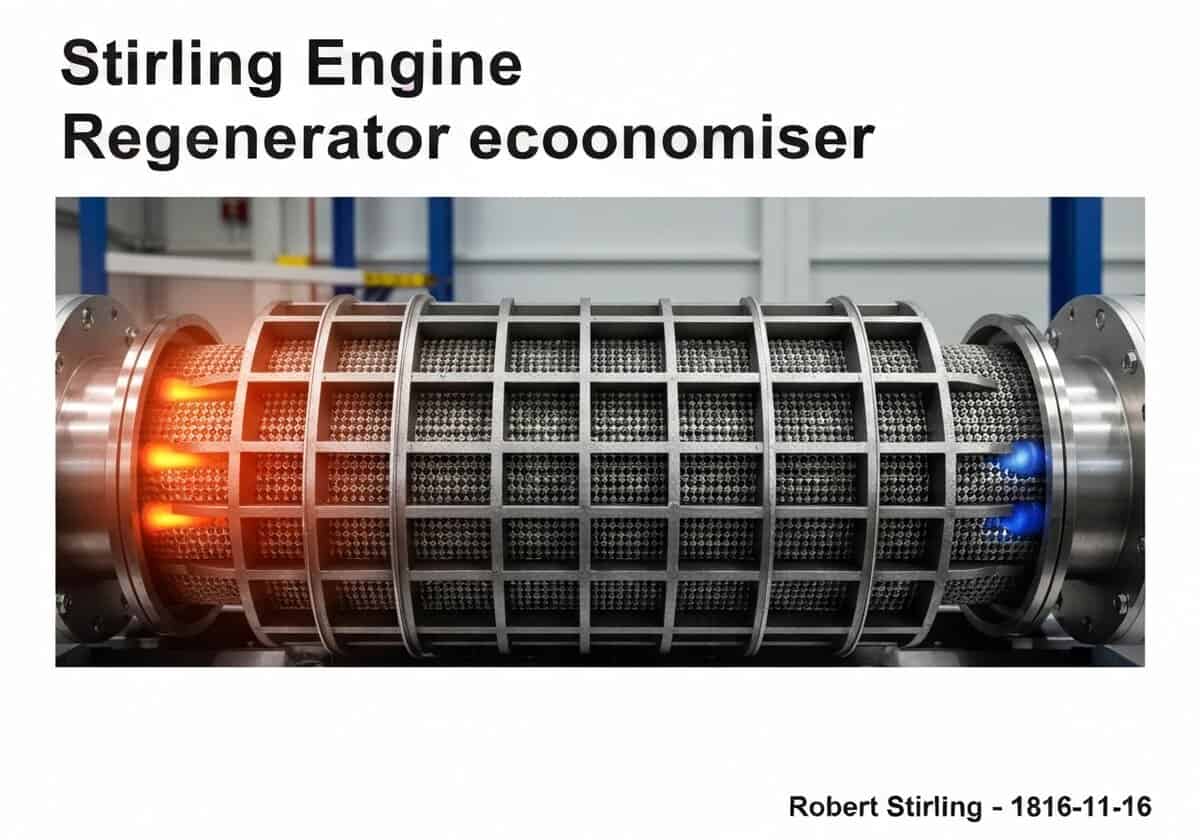
Regenerator matrix of a Stirling engine demonstrating thermal energy storage in thermodynamics.

(Imagem gerada apenas para fins ilustrativos)

O regenerador, ou "economizador", é a contribuição mais significativa de Robert Stirling e a chave para a alta eficiência do motor. Trata-se de um trocador de calor interno que armazena e libera temporariamente energia térmica durante o ciclo. À medida que o gás quente se move para o lado frio, ele deposita calor na matriz do regenerador, que é então absorvido pelo gás frio em seu retorno ao lado quente.
The regenerator’s function is to pre-cool the working gas before it enters the main cooler and pre-heat it before it enters the main heater. This dramatically reduces the amount of heat that must be added from the external source and rejected to the external sink during the isochoric (constant volume) phases of the cycle. In an ideal regenerator, the heat transferred from the gas to the matrix during the isochoric cooling process is exactly equal to the heat transferred back to the gas during the isochoric heating process. This internal heat recycling is what allows the ideal Stirling cycle’s efficiency to match the Carnot efficiency.

Designing an effective regenerator involves a careful balance of competing factors. It must have a high heat capacity to store sufficient energy, a large internal surface area for rapid heat transfer, and high thermal conductivity perpendicular to the gas flow to facilitate this transfer. However, it must also have low thermal conductivity parallel to the gas flow to prevent heat from simply bypassing the cycle and conducting from the hot to the cold end. Furthermore, it must have low aerodynamic resistance to minimize the work needed to pump the gas through it, and it must contain a minimal volume of gas (dead volume) to maximize the engine’s compression ratio. Common materials include stacks of fine metal wire mesh, metal foams, or ceramic matrices.

UNESCO Nomenclature: 2212
Termodinâmica

Tipo

Dispositivo físico

Interrupção

Revolucionário

Uso

Uso generalizado

Precursores

  • Princípios básicos de transferência de calor (condução, convecção)
  • Compreensão da capacidade térmica dos materiais
  • Projetos iniciais de trocadores de calor e recuperadores em fornos industriais

Aplicações

  • high-efficiency stirling engines for solar power and chp
  • cryocoolers and pulse tube refrigerators where regeneration is critical for reaching cryogenic temperatures
  • motores e refrigeradores termoacústicos
  • processos de separação de gases
  • criocongeladores giromill
  • certos tipos de bombas de calor de ciclo a gás

Patentes:

  • GB 4081 of 1816

Ideias de Inovação Potencial

Devido ao tráfego de bots de coleta de dados, atualmente superior a 40 mil por dia, este conteúdo é reservado aos membros da comunidade.
> Login < ou > Registrar < (100% gratuito) para acessar isso, assim como todo o restante do conteúdo e das ferramentas restritas.

Related to: regenerator, heat exchanger, thermal efficiency, stirling engine, isochoric process, heat storage, working fluid, Carnot efficiency, pumping loss, dead volume.

Contexto histórico

Regenerador/economizador de motor Stirling

1802
1810
1816
1816-11-16
1820
1820
1822
1802
1808
1811
1816-11-16
1820
1820
1821
1822

(Caso a data seja desconhecida ou irrelevante, por exemplo, "mecânica dos fluidos", é fornecida uma estimativa aproximada de seu surgimento notável)

Princípios relacionados à invenção, inovação e tecnologia

Imagens em tamanho real e downloads estão disponíveis apenas, 100% gratuitos, para membros registrados.