Product Design, Manufacturing & Innovation Resources
Heim » Gaussian Beam

Gaussian Beam

1960
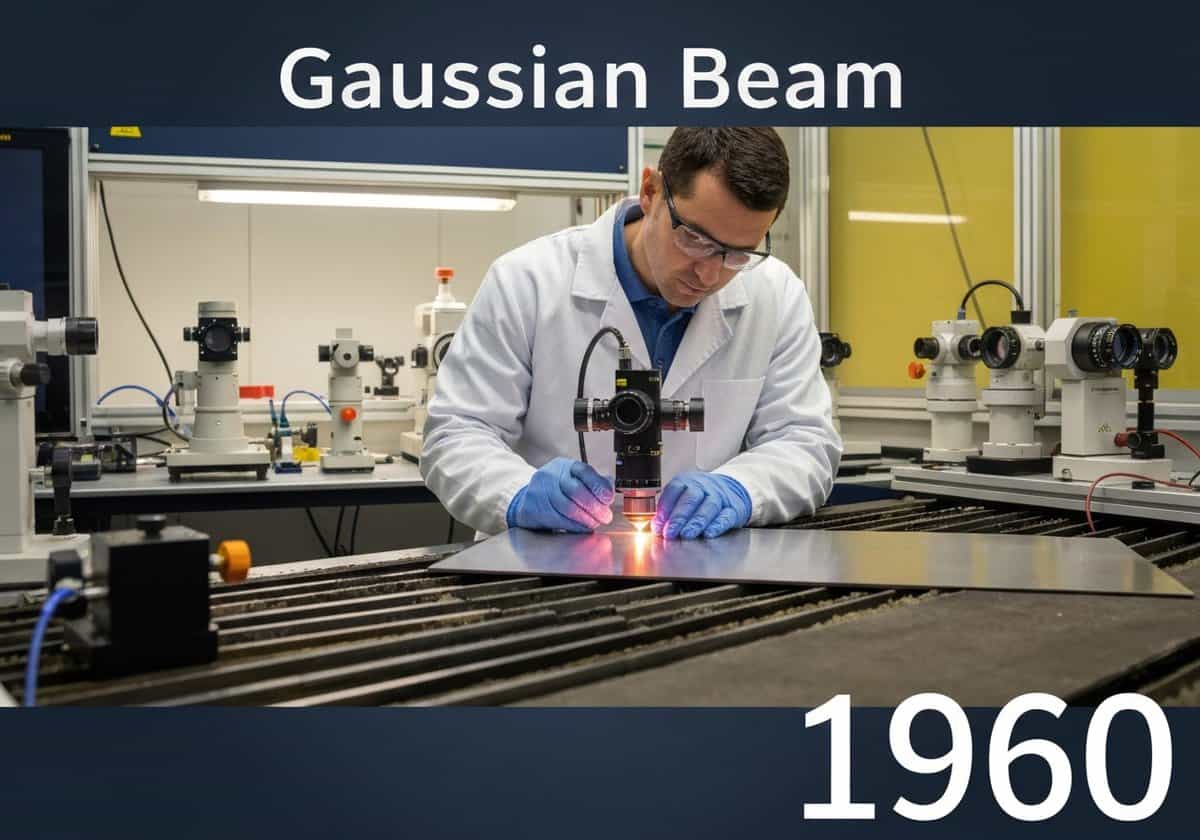
Laserschneidmaschine mit Gaußstrahl in einem Optiklabor.

(Abbildung dient nur zur Veranschaulichung)

A Gaussian beam is a beam of electromagnetic radiation whose transverse electric field and intensity distributions are described by Gaussian functions. It is the most common output profile of lasers operating in the fundamental transverse mode (TEM00). This profile allows the beam to remain tightly focused over a long distance and represents the ideal case for high beam quality.

The Gaussian beam is a solution to the paraxial Helmholtz equation, which is an approximation of Maxwell’s equations for beams that do not diverge rapidly. The intensity [latex]I(r, z)[/latex] of a Gaussian beam as a function of radial distance [latex]r[/latex] from the center of the beam and axial distance [latex]z[/latex] from its narrowest point (the ‘beam waist’) is given by [latex]I(r, z) = I_0 \left(\frac{w_0}{w(z)}\right)^2 \exp\left(\frac{-2r^2}{w(z)^2}\right)[/latex]. Here, [latex]I_0[/latex] is the peak intensity at the beam waist, [latex]w_0[/latex] is the beam waist radius (where the intensity drops to [latex]1/e^2[/latex] of its axial value), and [latex]w(z)[/latex] is the beam radius at distance [latex]z[/latex].

Key parameters describing a Gaussian beam include the beam waist ([latex]w_0[/latex]), the Rayleigh range ([latex]z_R[/latex]), which is the distance over which the beam remains relatively collimated, and the beam divergence angle ([latex]\theta[/latex]), which describes how fast the beam spreads out in the far field. These parameters are all interrelated. A smaller beam waist results in a larger divergence angle, a consequence of diffraction. The quality of a real laser beam is often described by the M-squared ([latex]M^2[/latex]) factor, which compares its beam parameter product (waist radius times far-field divergence) to that of an ideal Gaussian beam, for which [latex]M^2=1[/latex]. The Gaussian profile is desirable because it can be focused to the smallest possible spot size for a given wavelength, maximizing intensity.

UNESCO Nomenclature: 2210
- Optik

Typ

Abstraktes System

Störung

Grundlegendes

Verwendung

Weitverbreitete Verwendung

Vorläufer

  • Maxwells Gleichungen des Elektromagnetismus
  • Huygens–Fresnel principle of diffraction
  • development of laser resonators that naturally support a fundamental mode

Anwendungen

  • laser cutting and welding
  • fiber optic coupling
  • laser pointers
  • barcode scanners
  • optische Pinzette ('optische Pinzette')
  • Laserkommunikationssysteme

Patente:

NA

Potenzielle Innovationsideen

Aufgrund des hohen Datenverkehrs durch Web-Scraping-Bots, der derzeit mehr als 40.000 Anfragen pro Tag umfasst, ist dieser Inhalt ausschließlich Community-Mitgliedern vorbehalten.
> Anmelden < oder > Registrieren < (100% kostenlos) Zugriff darauf sowie auf alle anderen eingeschränkten Inhalte und Tools.

Verwandte Themen: Gaußscher Strahl, Laserstrahlprofil, EM00, Strahltaillenweite, Rayleigh-Länge, Strahldivergenz, M², paraxiale Näherung, Beugung, Strahlqualität.

Historischer Kontext

Gaussian Beam

1960
1960
1960
1960
1961
1962
1963
1960
1960
1960
1960
1960-05-16
1962
1963
1964

(wenn das Datum unbekannt oder nicht relevant ist, z. B. „Strömungsmechanik“, wird eine gerundete Schätzung seines bemerkenswerten Auftretens bereitgestellt)

Bilder in voller Größe und Downloads sind nur für registrierte Mitglieder 100% kostenlos verfügbar.

> Login <