Product Design, Manufacturing & Innovation Resources
بيت » الأكسدة والاختزال في التنفس الخلوي

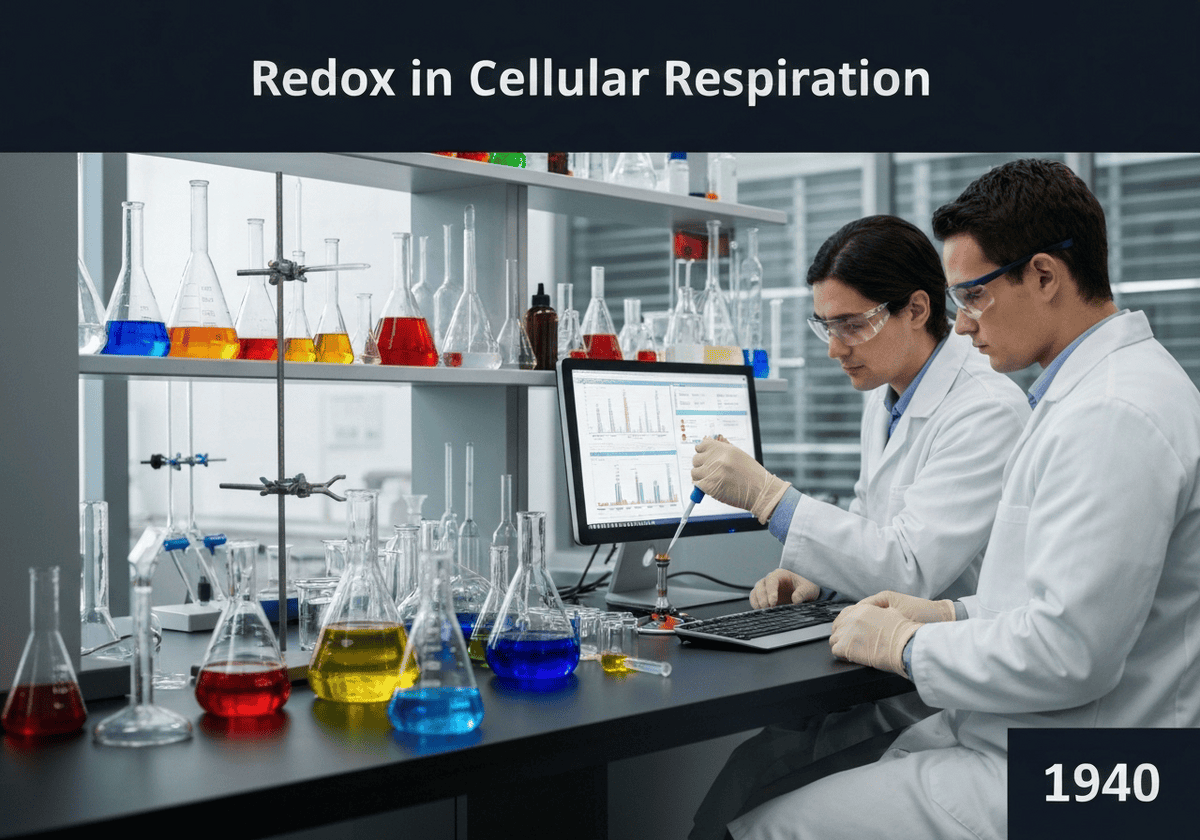
الأكسدة والاختزال في التنفس الخلوي

1940
Biochemist studying redox reactions in cellular respiration in a laboratory.

(صورة توضيحية فقط)

Cellular respiration is a series of redox reactions where organic molecules, like glucose, are oxidized to release energy. Glucose ([latex]C_6H_{12}O_6[/latex]) is oxidized to [latex]CO_2[/latex], while oxygen ([latex]O_2[/latex]) is reduced to water ([latex]H_2O[/latex]). This process transfers electrons through an electron transport chain, creating a proton gradient that drives the synthesis of ATP, the cell’s primary energy currency.
Cellular respiration is a controlled, multi-step oxidation of glucose. Unlike direct combustion, which releases energy explosively as heat, the cell breaks down glucose gradually through glycolysis, the Krebs cycle (citric acid cycle), and oxidative phosphorylation. In this cascade, electrons are stripped from glucose and its intermediates and transferred to electron carriers like [latex]NAD^+[/latex] and [latex]FAD[/latex], reducing them to [latex]NADH[/latex] and [latex]FADH_2[/latex].

These reduced coenzymes then donate their high-energy electrons to the electron transport chain (ETC), a series of protein complexes in the inner mitochondrial membrane. As electrons are passed down the chain, they move to successively lower energy levels. The final electron acceptor is molecular oxygen, which is highly electronegative and is reduced to form water. The energy released during this electron transfer is used to مضخة protons ([latex]H^+[/latex]) from the mitochondrial matrix into the intermembrane space, establishing an electrochemical gradient. This proton-motive force is a form of stored energy. The flow of protons back into the matrix through an enzyme called ATP synthase powers the synthesis of large amounts of ATP from ADP and inorganic phosphate, a process called chemiosmosis.

UNESCO Nomenclature: 2406
– Biochemistry

يكتب

Chemical Process

خلل

أساسيات

الاستخدام

استخدام واسع النطاق

مقدمات

  • اكتشاف الإنزيمات
  • antoine lavoisier’s work showing respiration is a form of slow combustion
  • توضيح بنية الجلوكوز
  • اكتشاف ATP ودوره في نقل الطاقة

التطبيقات

  • فهم الأمراض الأيضية
  • تطوير الأدوية التي تستهدف المسارات الأيضية (على سبيل المثال، الميتفورمين)
  • فسيولوجيا التمرين
  • علم الأغذية وحفظها
  • التكنولوجيا الحيوية (على سبيل المثال، الميكروبات خلايا الوقود)

براءات الاختراع:

NA

أفكار ابتكارية محتملة

  • العلاجات لتجديد الميتوكوندريا المتقدمة في السن من خلال تحسين كفاءة سلسلة نقل الإلكترون
  • بكتيريا معدلة بيولوجيًا لتحويل النفايات إلى طاقة بكفاءة في خلايا الوقود الميكروبية
  • منظمات التمثيل الغذائي لتعزيز الأداء الرياضي من خلال تحسين مسارات الأكسدة والاختزال
  • أجهزة استشعار حيوية للكشف عن العلامات المبكرة لمتلازمة التمثيل الغذائي من خلال مراقبة حالات الأكسدة والاختزال الخلوية
  • artificial البناء الضوئي systems that mimic the electron transport chain to produce hydrogen fuel
  • الأدوية التي تحفز بشكل انتقائي موت الخلايا المبرمج في الخلايا السرطانية عن طريق تعطيل تنفس الميتوكوندريا
  • تقنيات الحفظ بالتبريد التي تقلل من الضرر الذي يلحق بالميتوكوندريا نتيجة الإجهاد التأكسدي
  • علم الأحياء الاصطناعي circuits powered by cellular redox gradients for in-body computing
Related to: cellular respiration, metabolism, ATP, electron transport chain, krebs cycle, glycolysis, oxidative phosphorylation, mitochondria.

السياق التاريخي

الأكسدة والاختزال في التنفس الخلوي

1920
1928
1930
1940
1950
1950
1954
1910
1921
1930
1930
1940
1950
1951
1958

(إذا كان التاريخ غير معروف أو غير ذي صلة، على سبيل المثال "ميكانيكا الموائع"، يتم توفير تقدير تقريبي لظهوره الملحوظ)

أحدث الإضافات

أهم المنشورات والمقالات

أفضل الأدوات الأصلية

السنة العاشرة عيد

الصور والتنزيلات بالحجم الكامل متاحة فقط، ومجانية تمامًا، للأعضاء المسجلين.