Product Design, Manufacturing & Innovation Resources
Heim » Landé G-Faktor

Landé G-Faktor

1921
  • Alfred Landé
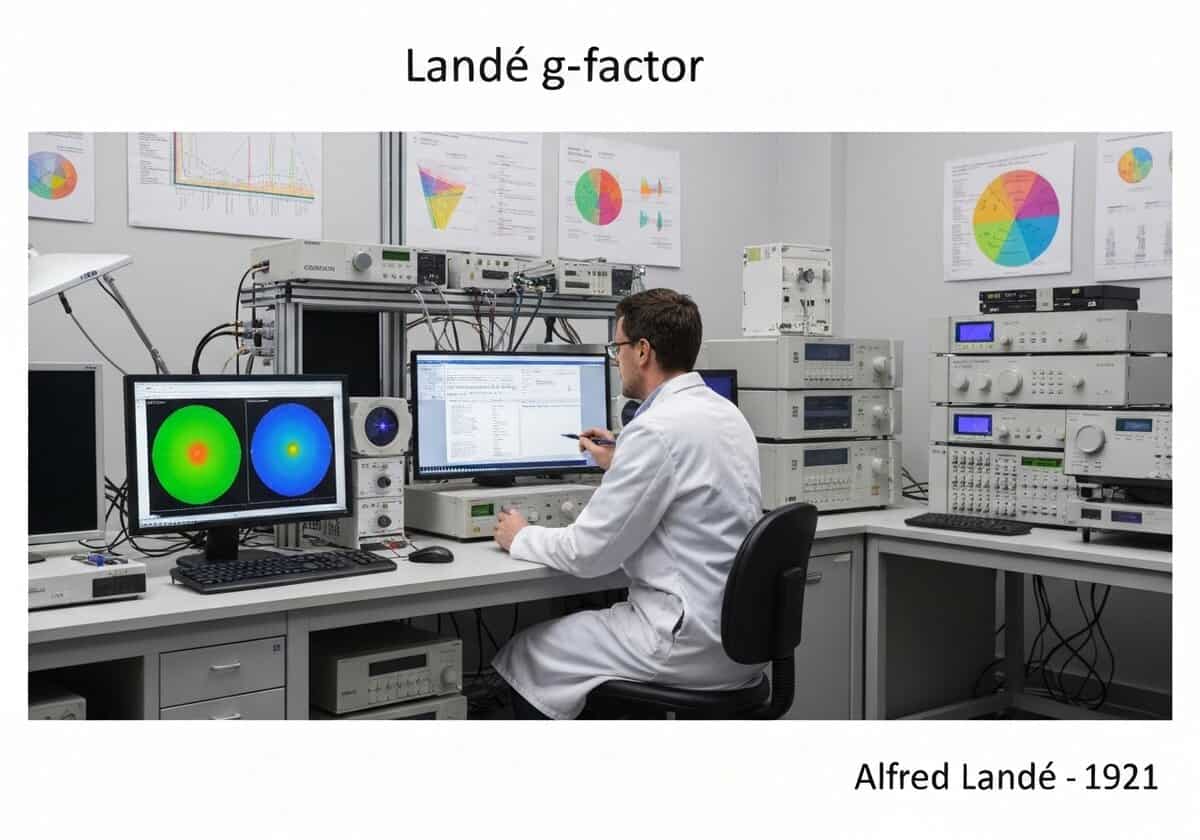
Laborszene mit einem Wissenschaftler, der ein Spektrometer für die Forschung im Bereich der Quantenmechanik analysiert.

(Abbildung dient nur zur Veranschaulichung)

Der Landé-g-Faktor ([latex]g_J[/latex]) ist eine dimensionslose Proportionalitätskonstante, die die Gesamtenergie eines Atoms in Beziehung setzt. magnetisches Moment zu seinem gesamten Drehimpuls im Schwachfeldlimit. Es ist entscheidend für die quantitative Erklärung der Anomalie. Zeeman-EffektSein Wert wird durch die Formel gegeben: [latex]g_J = 1 + frac{J(J+1) + S(S+1) – L(L+1)}{2J(J+1)}[/latex], wobei L, S und J die Quantenzahlen sind.
The Landé g-factor was introduced by Alfred Landé in 1921, even before the concept of electron spin was fully formulated, as an empirical way to fit the experimental data of the anomalous Zeeman effect. Its theoretical justification came later with the development of quantum mechanics. The formula arises from the vector model of the atom, where the orbital ([latex]\vec{L}[/latex]) and spin ([latex]\vec{S}[/latex]) angular momenta are considered to precess rapidly around their resultant total angular momentum vector ([latex]\vec{J}[/latex]) due to spin-orbit coupling. The interaction with a weak external magnetic field is much slower. Therefore, the field effectively interacts with the time-averaged magnetic moment, which is the projection of the total magnetic moment ([latex]\vec{\mu}_L + \vec{\mu}_S[/latex]) onto the direction of [latex]\vec{J}[/latex].

The g-factor essentially accounts for the different ratios of magnetic moment to angular momentum for orbital motion ([latex]g_L=1[/latex]) and spin ([latex]g_S \approx 2[/latex]). When [latex]S=0[/latex], then [latex]J=L[/latex], and the formula correctly gives [latex]g_J=1[/latex], corresponding to the normal Zeeman-Effekt. When [latex]L=0[/latex], then [latex]J=S[/latex], and the formula gives [latex]g_J=2[/latex] (using [latex]g_S=2[/latex] instead of 1 in the derivation), corresponding to pure spin systems as in electron spin resonance. For all other cases, [latex]g_J[/latex] takes on a rational value between 1 and 2, quantifying the complex interplay between spin and orbital contributions to the atom’s magnetism.

UNESCO Nomenclature: 2209
- Mechanik

Typ

Theoretisches Konzept

Störung

Grundlegendes

Verwendung

Weitverbreitete Verwendung

Vorläufer

  • das Vektormodell des Atoms
  • das Konzept der Spin-Bahn-Kopplung
  • experimentelle Daten zum anomalen Zeeman-Effekt, die eine quantitative Erklärung erforderten
  • die Quantisierung des Drehimpulses im Bohr-Sommerfeld-Modell

Anwendungen

  • Quantitative Vorhersage anomaler Zeeman-Aufspaltungsmuster in der Spektroskopie
  • electron spin resonance (esr) and Kernspinresonanz (NMR) Analyse
  • Berechnung der magnetischen Suszeptibilität und anderer magnetischer Eigenschaften von Materialien
  • Quanteninformationsverarbeitung unter Verwendung atomarer Zustände
  • Bestimmung atomarer Termsymbole aus experimentellen Daten

Patente:

NA

Potenzielle Innovationsideen

  • Materialien mit konstruierten Landé-g-Faktoren zur Herstellung hochempfindlicher Magnetfeldsensoren
  • Spintronische Transistoren, deren Schaltverhalten durch die Abstimmung des g-Faktors mit einem elektrischen Feld gesteuert wird
  • eine neue Klasse von Quantenbits (Qubits) mit g-Faktoren, die so konstruiert sind, dass sie unempfindlich gegenüber Magnetfeldrauschen sind
  • Arzneimittel, die an Metallionen in Enzymen binden und deren g-Faktor verändern und so einen neuen therapeutischen Mechanismus bieten
  • eine Methode zur Messung von Gravitationsfeldern durch die Erkennung winziger Änderungen des Landé-g-Faktors von Atomen
  • synthetic molecules with precisely tailored g-factors for use as calibration standards in esr Spektroskopie
  • eine Quantensimulationsplattform, die Atome mit einstellbaren g-Faktoren verwendet, um komplexe magnetische Materialien zu modellieren
  • eine Diagnosetechnik in der Materialwissenschaft, die den lokalen g-Faktor über eine Oberfläche abbildet, um Defekte zu erkennen
  • an advanced Verschlüsselung method where information is encoded in the precise g-factor of custom-designed quantum dots
  • ein vorgeschlagener Test der fundamentalen Physik durch die Suche nach Zeitvariationen des Landé-g-Faktors
Related to: Landé g-factor, g-factor, anomalous Zeeman effect, angular momentum, quantum numbers, spin-orbit coupling, magnetisches Moment, spectroscopy, atomic physics, vector model.

Historischer Kontext

Landé G-Faktor

1919-05-29
1920
1920
1921
1924
1924
1925
1918
1920
1920
1921
1922
1924
1925
1926

(wenn das Datum unbekannt oder nicht relevant ist, z. B. „Strömungsmechanik“, wird eine gerundete Schätzung seines bemerkenswerten Auftretens bereitgestellt)

10. Jahr Jubiläum

Bilder in voller Größe und Downloads sind nur für registrierte Mitglieder 100% kostenlos verfügbar.

> Login <