Product Design, Manufacturing & Innovation Resources
Lar » Fator g de Landé

Fator g de Landé

1921
  • Alfred Landé
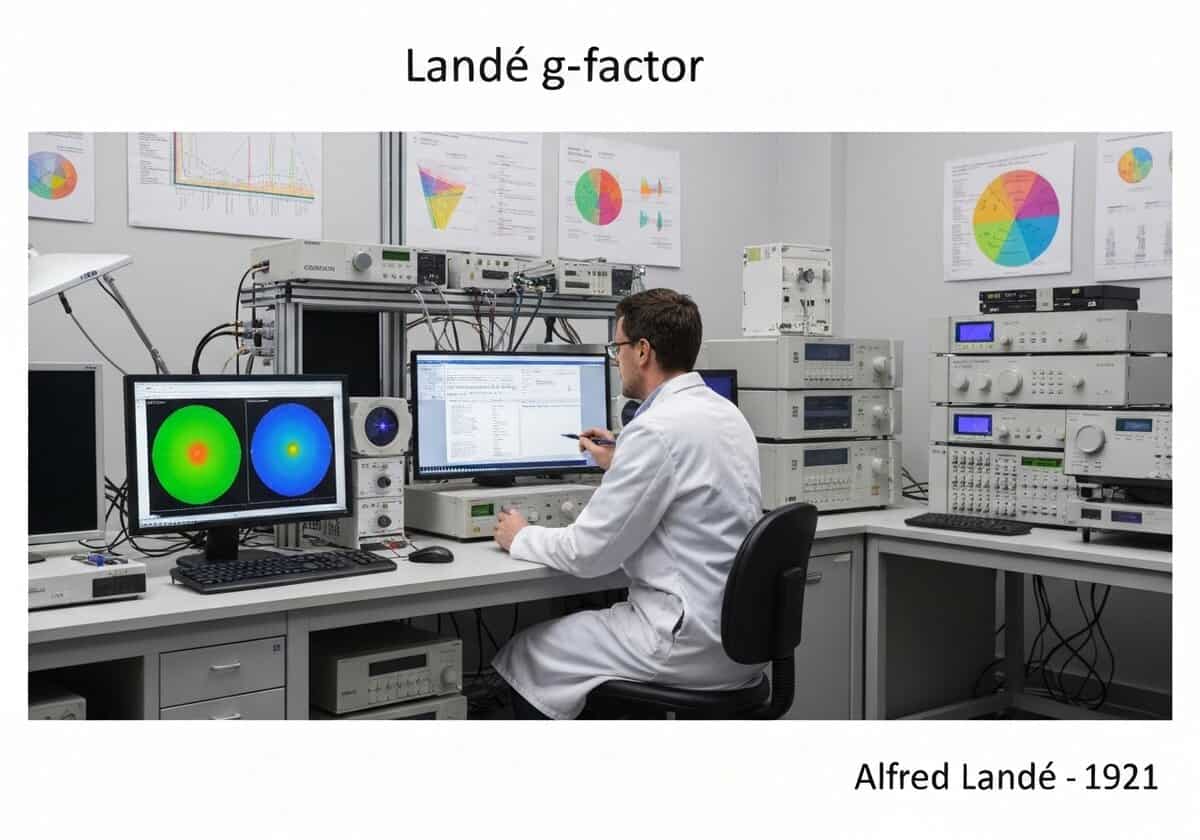
Laboratory scene with scientist analyzing spectrometer for quantum mechanics research.

(Imagem gerada apenas para fins ilustrativos)

O fator g de Landé ([latex]g_J[/latex]) é uma constante de proporcionalidade adimensional que relaciona o total de um átomo momento magnético ao seu momento angular total no limite de campo fraco. É crucial para explicar quantitativamente a anomalia. Efeito Zeeman. Seu valor é dado pela fórmula: [latex]g_J = 1 + frac{J(J+1) + S(S+1) – L(L+1)}{2J(J+1)}[/latex], onde L, S e J são os números quânticos.
The Landé g-factor was introduced by Alfred Landé in 1921, even before the concept of electron spin was fully formulated, as an empirical way to fit the experimental data of the anomalous Zeeman effect. Its theoretical justification came later with the development of quantum mechanics. The formula arises from the vector model of the atom, where the orbital ([latex]\vec{L}[/latex]) and spin ([latex]\vec{S}[/latex]) angular momenta are considered to precess rapidly around their resultant total angular momentum vector ([latex]\vec{J}[/latex]) due to spin-orbit coupling. The interaction with a weak external magnetic field is much slower. Therefore, the field effectively interacts with the time-averaged magnetic moment, which is the projection of the total magnetic moment ([latex]\vec{\mu}_L + \vec{\mu}_S[/latex]) onto the direction of [latex]\vec{J}[/latex].

The g-factor essentially accounts for the different ratios of magnetic moment to angular momentum for orbital motion ([latex]g_L=1[/latex]) and spin ([latex]g_S \approx 2[/latex]). When [latex]S=0[/latex], then [latex]J=L[/latex], and the formula correctly gives [latex]g_J=1[/latex], corresponding to the normal Efeito Zeeman. When [latex]L=0[/latex], then [latex]J=S[/latex], and the formula gives [latex]g_J=2[/latex] (using [latex]g_S=2[/latex] instead of 1 in the derivation), corresponding to pure spin systems as in electron spin resonance. For all other cases, [latex]g_J[/latex] takes on a rational value between 1 and 2, quantifying the complex interplay between spin and orbital contributions to the atom’s magnetism.

UNESCO Nomenclature: 2209
Mecânica

Tipo

Conceito teórico

Interrupção

Fundamentais

Uso

Uso generalizado

Precursores

  • o modelo vetorial do átomo
  • o conceito de acoplamento spin-órbita
  • dados experimentais do efeito Zeeman anômalo que exigiam uma explicação quantitativa
  • a quantização do momento angular no modelo de Bohr-Sommerfeld

Aplicações

  • quantitative prediction of anomalous zeeman splitting patterns in spectroscopy
  • electron spin resonance (esr) and ressonância magnética nuclear (RMN) análise
  • cálculo da susceptibilidade magnética e outras propriedades magnéticas de materiais
  • Processamento de informação quântica usando estados atômicos
  • Determinação dos símbolos dos termos atômicos a partir de dados experimentais

Patentes:

NA

Ideias de Inovação Potencial

  • materials with engineered landé g-factors for creating highly sensitive magnetic field sensors
  • spintronic transistors whose switching behavior is controlled by tuning the g-factor with an electric field
  • a new class of quantum bits (qubits) with g-factors engineered to be insensitive to magnetic field noise
  • pharmaceuticals designed to bind to metal ions in enzymes and alter their g-factor, providing a new therapeutic mechanism
  • a method for measuring gravitational fields by detecting minute changes in the landé g-factor of atoms
  • synthetic molecules with precisely tailored g-factors for use as calibration standards in esr espectroscopia
  • a quantum simulation platform that uses atoms with tunable g-factors to model complex magnetic materials
  • a diagnostic technique in materials science that maps the local g-factor across a surface to detect defects
  • an advanced encryption method where information is encoded in the precise g-factor of custom-designed quantum dots
  • a proposed test of fundamental physics by searching for time-variations of the landé g-factor
Related to: Landé g-factor, g-factor, anomalous Zeeman effect, angular momentum, quantum numbers, spin-orbit coupling, momento magnético, spectroscopy, atomic physics, vector model.

Contexto histórico

Fator g de Landé

1919-05-29
1920
1920
1921
1924
1924
1925
1918
1920
1920
1921
1922
1924
1925
1926

(Caso a data seja desconhecida ou irrelevante, por exemplo, "mecânica dos fluidos", é fornecida uma estimativa aproximada de seu surgimento notável)

10º ano aniversário

Imagens em tamanho real e downloads estão disponíveis apenas, 100% gratuitos, para membros registrados.