Product Design, Manufacturing & Innovation Resources
家 » ランデのg因子

ランデのg因子

1921
  • Alfred Landé
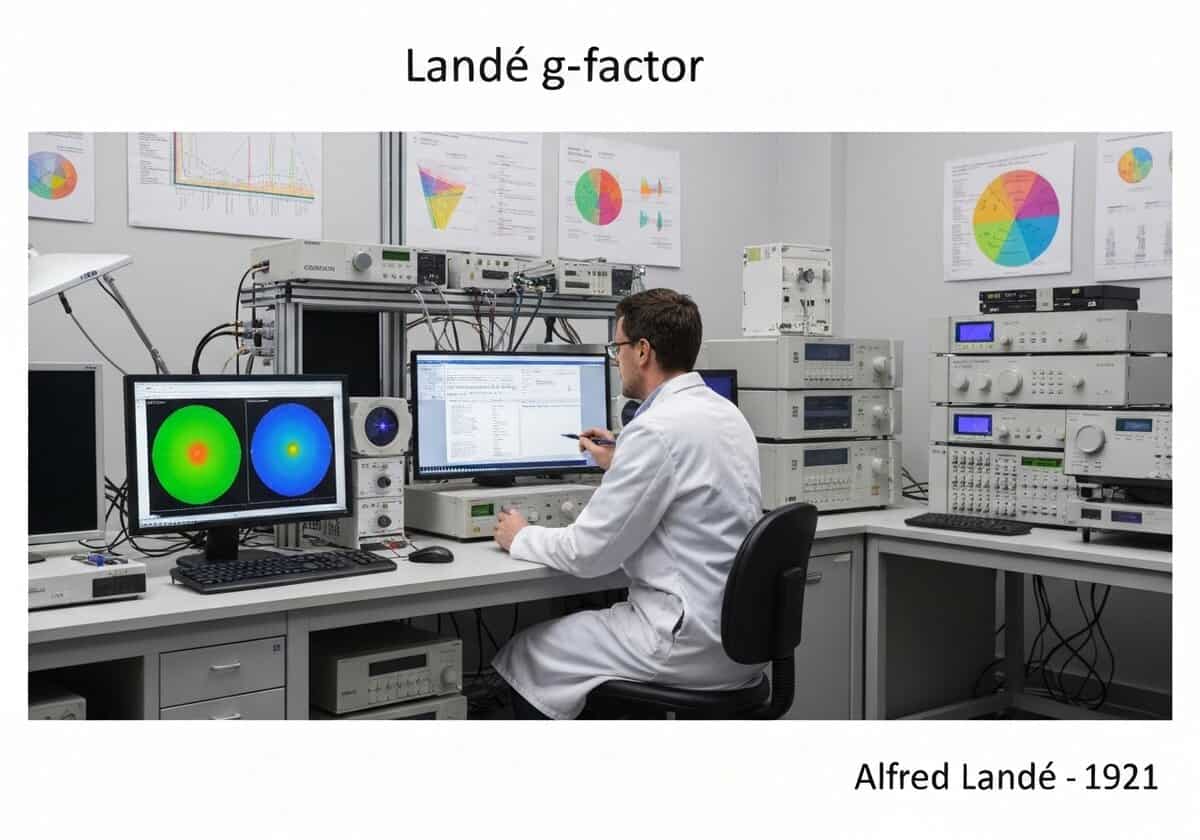
Laboratory scene with scientist analyzing spectrometer for quantum mechanics research.

(画像はイメージです)

ランデのg因子([latex]g_J[/latex])は、原子の全エネルギーと原子のエネルギーを関連付ける無次元の比例定数である。 磁気モーメント 弱場極限における全角運動量に対して。これは異常を定量的に説明するために重要である。 ゼーマン効果その値は次の式で与えられます。[latex]g_J = 1 + frac{J(J+1) + S(S+1) – L(L+1)}{2J(J+1)}[/latex]、ここで、L、S、Jは量子数です。
The Landé g-factor was introduced by Alfred Landé in 1921, even before the concept of electron spin was fully formulated, as an empirical way to fit the experimental data of the anomalous ジーマン effect. Its theoretical justification came later with the development of quantum mechanics. The formula arises from the vector model of the atom, where the orbital ([latex]\vec{L}[/latex]) and spin ([latex]\vec{S}[/latex]) angular momenta are considered to precess rapidly around their resultant total angular momentum vector ([latex]\vec{J}[/latex]) due to spin-orbit coupling. The interaction with a weak external magnetic field is much slower. Therefore, the field effectively interacts with the time-averaged magnetic moment, which is the projection of the total magnetic moment ([latex]\vec{\mu}_L + \vec{\mu}_S[/latex]) onto the direction of [latex]\vec{J}[/latex].

The g-factor essentially accounts for the different ratios of magnetic moment to angular momentum for orbital motion ([latex]g_L=1[/latex]) and spin ([latex]g_S \approx 2[/latex]). When [latex]S=0[/latex], then [latex]J=L[/latex], and the formula correctly gives [latex]g_J=1[/latex], corresponding to the normal ゼーマン効果. When [latex]L=0[/latex], then [latex]J=S[/latex], and the formula gives [latex]g_J=2[/latex] (using [latex]g_S=2[/latex] instead of 1 in the derivation), corresponding to pure spin systems as in electron spin resonance. For all other cases, [latex]g_J[/latex] takes on a rational value between 1 and 2, quantifying the complex interplay between spin and orbital contributions to the atom’s magnetism.

UNESCO Nomenclature: 2209
機械工学

タイプ

理論的概念

混乱

基礎

使用法

広く普及している

前駆物質

  • 原子のベクトルモデル
  • スピン軌道結合の概念
  • 定量的な説明を必要とする異常ゼーマン効果の実験データ
  • ボーア・ゾンマーフェルトモデルにおける角運動量の量子化

アプリケーション

  • quantitative prediction of anomalous zeeman splitting patterns in spectroscopy
  • electron spin resonance (esr) and nuclear magnetic resonance (NMR) 分析
  • 材料の磁化率およびその他の磁気特性の計算
  • 原子状態を用いた量子情報処理
  • 実験データからの原子項記号の決定

特許:

NA

潜在的なイノベーションのアイデア

  • materials with engineered landé g-factors for creating highly sensitive magnetic field sensors
  • spintronic transistors whose switching behavior is controlled by tuning the g-factor with an electric field
  • a new class of quantum bits (qubits) with g-factors engineered to be insensitive to magnetic field noise
  • pharmaceuticals designed to bind to metal ions in enzymes and alter their g-factor, providing a new therapeutic mechanism
  • a method for measuring gravitational fields by detecting minute changes in the landé g-factor of atoms
  • synthetic molecules with precisely tailored g-factors for use as calibration standards in esr 分光法
  • a quantum simulation platform that uses atoms with tunable g-factors to model complex magnetic materials
  • a diagnostic technique in materials science that maps the local g-factor across a surface to detect defects
  • an advanced 暗号化 method where information is encoded in the precise g-factor of custom-designed quantum dots
  • a proposed test of fundamental physics by searching for time-variations of the landé g-factor
Related to: Landé g-factor, g-factor, anomalous Zeeman effect, angular momentum, quantum numbers, spin-orbit coupling, 磁気モーメント, spectroscopy, atomic physics, vector model.

歴史的背景

ランデのg因子

1919-05-29
1920
1920
1921
1924
1924
1925
1918
1920
1920
1921
1922
1924
1925
1926

(日付が不明または関連性がない場合、例えば「流体力学」などでは、その注目すべき出現時期の概算値が提示されます。)

10年目 周年

フルサイズの画像とダウンロードは、登録会員のみが100%無料で利用できます。