Product Design, Manufacturing & Innovation Resources
Heim » Interne vs. externe Einrichtung in SMED

Interne vs. externe Einrichtung in SMED

1960
  • Shigeo Shingo
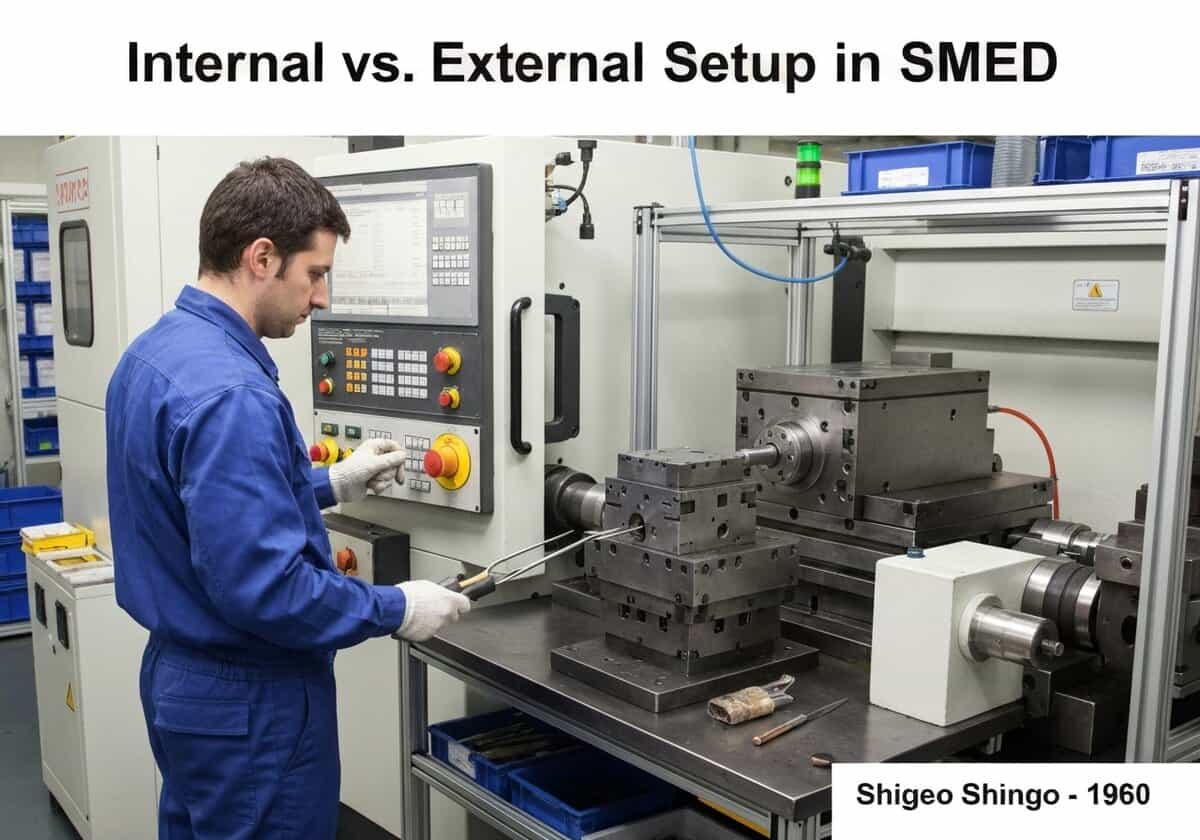
Externe Rüstvorgänge im Rahmen der SMED-Methodik im Bereich des Wirtschaftsingenieurwesens.

(Abbildung dient nur zur Veranschaulichung)

Der SCHMIED Methodik fundamentally distinguishes between internal and external setup operations. Internal setup activities can only be performed when a machine is stopped, such as the usual example of mounting a new die. External setup activities can be completed while the machine is still running, like pre-heating tools or fetching the next die. The primary goal is to convert internal setup time to external.


The distinction between internal and external setup is the cornerstone of the SCHMIED system. Before its formalization, changeover processes were often treated as a monolithic block of time where the machine was unproductive. Shigeo Shingo’s critical insight was to analyze every single action taken during a changeover and categorize it. Internal setup (Internal Exchange of Die or IED) includes any task that absolutely requires the machine to be shut down. Examples include unbolting the old tool, cleaning the machine bed, and securing the new tool. External setup (External Exchange of Die or OED) encompasses all preparatory and post-processing tasks that can be performed while the machine is still producing the last batch. This includes transporting the next die to the machine, pre-heating molds, preparing clamps and bolts, and moving the finished parts away. The initial stages of a SMED implementation focus heavily on identifying and separating these activities. A simple checklist is often the first tool used. By meticulously preparing all necessary tools, parts, and conditions beforehand (externalizing the setup), the time the machine is actually stopped (internal setup) can be dramatically reduced. This conceptual separation is what enables the subsequent, more technical steps of converting and streamlining.

UNESCO Nomenclature: 3307
- Industrielle Technik

Typ

Abstraktes System

Störung

Wesentliche

Verwendung

Weitverbreitete Verwendung

Vorläufer

  • time and motion studies by Frederick Winslow Taylor
  • Bewegungsanalyse von Frank und Lillian Gilbreth (Therbligs)
  • Henry Fords Fließbandprinzipien
  • Toyota-Produktionssystem (TPS) Entwicklung

Anwendungen

Patente:

NA

Potenzielle Innovationsideen

  • automated guided vehicles (agvs) for die transport
  • smart tool cabinets that prepare toolkits based on production schedules
  • augmented reality guides for complex changeover procedures
  • iot sensors to monitor tool pre-heating status remotely
  • modular machine design with quick-connect fixtures
  • ai-powered video analysis to automatically identify and classify setup activities
  • 3d printing of custom jigs and fixtures for specific changeovers
  • digitaler Zwilling simulations to practice and optimize changeover sequences offline
  • robotic process automation for standardized setup tasks
  • predictive maintenance alerts for changeover tooling
Related to: SMED, internal setup, external setup, changeover, schlanke Fertigung, Shigeo Shingo, IED, OED, process improvement, industrial engineering.

Historischer Kontext

Interne vs. externe Einrichtung in SMED

1960
1960
1960
1960
1962-10-09
1964
1970
1960
1960
1960
1960
1962
1963
1965-12-21
1970

(wenn das Datum unbekannt oder nicht relevant ist, z. B. „Strömungsmechanik“, wird eine gerundete Schätzung seines bemerkenswerten Auftretens bereitgestellt)

10. Jahr Jubiläum

Bilder in voller Größe und Downloads sind nur für registrierte Mitglieder 100% kostenlos verfügbar.

> Login <