Product Design, Manufacturing & Innovation Resources
Heim » Hochtemperatur-Supraleitung

Hochtemperatur-Supraleitung

1986
  • Johannes Georg Bednorz
  • Karl Alexander Müller
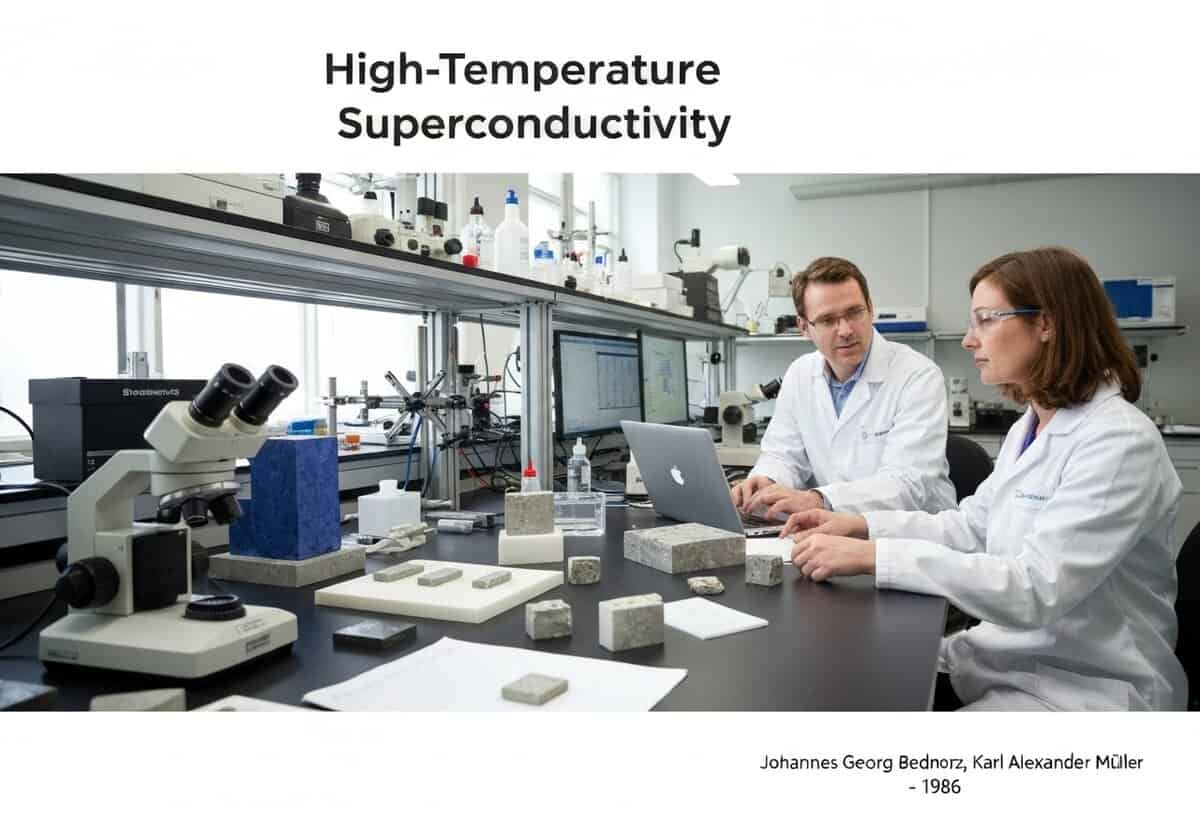
Laborszene mit Forschern, die hochtemperatursupraleitende keramische Materialien untersuchen.

(Abbildung dient nur zur Veranschaulichung)

In 1986, Georg Bednorz and K. Alex Müller discovered Supraleitung in a ceramic material, a lanthanum-based cuprate perovskite, at a kritische Temperatur of ~35 K. This was significantly higher than the ~23 K record for conventional superconductors at the time and shattered the belief that superconductivity was restricted to much lower temperatures, opening the field of high-temperature superconductivity.
The discovery by Bednorz and Müller at the IBM Zurich Research Laboratory was a major breakthrough. For decades, the progress in raising the critical temperature ([latex]T_c[/latex]) had been slow and incremental, with most physicists believing that the electron-phonon mechanism described by BCS theory had a theoretical upper limit of around 30-40 K. Bednorz and Müller decided to investigate metallic oxides, a class of materials generally considered unsuitable for superconductivity. Their discovery in lanthanum barium copper oxide (LBCO) with a [latex]T_c[/latex] of 35 K was quickly confirmed and followed by a rapid succession of discoveries of related materials with even higher critical temperatures. In 1987, Paul Chu’s group discovered yttrium barium copper oxide (YBCO) with a [latex]T_c[/latex] of 92 K. This was a particularly significant milestone because 92 K is above the boiling point of liquid nitrogen (77 K), a coolant that is far cheaper and easier to handle than the liquid helium required for all previous superconductors. This made many applications economically and practically feasible for the first time. These materials, known as cuprates, are Type II superconductors with a layered, perovskite-like crystal structure. Despite intense research for over three decades, a complete, universally accepted microscopic theory for high-temperature superconductivity in cuprates remains elusive, though it is widely believed to involve a different pairing mechanism than the conventional phonon-mediated attraction of BCS theory.

UNESCO Nomenclature: 2211
- Festkörperphysik

Typ

Physikalische Eigenschaft

Störung

Inkremental

Verwendung

Weitverbreitete Verwendung

Vorläufer

  • BCS-Theorie (Bereitstellung einer Vergleichsbasis)
  • Forschung zu Metalloxiden und Keramiken
  • fortgeschrittene Materialsynthesetechniken
  • Entwicklung zuverlässiger Tieftemperatur-Messsysteme

Anwendungen

  • supraleitende Stromübertragungskabel
  • Hochfeld-Elektromagnete für Forschung und MRT
  • Fehlerstrombegrenzer für Stromnetze
  • Mobilfunkfilter
  • Hochleistungs-Elektromotoren und Generatoren

Patente:

NA

Potenzielle Innovationsideen

  • kompakte Fusionsreaktoren (Tokamaks) mit Hochfeldmagneten
  • verlustfreie Rechenzentren mit supraleitenden Verbindungen
  • high-speed maglev transport systems operating with flüssiger Stickstoff cooling
  • effiziente und leichte elektrische Flugzeugantriebssysteme
  • Schwungräder für große Energiespeicher mit supraleitenden Lagern
  • Geräuschlose Schiffsantriebe (magnetohydrodynamischer Antrieb)
  • Teilchenbeschleuniger der nächsten Generation mit Strahlen höherer Energie
  • drahtlose Energieübertragung über große Entfernungen
  • Weltraumaufzüge mit supraleitenden Bändern
  • ultraempfindliche Detektoren für die Suche nach dunkler Materie
Related to: high-temperature Supraleitung, cuprates, YBCO, critical temperature, liquid nitrogen, Bednorz and Müller, unconventional superconductivity, condensed matter physics, perovskite, ceramic superconductor.

Historischer Kontext

Hochtemperatur-Supraleitung

1980
1984
1986
1986
1991
1994
1997
1980
1984
1985
1986
1990
1993-01-01
1995
2000

(wenn das Datum unbekannt oder nicht relevant ist, z. B. „Strömungsmechanik“, wird eine gerundete Schätzung seines bemerkenswerten Auftretens bereitgestellt)

10. Jahr Jubiläum

Bilder in voller Größe und Downloads sind nur für registrierte Mitglieder 100% kostenlos verfügbar.

> Login <