Product Design, Manufacturing & Innovation Resources
Heim » Bayes'sche Inferenz

Bayes'sche Inferenz

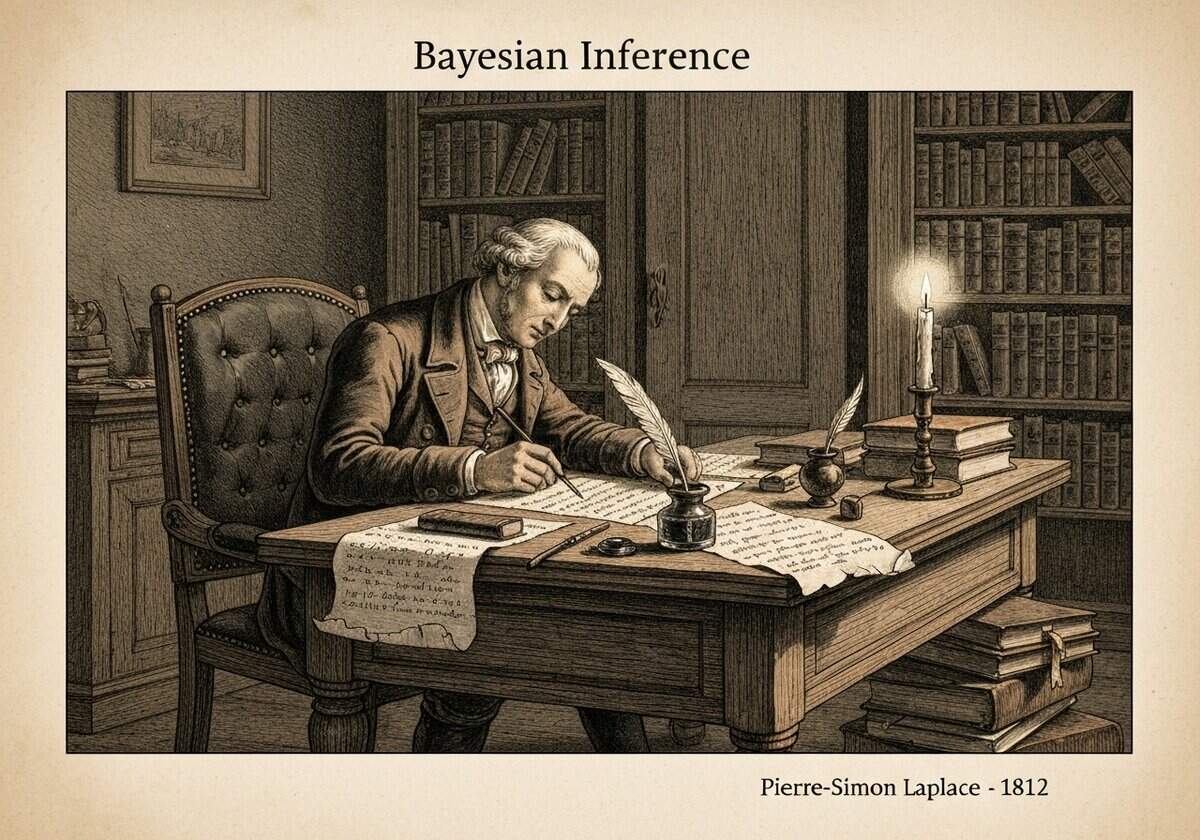
1812
  • Pierre-Simon Laplace
Ein Gelehrter aus dem 19. Jahrhundert berechnet an einem Holzschreibtisch mit Pergament die Bayes'sche Inferenz.

(Abbildung dient nur zur Veranschaulichung)

Bayesian inference is a statistical method where Bayes’ theorem is used to update the probability for a hypothesis as more evidence or information becomes available. It is a central tenet of Bayesian statistics. The core idea is expressed as: posterior probability is proportional to the product of the prior probability and the likelihood, [latex]p(\theta|D) \propto p(D|\theta)p(\theta)[/latex], where [latex]\theta[/latex] is the parameter and D is the data.

Bayesian inference treats model parameters as random variables about which we can have beliefs. The process begins with a ‘prior’ probability distribution, [latex]p(\theta)[/latex], which encapsulates our knowledge or uncertainty about a parameter [latex]\theta[/latex] before observing any data. When data [latex]D[/latex] is collected, its probability of occurring given the parameter, known as the ‘likelihood’ [latex]p(D|\theta)[/latex], is calculated. Bayes’ theorem then combines the prior and the likelihood to produce the ‘posterior’ distribution, [latex]p(\theta|D)[/latex]. This posterior distribution represents our updated knowledge about the parameter after accounting for the data.

This approach fundamentally differs from frequentist inference, which assumes parameters are fixed, unknown constants and calculates the probability of data given these parameters. Bayesian inference, in contrast, provides a probability distribution for the parameters themselves, which allows for direct probabilistic statements about them, such as ‘there is a 95% probability that the parameter lies in this range.’ This interpretability is a key advantage. The main historical challenge was computational; calculating the posterior often requires solving complex integrals, a problem largely overcome in the late 20th century with the advent of powerful computers and Algorithmen wie MCMC.

UNESCO Nomenclature: 1208
- Statistik

Typ

Abstraktes System

Störung

Grundlegendes

Verwendung

Weitverbreitete Verwendung

Vorläufer

  • Bayes’ Theorem
  • Wahrscheinlichkeitstheorie
  • Entwicklung der Likelihood-Theorie durch R. A. Fisher

Anwendungen

  • Parameterschätzung in wissenschaftlichen Modellen
  • A/B-Testing in der Webentwicklung und im Marketing
  • Rekonstruktion phylogenetischer Bäume in der Biologie
  • Unsicherheitsquantifizierung in komplexen Systemen
  • Bildrekonstruktion und Signalverarbeitung
  • Künstliche Intelligenz und Expertensysteme

Patente:

NA

Potenzielle Innovationsideen

  • Automatisierte Wirkstoffforschung, die Modelle der molekularen Wirksamkeit mit jedem neuen experimentellen Ergebnis aktualisiert
  • Self-improving robotics that update Motor control parameters based on trial-and-error experience
  • Personalized education software that updates its model of a student’s knowledge to tailor curriculum in real-time
  • Lieferkettenlogistik, die Nachfrageprognosen kontinuierlich auf Basis von Verkaufsdaten und externen Faktoren aktualisiert
  • Kognitive Modelle in der Psychologie, die mit Daten aus Verhaltensexperimenten aktualisiert werden
  • Real-time fraud detection systems that update a user’s risk profile with every transaction
  • Intelligente Landwirtschaftssysteme, die Ertragsmodelle auf Basis von Bodensensor- und Wetterdaten aktualisieren
  • KI-Kunstgeneratoren, die ihren Stil anhand von Nutzerfeedback und Bewertungen verfeinern.
  • Weltraumschrott-Überwachungssysteme, die Umlaufbahnvorhersagen mit neuen Radarbeobachtungen aktualisieren
  • Epidemiologische Modelle, die Prognosen zur Krankheitsausbreitung während eines Ausbruchs in Echtzeit aktualisieren
Verwandt mit: Bayes'sche Inferenz, Posterior-Verteilung, Prior-Verteilung, Likelihood-Funktion, statistische Modellierung, Parameterschätzung, Ungewissheit, Evidenz, Glaubensaktualisierung, MCMC.

Historischer Kontext

Bayes'sche Inferenz

1758
1777
1799
1812
1822
1827
1829
1750
1763-12-23
1780
1805
1822
1822
1828
1848

(wenn das Datum unbekannt oder nicht relevant ist, z. B. „Strömungsmechanik“, wird eine gerundete Schätzung seines bemerkenswerten Auftretens bereitgestellt)

10. Jahr Jubiläum

Bilder in voller Größe und Downloads sind ausschließlich für registrierte Mitglieder kostenlos verfügbar.

> Login <