Product Design, Manufacturing & Innovation Resources
家 » ベイズ推論

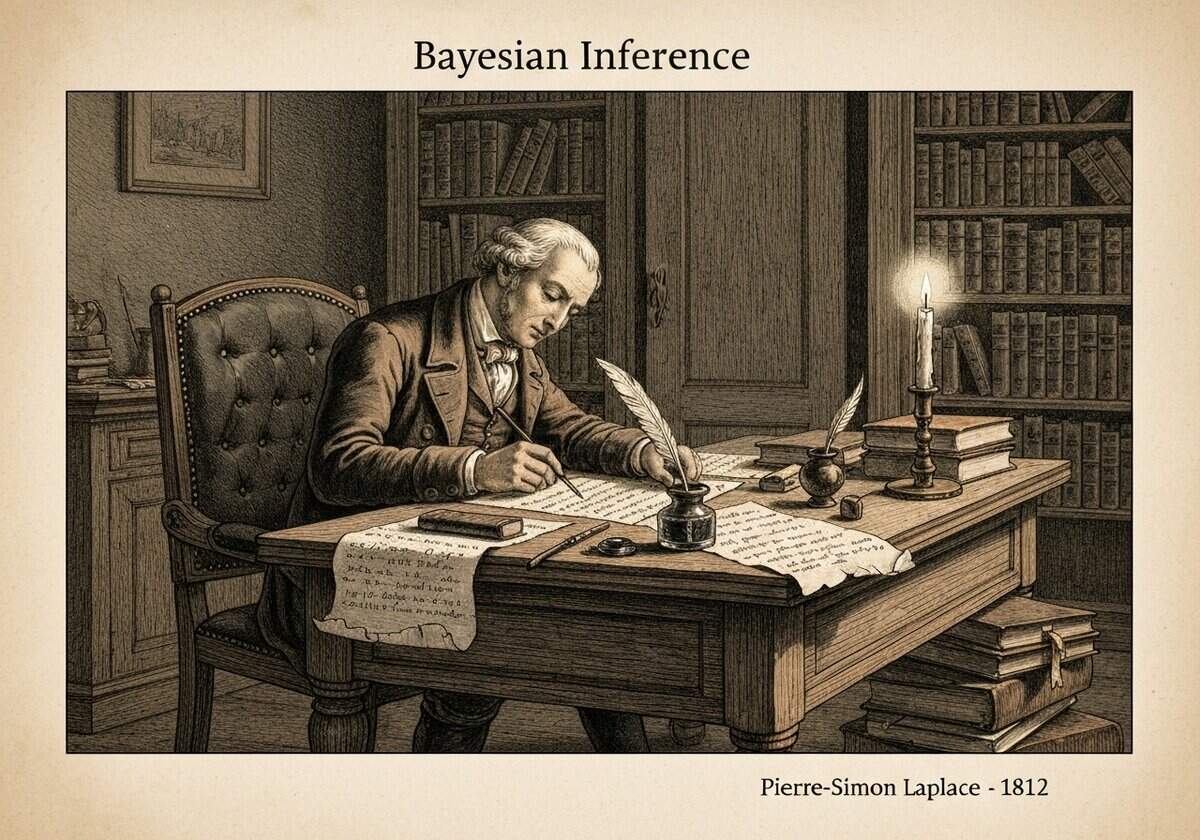
ベイズ推論

1812
  • Pierre-Simon Laplace
羊皮紙と木の机でベイズ推論を計算する19世紀の学者。.

(画像はイメージです)

Bayesian inference is a statistical method where Bayes’ theorem is used to update the probability for a hypothesis as more evidence or information becomes available. It is a central tenet of Bayesian statistics. The core idea is expressed as: posterior probability is proportional to the product of the prior probability and the likelihood, [latex]p(\theta|D) \propto p(D|\theta)p(\theta)[/latex], where [latex]\theta[/latex] is the parameter and D is the data.

Bayesian inference treats model parameters as random variables about which we can have beliefs. The process begins with a ‘prior’ probability distribution, [latex]p(\theta)[/latex], which encapsulates our knowledge or uncertainty about a parameter [latex]\theta[/latex] before observing any data. When data [latex]D[/latex] is collected, its probability of occurring given the parameter, known as the ‘likelihood’ [latex]p(D|\theta)[/latex], is calculated. Bayes’ theorem then combines the prior and the likelihood to produce the ‘posterior’ distribution, [latex]p(\theta|D)[/latex]. This posterior distribution represents our updated knowledge about the parameter after accounting for the data.

This approach fundamentally differs from frequentist inference, which assumes parameters are fixed, unknown constants and calculates the probability of data given these parameters. Bayesian inference, in contrast, provides a probability distribution for the parameters themselves, which allows for direct probabilistic statements about them, such as ‘there is a 95% probability that the parameter lies in this range.’ This interpretability is a key advantage. The main historical challenge was computational; calculating the posterior often requires solving complex integrals, a problem largely overcome in the late 20th century with the advent of powerful computers and アルゴリズム like MCMC.

UNESCO Nomenclature: 1208
統計

タイプ

抽象システム

混乱

基礎

使用法

広く普及している

前駆物質

  • ベイズの定理
  • 確率論
  • R.A.フィッシャーによる尤度理論の発展

アプリケーション

  • 科学モデルにおけるパラメータ推定
  • A/B testing in web development and marketing
  • 生物学における系統樹の再構築
  • 複雑系における不確実性の定量化
  • 画像再構成と 信号処理
  • 人工知能とエキスパートシステム

特許:

NA

潜在的なイノベーションのアイデア

  • Automated drug discovery that updates models of molecular effectiveness with each new experimental result
  • Self-improving robotics that update モーター control parameters based on trial-and-error experience
  • Personalized education software that updates its model of a student’s knowledge to tailor curriculum in real-time
  • Supply chain logistics that continuously update demand forecasts based on sales data and external factors
  • Cognitive models in psychology that are updated with behavioral experiment data
  • Real-time fraud detection systems that update a user’s risk profile with every transaction
  • Smart agriculture systems that update crop yield models based on soil sensor and weather data
  • AI art generators that refine their style based on user feedback and ratings
  • Space debris tracking systems that update orbital predictions with new radar observations
  • Epidemiological models that update disease spread forecasts in real-time during an outbreak
関連キーワード:ベイズ推論、事後分布、事前分布、尤度関数、統計モデリング、パラメータ推定、不確実性、証拠、信念更新、MCMC。

歴史的背景

ベイズ推論

1758
1777
1799
1812
1822
1827
1829
1750
1763-12-23
1780
1805
1822
1822
1828
1848

(日付が不明または関連性がない場合、例えば「流体力学」などでは、その注目すべき出現時期の概算値が提示されます。)

10年目 周年

フルサイズの画像とダウンロードは、登録会員のみが100%無料で利用できます。