Product Design, Manufacturing & Innovation Resources
بيت » مخطط شوارت للتحكم

مخطط شوارت للتحكم

1924
  • Walter A. Shewhart
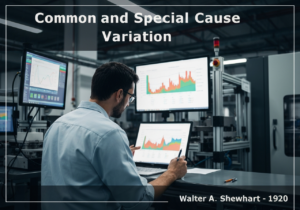
مخطط التحكم Shewhart لمراقبة العمليات في مراقبة الجودة.

(صورة تم إنشاؤها للتوضيح فقط)

أداة رسومية تستخدم في SPC لمراقبة متغير عملية ما بمرور الوقت، يتم رسم نقاط البيانات بين خط مركزي (CL) يمثل متوسط ​​العملية، وحدود تحكم عليا (UCL) وسفلى (LCL). تُحدد هذه الحدود عادةً عند ثلاثة انحرافات معيارية عن المتوسط ​​(μ ± 3σ)، مما يُحدد نطاق التباين المتوقع الناتج عن الأسباب المشتركة.

The control chart is the primary instrument of Statistical Process Control. Invented by Walter A. Shewhart, it serves as a visual method to distinguish between common and special cause variation in a process. A typical chart has a time-based x-axis and a measurement-based y-axis. Three horizontal lines are crucial: the Center Line (CL), which is the statistical average of the process data; the Upper Control Limit (UCL); and the Lower Control Limit (LCL). These control limits are not arbitrary goals or specification limits set by customers. Instead, they are calculated directly from the process data itself, representing the “voice of the process.”

The standard calculation for these limits is based on the process mean ([latex]\mu[/latex]) and standard deviation ([latex]\sigma[/latex]), with the UCL at [latex]\mu + 3\sigma[/latex] and the LCL at [latex]\mu – 3\sigma[/latex]. The use of three standard deviations is a statistical and economic choice; it balances the risk of failing to detect a process shift (a Type II error) with the risk of a false alarm (a Type I error). When data points fall within these limits and exhibit a random pattern, the process is considered “in statistical control.” However, if a point falls outside the limits, or if the points within the limits show a non-random pattern (as defined by rules like the Western Electric Rules), it signals the presence of a special cause of variation that requires investigation.

UNESCO Nomenclature: 1209
- الإحصائيات

يكتب

البرنامج/الخوارزمية

الاضطراب

كبير

الاستخدام

الاستخدام الواسع النطاق

السلائف

  • run charts (time series plots)
  • concept of standard deviation (karl pearson)
  • theory of statistical sampling
  • distinction between common and special cause variation (walter a. shewhart)

التطبيقات

  • manufacturing process monitoring (e.g., part dimensions, weights)
  • service industry performance tracking (e.g., call wait times, error rates)
  • healthcare patient monitoring (e.g., blood pressure, infection rates)
  • software performance monitoring (e.g., server response time, bug reports)
  • financial auditing (e.g., expense report variations)

براءات الاختراع:

NA

أفكار ابتكارات محتملة

بسبب عمليات جمع البيانات من خلال برامج الروبوت، والتي تتجاوز حاليًا 40 ألفًا يوميًا، فإن هذا المحتوى مخصص لأعضاء المجتمع فقط.
> تسجيل الدخول < أو > سجل < (مجاني 100٪) للوصول إلى هذا، وكذلك جميع المحتويات والأدوات الأخرى المقيدة.

يتعلق بـ: مخطط التحكم، مخطط شوارت، الحد الأعلى للتحكم، الحد الأدنى للتحكم، الخط المركزي، حدود ثلاثة سيجما، مراقبة العمليات، التحكم الإحصائي في العمليات، مراقبة الجودة، التحليل الإحصائي.

السياق التاريخي

مخطط شوارت للتحكم

1900
1903
1914
1924
1925
1930
1931
1899
1900
1911
1922
1925
1928
1930
1936

(إذا كان التاريخ غير معروف أو غير ذي صلة، على سبيل المثال "ميكانيكا الموائع"، يتم توفير تقدير تقريبي لظهوره الملحوظ)

الاختراع والابتكار والمبادئ التقنية ذات الصلة

الصور بالحجم الكامل والتنزيلات متاحة فقط 100% مجاناً للأعضاء المسجلين.