平衡蒸汽 压力 在潮湿空气中,液面上的水蒸气压 (p*_{H_2O,a}) 略大于纯水面上的平衡水蒸气压 (p*_{H_2O})。这种差异可以用水蒸气增强因子 f_w 来量化,该因子取决于温度和潮湿空气的压力。其关系式为 p*_{H_2O,a} = f_w(T, p_{ms}) cdot p*_{H_2O}。

(图片仅供参考)
平衡蒸汽 压力 在潮湿空气中,液面上的水蒸气压 (p*_{H_2O,a}) 略大于纯水面上的平衡水蒸气压 (p*_{H_2O})。这种差异可以用水蒸气增强因子 f_w 来量化,该因子取决于温度和潮湿空气的压力。其关系式为 p*_{H_2O,a} = f_w(T, p_{ms}) cdot p*_{H_2O}。
增强因子用于解释湿空气的非理想行为。在纯水蒸气系统中,分子间仅相互作用。而在湿空气中,水分子还会与氮气、氧气和其他组成气体的分子相互作用。这些相互作用会略微改变水蒸气的化学势,导致其饱和蒸汽压相比相同温度下的纯水蒸气系统略有增加。这种影响通常很小,增强因子 f_w 接近 1.00。例如,在海平面气压和 20°C 下,该因子约为 1.004。
However, for applications requiring high accuracy, such as in national metrology institutes or for the calibration of precision instruments, this correction is essential. The value of [latex]f_w[/latex] increases with total pressure and decreases with temperature. Various empirical formulas have been developed to calculate the enhancement factor, often based on extensive experimental data. Ignoring this factor in high-precision calculations can lead to errors in relative humidity determination, particularly at high pressures and low temperatures. It is a subtle but important concept in advanced psychrometrics and thermodynamics.
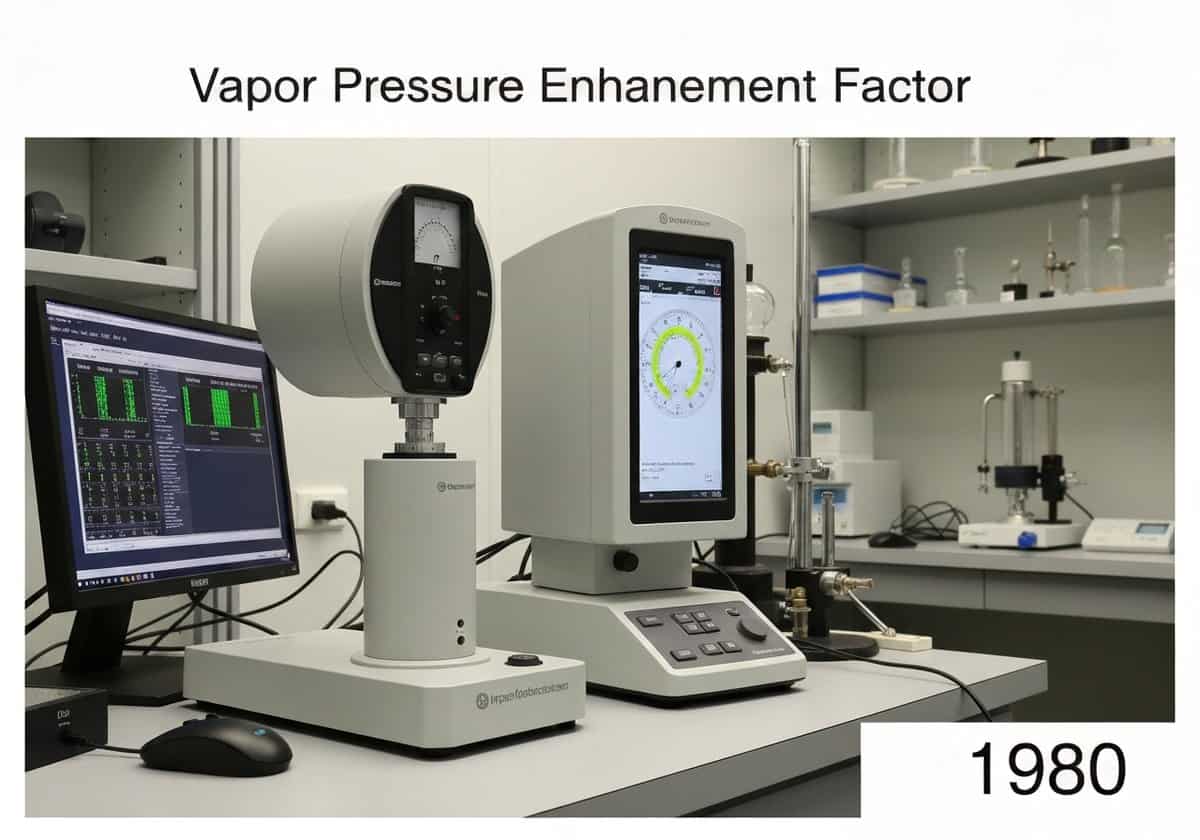
蒸汽压增强因子
(如果日期未知或不相关,例如“流体力学”,则提供其显著出现的近似估计)
只有注册会员才能免费获取完整尺寸的图片和下载内容。
> 登录 <