Product Design, Manufacturing & Innovation Resources
家 » 肖克利-奎塞尔极限

肖克利-奎塞尔极限

1961
  • William Shockley
  • Hans-Joachim Queisser
Research laboratory analyzing single p-n junction solar cell efficiency based on Shockley–Queisser Limit.

(图片仅供参考)

The Shockley–Queisser limit is the maximum theoretical efficiency for a single p-n junction solar cell. It considers only radiative recombination and black-body radiation losses. For a single-junction cell with an optimal bandgap of 1.34 eV under standard solar illumination (AM1.5G), the maximum efficiency is approximately 33.7%. This fundamental limit guides solar cell research and design.

肖克利-奎瑟 (SQ) 极限,也称为详细平衡极限,为太阳能电池的能量转换效率提供了基本上限。 热力学 balance between the energy absorbed from the sun and the energy lost by the cell. The model makes several key assumptions: the cell is a single p-n junction, it operates at a standard temperature (300 K), and it is illuminated by unconcentrated sunlight (AM1.5G spectrum).

The calculation accounts for several unavoidable loss mechanisms. First, photons with energy less than the semiconductor’s bandgap ([latex]E_g[/latex]) pass through the cell without being absorbed, contributing nothing to the current. Second, for photons with energy greater than the bandgap, the excess energy ([latex]E_{photon} – E_g[/latex]) is quickly lost as heat through thermalization, as the excited electron relaxes to the bottom of the conduction band. The voltage is thus limited by the bandgap, not the photon energy. The most significant loss mechanism considered in the SQ limit is radiative recombination. This is the reverse process of absorption, where an electron and hole recombine and emit a photon. In an ideal cell, this is the only recombination pathway. The cell, being at a non-zero temperature, also radiates energy as a black body.

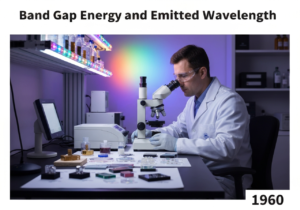
By balancing the incoming photon flux from the sun with the outgoing flux from radiative recombination and black-body radiation, Shockley and Queisser derived the current-voltage characteristic of an ideal cell. The maximum power point on this curve defines the maximum efficiency. The efficiency is a strong function of the bandgap energy, peaking at ~33.7% for a bandgap of 1.34 eV, which is close to that of Gallium Arsenide (GaAs). For silicon ([latex]E_g \approx 1.12[/latex] eV), the limit is around 32%.

UNESCO Nomenclature: 2210
– Physics

类型

Theoretical Limit

中断

Foundational

用法

广泛使用

前体

  • planck’s law of black-body radiation
  • einstein’s work on the photoelectric effect and stimulated emission
  • 半导体pn结理论
  • thermodynamics principles, particularly the second law

应用程序

  • 单结太阳能电池性能基准
  • 多结太阳能电池的设计克服了限制
  • 热载流子和上转换/下转换太阳能电池的研究
  • 太阳能成本的经济模型

专利:

NA

潜在创新理念

  • 太阳能电池采用可调带隙的量子点,完美匹配平方峰
  • 热光伏系统将废热转换回窄带光,用于匹配的太阳能电池
  • 动态带隙材料,可适应全天变化的太阳光谱
  • luminescent solar concentrators that shift uv light to the optimal sq wavelength
  • 光子晶体设计可增强带隙上方的光吸收,同时抑制亚带隙光子
  • hybrid solar cells that use hot-carrier extraction for 高能 photons and a standard p-n junction for lower-energy ones
  • 通过角度限制电池发射来减少辐射复合损失的超材料
  • 人工智能驱动的具有理想方格带隙和材料特性的新型半导体合金的发现
Related to: shockley-queisser limit, solar cell efficiency, thermodynamic limit, radiative recombination, bandgap, detailed balance, single-junction, black-body radiation.

历史背景

肖克利-奎塞尔极限

1960
1960
1960
1961
1962
1963
1965
1960
1960
1960
1960-05-16
1962
1963
1964
1968

(如果日期未知或不相关,例如“流体力学”,则提供其显著出现的近似估计)

第十年 周年纪念日

只有注册会员才能免费获取完整尺寸的图片和下载内容。

> 登录 <