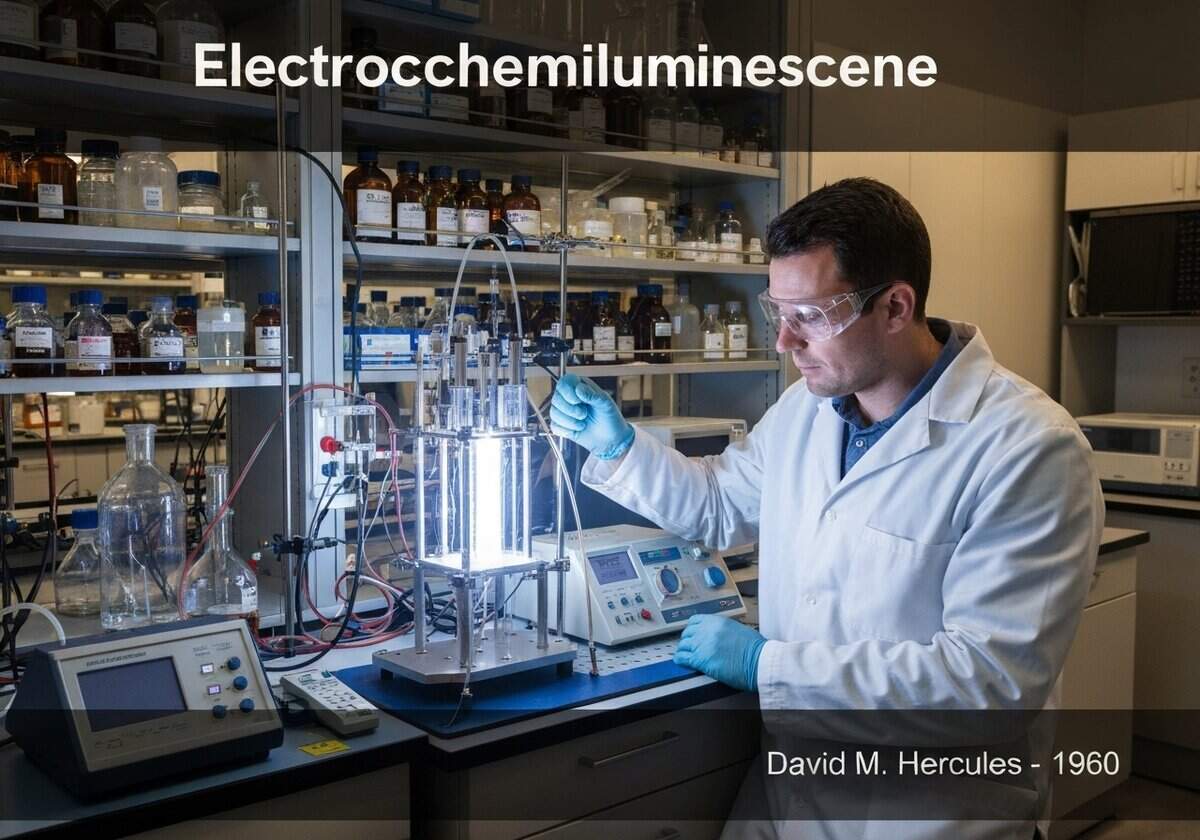
电化学发光,或称电致化学发光 (ECL),是指在电极表面引发化学反应并产生光的过程。电化学产生的物质经过高能电子转移反应形成激发态,并在弛豫后发光。它结合了化学发光的分析优势(低背景、高灵敏度)和对电化学触发的精确控制。

(图片仅供参考)
电化学发光,或称电致化学发光 (ECL),是指在电极表面引发化学反应并产生光的过程。电化学产生的物质经过高能电子转移反应形成激发态,并在弛豫后发光。它结合了化学发光的分析优势(低背景、高灵敏度)和对电化学触发的精确控制。
In a typical ECL system, a stable precursor molecule, such as a ruthenium(II) complex like [latex]Ru(bpy)_3^{2+}[/latex], is used. When a voltage is applied to an electrode in a solution containing this complex and a co-reactant (e.g., tripropylamine, TPA), both species are oxidized at the electrode surface. The oxidized TPA loses a proton and an electron to become a highly reducing radical intermediate. This radical then transfers an electron to the oxidized ruthenium complex, [latex]Ru(bpy)_3^{3+}[/latex], in a highly exothermic reaction. This 电子转移 is so energetic that it promotes the resulting [latex]Ru(bpy)_3^{2+}[/latex] to an electronically excited state, [latex][Ru(bpy)_3^{2+}]^*[/latex]. This excited state then relaxes to the ground state, emitting a photon of light at approximately 620 nm. The key advantage of ECL is its temporal and spatial control. The reaction only occurs when the voltage is applied and only at the electrode surface, which dramatically reduces background noise and allows for highly sensitive detection, often down to the attomolar level. This makes it a powerful tool in modern bioanalytical assays.
电化学发光(ECL)
(如果日期未知或不相关,例如“流体力学”,则提供其显著出现的近似估计)
只有注册会员才能免费获取完整尺寸的图片和下载内容。
> 登录 <