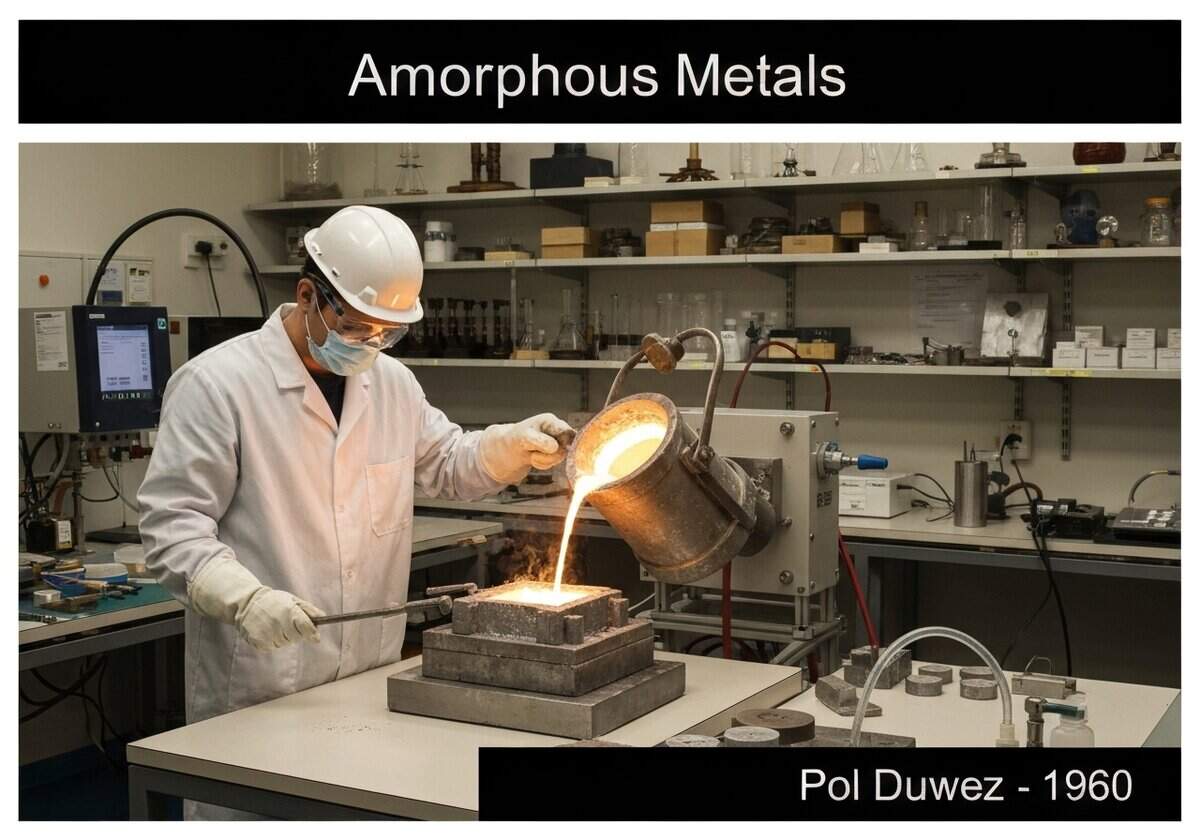
非晶态金属或金属玻璃是具有无序、非晶态原子结构的合金,类似于普通玻璃。这是通过以极高的速度(如 [latex]10^6[/latex] K/s)冷却熔融合金,阻止原子组织成规则的晶格而实现的。由于缺乏晶界,它们表现出高强度、高弹性和耐腐蚀等独特性能。.

(图片仅供参考)
非晶态金属或金属玻璃是具有无序、非晶态原子结构的合金,类似于普通玻璃。这是通过以极高的速度(如 [latex]10^6[/latex] K/s)冷却熔融合金,阻止原子组织成规则的晶格而实现的。由于缺乏晶界,它们表现出高强度、高弹性和耐腐蚀等独特性能。.
非晶态金属的形成需要在凝固过程中绕过结晶过程。每种液体在冷却时都会 热力学 driving force to crystallize, but this process takes time for atoms to arrange themselves. By cooling the molten 合金 faster than this critical rate, the liquid’s disordered structure is ‘frozen’ into the solid state. The first amorphous alloy, Au₇₅Si₂₅, was produced by Pol Duwez’s team using a ‘gun technique’ to propel a molten droplet onto a cold copper substrate, achieving the necessary rapid quenching.
A significant challenge was the limitation to very thin ribbons or foils, as heat could not be extracted quickly enough from thicker sections. This led to the development of Bulk Metallic Glasses (BMGs). BMGs are multi-component alloys (typically 3 or more elements) with large atomic size mismatches, which frustrates the crystallization process and dramatically lowers the required critical cooling rate, allowing for the casting of parts several centimeters thick. Unlike crystalline metals that deform plastically through dislocation motion, metallic glasses deform elastically to much higher strains. Once their elastic limit is exceeded, deformation localizes into narrow regions called shear bands, often leading to catastrophic failure with little to no overall 延展性. This combination of extreme strength but limited toughness is a key area of ongoing research.
非晶态金属(金属玻璃)
(如果日期未知或不相关,例如“流体力学”,则提供其显著出现的近似估计)
只有注册会员才能免费获取完整尺寸的图片和下载内容。
> 登录 <