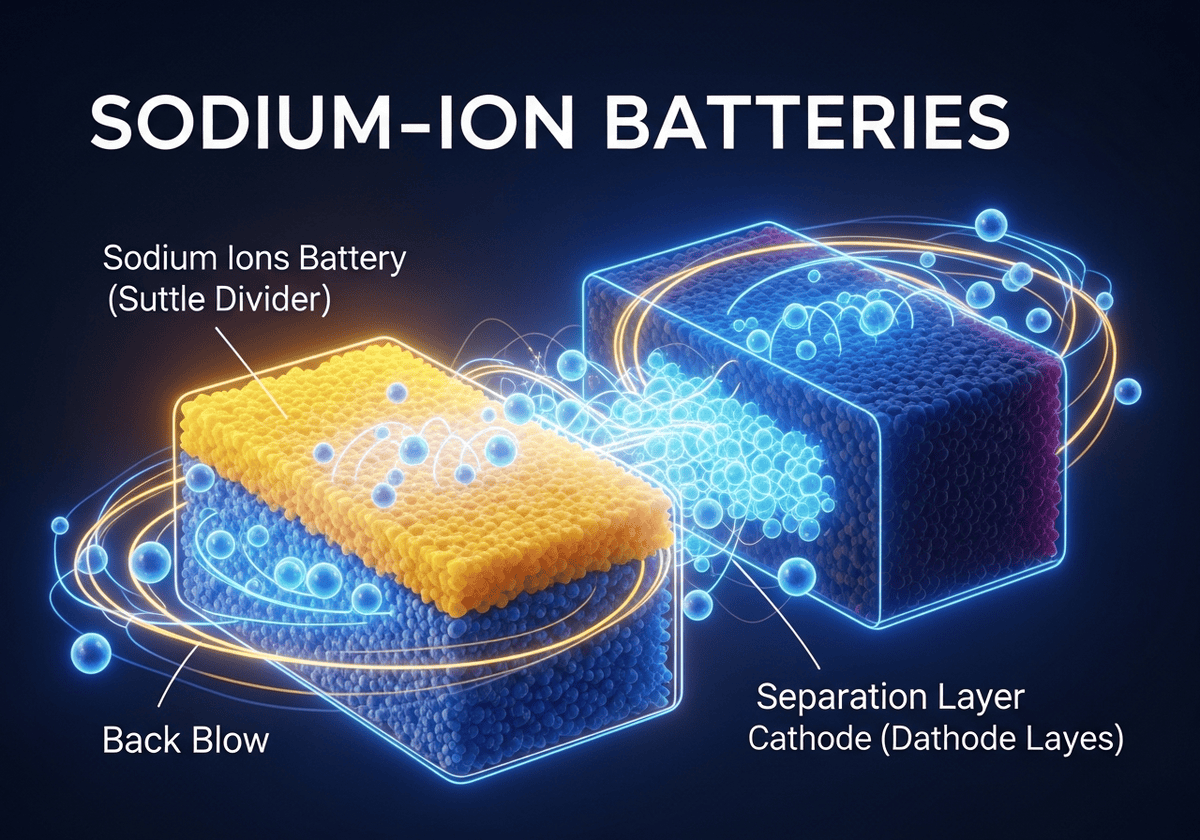
Sodium-ion batteries are electrochemical energy storage cells that substitute sodium ions for lithium as the charge-carrying species shuttling between cathode and anode during charge and discharge cycles, operating on insertion and extraction chemistry mechanistically analogous to lithium-ion but governed by sodium’s larger ionic radius, lower reduction potential, and substantially greater crustal abundance.
A tecnologia de materiais catódicos divide-se em três famílias principais:
- óxidos de metais de transição em camadas
- Análogos do azul da Prússia
- Compostos polianiônicos, incluindo fosfatos e sulfatos do tipo NASICON.
Cada uma apresentando diferentes vantagens e desvantagens em termos de capacidade específica, patamar de tensão, estabilidade estrutural sob sodiação repetida e custo de síntese; nenhuma química de cátodo isoladamente alcançou a consolidação de mercado que NMC e LFP detêm no setor de íon-lítio.
No lado do ânodo, a capacidade de intercalação de sódio insignificante do grafite o torna inadequado, direcionando a pesquisa para carbono duro derivado de biomassa ou precursores de resina como o padrão prático atual, com ânodos de sódio metálico representando uma fronteira de maior energia, porém propensa à formação de dendritos. A formulação do eletrólito — sais de NaPF6 ou NaClO4 em solventes de éter ou carbonato, líquidos iônicos ou condutores de sódio de estado sólido emergentes — determina criticamente a química da interface do eletrólito sólido que governa a eficiência coulombiana do primeiro ciclo, a capacidade de taxa e o envelhecimento por tempo.
As publicações e patentes indexadas abaixo abordam a síntese de materiais de cátodo e ânodo, engenharia de eletrólitos, caracterização da SEI (interface eletrólito-eletrodo), projeto de formato de célula, otimização do protocolo de formação e modelagem tecnoeconômica em nível de sistema.
Esta é a nossa mais recente seleção de publicações e patentes mundiais em inglês sobre baterias de íon-sódio, provenientes de diversos periódicos científicos online, classificadas e focadas em bateria de íon-sódio, célula de íon-sódio, cátodo de íon-sódio, cátodo de óxido de sódio em camadas, cátodo análogo ao azul da Prússia, cátodo polianiônico de sódio, cátodo NASICON, ânodo de sódio de carbono duro, ânodo de sódio de carbono macio, ânodo de sódio metálico, eletrólito de íon-sódio, eletrólito de sódio à base de éter, eletrólito de sal de sódio, eletrólito NaPF6, íon-sódio, eletrólito sólido e camada SEI de íon-sódio.
Positive electrode for lithium-sulfur battery and lithium-sulfur battery comprising same
Patent published on the 2026-10-15 in WO under Ref WO2026216696 by SAMSUNG SDI CO LTD [KR] (Jeon Eunju [kr], Lim Hyungsub [kr], Jo Sungnim [kr], Son Inhyuk [kr], Park Taehyun [kr], Lee Jieun [kr], Lee Seungwoo [kr])
Abstract: The present invention relates to a positive electrode for a lithium-sulfur battery and a lithium-sulfur battery comprising same. The positive electrode for a lithium-sulfur battery comprises: a positive electrode current collector; and a positive electrode active material layer disposed on at least one surface of the positive electrode current collector, wherein the positive electrode active material layer includes a positive electrode active material including a sulfide-based composite, a solid[...]
Our summary: The invention describes a positive electrode for lithium-sulfur batteries. It includes a current collector and an active material layer with a sulfide-based composite. The active material also contains a solid electrolyte and a polymer composite derived from specific compounds.
lithium-sulfur battery, positive electrode, sulfide-based composite, solid electrolyte
Patent
Slurry for all-solid-state battery, positive electrode for all-solid-state battery, and all-solid-state battery
Patent published on the 2026-10-15 in WO under Ref WO2026216716 by SAMSUNG SDI CO LTD [KR] (Oh Daeyang [kr], Kim Jinhee [kr], You Hoseon [kr], Kang Dongwoo [kr], Woo Seunghee [kr])
Abstract: The present invention relates to: a slurry for an all-solid-state battery; a positive electrode for an all-solid-state battery, the positive electrode being manufactured using the slurry; and an all-solid-state battery. More specifically, the slurry for an all-solid-state battery comprises a sulfide-based solid electrolyte, a binder, a non-aqueous solvent, and an additive, wherein the additive may include an aluminum halide compound.[...]
Our summary: The invention involves a slurry designed for all-solid-state batteries. It includes a sulfide-based solid electrolyte, a binder, a non-aqueous solvent, and an additive. The positive electrode is produced using this slurry.
slurry, all-solid-state battery, positive electrode, sulfide-based electrolyte
Patent
Electrochemical carbon capture apparatus based on solid electrolyte reactor, preparation method thereof, and carbon capture method
Patent published on the 2026-10-15 in US under Ref US20260317913 by THE HONG KONG POLYTECHNIC UNIV [CN] (Zhang Xiao [cn], Zhai Yanjie [cn])
Abstract: [0000] The present application relates to the technical field of carbon capture and environmental protection, and in particular to an electrochemical carbon capture apparatus based on a solid electrolyte reactor, a preparation method, and a carbon capture method. The electrochemical carbon capture apparatus based on the solid electrolyte reactor includes: a porous solid electrolyte layer; a cathode electrode and an anode electrode, respectively arranged on two sides of the porous solid electroly[...]
Our summary: The application describes an electrochemical carbon capture apparatus utilizing a solid electrolyte reactor. It includes a porous solid electrolyte layer, cathode and anode electrodes, and various membranes. The method focuses on improving carbon capture efficiency and environmental protection.
Electrochemical, Carbon Capture, Solid Electrolyte, Environmental Protection
Patent
Composite polymer electrolyte for a lithium-ion secondary battery
Patent published on the 2026-10-14 in EP under Ref EP4822800 by DAIKIN CHEMICAL EUROPE GMBH [DE] (Friesen Alex [de], BrÄndel Timo [de], Nassmacher Alexander [de])
Abstract: The present disclosure relates to an improved solid composite polymer electrolyte (CPE) for a lithium ion secondary battery comprising (A) a fluorine-containing copolymer; (B) lithium-containing solid electrolyte particles having a garnet-type structure; (C) a lithium salt; and (D) an ionic liquid, a method for its preparation, and a secondary battery comprising it.[...]
Our summary: The disclosure presents an improved solid composite polymer electrolyte for lithium-ion batteries. It includes a fluorine-containing copolymer, garnet-type lithium-containing solid electrolyte particles, a lithium salt, and an ionic liquid. A method for preparation and a secondary battery utilizing this electrolyte are also described.
Composite polymer electrolyte, lithium-ion battery, solid electrolyte particles, ionic liquid
Patent
Composition comprising acid and diamine compounds for use in the manufacture of electrolytic capacitors
Patent published on the 2026-10-14 in EP under Ref EP4822726 by HERAEUS EPURIO GMBH [DE] (Mottweiler Dr Jakob [de], Intelmann Dr Matthias [de], Merker Dr Udo [de])
Abstract: [0001] The present invention relates to a process for the preparation of an electrolytic capacitor, comprising the process steps: A) providing a porous electrode body made of an electrode material (100a), the porous electrode body comprising a dielectric layer (100b) that at least partially covers a surface of the electrode material (100a), and a solid electrolyte layer (100c) that comprises a conductive polymer CP1, wherein the dielectric layer (100b) is arranged between the electrode material [...]
Our summary: The invention describes a process for manufacturing electrolytic capacitors using a porous electrode body with a dielectric and solid electrolyte layer. It involves applying a primer solution containing a diamine and acid, followed by a liquid composition to form a polymeric outer layer. The process aims to improve the coverage of the solid electrolyte layer with the polymeric outer layer.
acid, diamine, electrolytic capacitors, conductive polymer
Patent
Sulfide solid electrolyte
Patent published on the 2026-10-08 in WO under Ref WO2026211769 by IDEMITSU KOSAN CO LTD [JP] (Moriyama Kenji [jp], Kobayashi Takayuki [jp])
Abstract: Provided is a sulfide solid electrolyte having high ionic conductivity and a rough surface shape, containing lithium atoms, phosphorus atoms, and sulfur atoms, and having a roughness index (RI) of 200% or more, calculated by a formula: RI = A1/A0 × 100 (in the formula, A1 represents the surface area per particle (μm2/particle) and A0 represents the surface area per true spherical particle (μm2/particle)).[...]
Our summary: The sulfide solid electrolyte exhibits high ionic conductivity. It contains lithium, phosphorus, and sulfur atoms. The roughness index is calculated to be 200% or more.
Sulfide solid electrolyte, ionic conductivity, rough surface, lithium phosphorus sulfur
Patent
Crosslinked Zwitterionic PVA-g-SBMA/PEDOT:PSS Networks for Mechanically Robust All-Solid-State Electrolytes
Published on 2026-01-28 by Chia-Wen Wei, Chia-Yu Chen, Shyh-Chyang Luo, Dmitry G. Belov, Szu-Nan Yang @MDPI
Abstract: Conventional lithium-ion batteries face issues like electrolyte leakage and interface instability. Solid-state lithium batteries with solid electrolytes address these, while solid-state polymer electrolytes (SPEs) offer safety and flexibility. This study primarily aimed to develop and synthesize a graft copolymer, PVA-g-SBMA, which was successfully synthesized by grafting [2-(methacryloyloxy)ethyl] dimethyl-(3-sulfopropyl)ammonium hydroxide (SBMA) onto poly(vinyl alcohol) (PVA). PVA provided exc[...]
Our summary: This study developed a graft copolymer, PVA-g-SBMA, by grafting SBMA onto PVA to enhance ionic conductivity and mechanical properties in solid-state electrolytes. The copolymer was crosslinked with PEDOT:PSS to form a robust network, improving film performance. The optimal system achieved a conductivity of 4.9 × 10⁻⁴ S/cm at room temperature with specific lithium salt concentrations.
Crosslinked, Zwitterionic, Solid-state, Electrolytes
Advances in Sodium Ion Batteries Based on Mixed Electrolytes of ILs and Organic Solvents
Published on 2026-01-28 by Sajjad Ghiyami, Claudio Mele @MDPI
Abstract: Sodium-ion batteries (SIBs) represent a topic of extreme interest in the research field, especially because the materials used are cheaper than those in lithium-ion batteries (LIBs). In SIBs, the choice of cathodes and electrolytes is very important because they will affect the energy density, cycling stability, and safety of the battery. This work focuses on the prospect of hybrid electrolyte cells that incorporate ionic liquids (ILs) into organic liquids in order to improve the safety and perf[...]
Our summary: This study explores the use of hybrid electrolytes combining ionic liquids and organic solvents in sodium-ion batteries. It highlights improvements in ionic conductivity, electrochemical stability, and thermal safety. The research suggests that these advancements could enhance the performance and lifecycle of sodium-ion battery technology for large-scale energy storage applications.
Sodium-ion batteries, hybrid electrolytes, ionic liquids, energy storage
Publication