Agricultural Sciences, Forestry, Veterinary Medicine
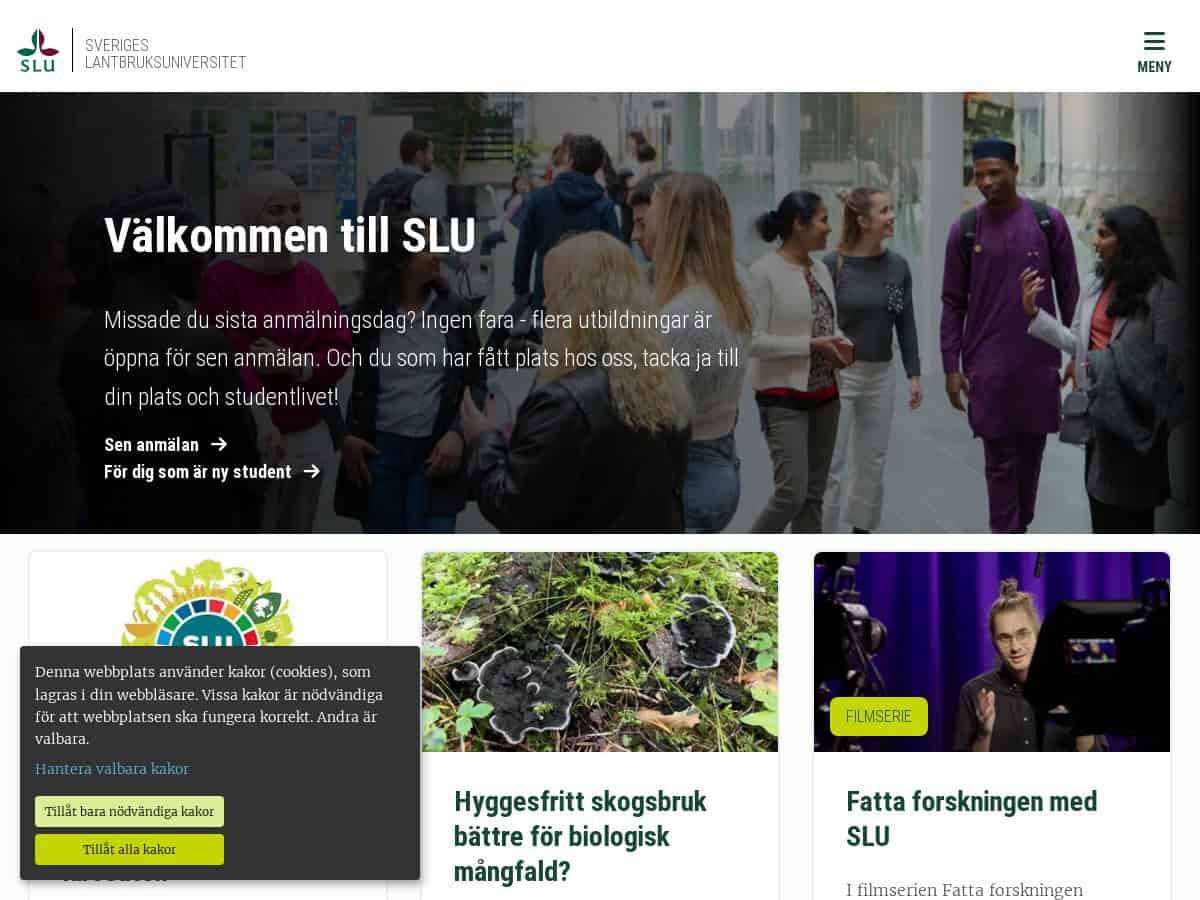
The Swedish University of Agricultural Sciences (SLU) is a university in Sweden. Although its head office is in Uppsala, the university has several campuses in different parts of Sweden. The university is a world-class institution in the fields of life and environmental sciences.
The Swedish University of Agricultural Sciences, SLU, is a university for the life sciences, formed in 1977 by bringing together several older schools of agriculture, forestry and veterinary medicine. It has about 5,000 students and 3,100 staff, and roughly one student in ten comes from abroad. Its seat is at Ultuna, in Uppsala, with other campuses at Alnarp in the south, Umeå in the north and Skara, and with research stations and forests across the country.
The roots are deep. The Forest Institute in Stockholm began in 1828, the agricultural institutes at Ultuna and Alnarp date from the nineteenth century, and the veterinary school in Stockholm is older still. In Uppsala, SLU is next to Uppsala University, and the two share research environments. SLU teaches agriculture, forestry, veterinary medicine, horticulture, landscape architecture, food science, animal science, rural development, environmental science and biology.
SLU is the only university in Sweden that trains veterinarians, at the Ultuna campus in Uppsala. It is also responsible for national environmental monitoring. The Swedish Species Information Centre, which runs the national red list of threatened species, belongs to SLU, as does the National Forest Inventory, one of the oldest in the world. Research focuses on sustainable food production, forest management, animal health, soil, climate and biodiversity.
Tuition is free for citizens of the EU, the EEA and Switzerland, while students from other countries pay tuition fees that vary by programme. Check the current tariff and the scholarships available. Applications for bachelor’s and master’s programmes go through the national portal, and deadlines are in the winter for the autumn intake. Bachelor’s programmes are mostly in Swedish, while many master’s programmes are in English.
The Ultuna campus lies a short bicycle ride from the centre of Uppsala, and students there are part of the large student community of the city. Housing is scarce, so applying early for a room is advised.
Domains taught:
Agriculture, Bioengineering, Bioinformatics, Ecology and Sustainability, Food Science, Life Sciences, Microbiology and Genetics
Diplomas*:
Bachelor, Doctor, Master
Status:
Public
Partnerships:
SLU has a long tradition of collaboration with the agricultural and forestry industries, as well as with the public sector. The university has a number of strategic partnerships with companies like Lantmännen and is a member of the Euroleague for Life Sciences (ELLS).
Research:
SLU’s research is focused on creating a sustainable future for our planet. Key research areas include agricultural sciences, forestry, and veterinary medicine. The university is home to several world-class research facilities, including the Biocenter and the Centre for Chemical Pesticides.
Famous Alumnis:
N/A
International recognition**:
Number of staff***:
3100
Current students***:
5000
Foreign students***:
10%
Cumulative former students***:
10000
Pros
A world-class university in the fields of life and environmental sciences. A strong focus on sustainability and a beautiful natural environment.
Cons
The university has a relatively narrow focus, which may not be suitable for all students. The multi-campus structure can also be a challenge.
Best For
Students who are passionate about life and environmental sciences and who want to contribute to a sustainable future.
Think of Karolinska Institute when bioinformatics, microbiology and genetics and bioengineering is the priority: it covers statistics and data analytics as well, and is slightly larger, at about 6,500 students against roughly 5,000 here.
For students who like the bioinformatics, microbiology and genetics and ecology and sustainability focus of this institution but want another option nearby, Umeå University fits well: it is far larger, with about 34,000 students against roughly 5,000 here, and is also a public institution.
Luleå University of Technology follows much the same lines as this institution, with ecology and sustainability as common ground, and it is far larger, with about 19,000 students against roughly 5,000 here, and is also a public institution.
Think of Royal Institute of Technology when bioengineering and life sciences is the priority: it covers aerospace and transportations as well, and is larger, enrolling about 13,955 students against roughly 5,000 here.
A good alternative in the same country is Uppsala University, which likewise covers bioengineering, ecology and sustainability and life sciences; it covers statistics and physics as well, and is far larger, with about 50,000 students against roughly 5,000 here.
Most Similar Schools Abroad
Abroad, Norwegian University of Life Sciences (Norway) covers agriculture, food science and microbiology and genetics in a comparable way, and it is also a public institution, and teaches at the same levels, namely bachelor's, master's and doctoral.
Abroad, Royal Veterinary College (the United Kingdom) covers agriculture, bioinformatics and microbiology and genetics in a comparable way, and it is also a public institution, and teaches at the same levels, namely bachelor's, master's and doctoral.
Beyond national borders, Hannover Medical School stands out as a comparable school for bioinformatics, microbiology and genetics and bioengineering; it runs the same bachelor's, master's and doctoral programmes, and is slightly smaller, at about 3,997 students against roughly 5,000 here.
Huazhong Agricultural University in China shares the agriculture, food science and microbiology and genetics orientation of this institution, and it teaches at the same levels, namely bachelor's, master's and doctoral, and is also a public institution.
Seen from abroad, Medical University of Graz (Austria) is a close relative on subject matter, since bioinformatics, microbiology and genetics and life sciences are central to both, and it has almost the same size, at about 5,110 students, and is also a public institution.
*our own picks (our criteria: a mix between domains, diploma delivered, reputation and size), but obviously too many criteria for an apple-to-apple ranking.
FAQ
What is SLU?
The Swedish University of Agricultural Sciences, a university for the life sciences, formed in 1977.
Where is it?
The seat is at Almas allé 8 in Ultuna, Uppsala, Sweden. Other campuses are at Alnarp, Umeå and Skara.
Tuition is free for citizens of the EU, the EEA and Switzerland. Other students pay fees that vary by programme. Check the current tariff and scholarships.
In which language are courses taught?
Bachelor's programmes mostly in Swedish, and many master's programmes in English.
Is housing easy to find?
No. Housing is scarce, so apply early for a room.
Agriculture, Biodiversity, Environmental Impact, Environmental Technologies, Sustainable Development
*: without any judgment of the quality, readers are strongly encouraged to check the official status of the exact diploma envisioned as many universities have a mix of recognized diplomas, not recognized, “co-delivered,” “equivalent to”, “some pathways” (…), can change over time, and can be named differently from one country to another.
**: international reputation: is based on some criteria that do not mean much in some domains or specialties (number of researchers, of scientific publications, on budget ….). Our approximate 1-4 scale:
known locally
known locally and internationally
is listed in some of the world university’s classifications
is listed among the 20 firsts in some of world university’s classifications
***: estimated numbers, based on online sources and/or feedbacks. The numbers can vary greatly depending on school organisation (ex.: school is part of a group, it employs internal staff or external consultants or has public staff without employing them …). Refer to all the links provided to have accurate and updated numbers.
Innovation.world is not affiliated with this school/university. We recommend to contact them directly on their website for any special request.
To complete or correct any information here or share your opinion, please comment below or > send us a direct message <.