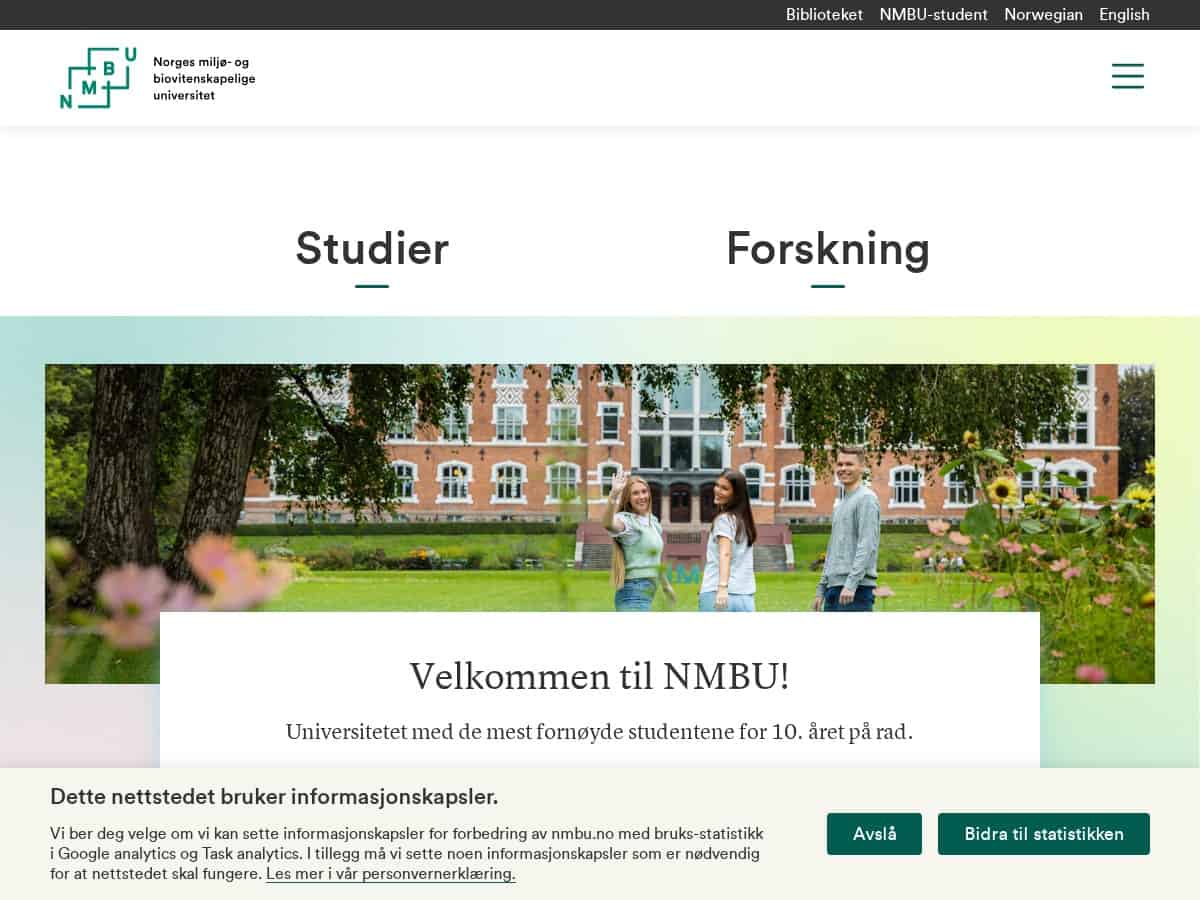
Life Sciences, Environmental Sciences, Veterinary Medicine
The Norwegian University of Life Sciences (NMBU) is a public university located in Ås, Norway. It is a leading international center of knowledge, focused on higher education and research within environmental and biosciences.
The Norwegian University of Life Sciences, NMBU, is a public university in Ås, about 30 kilometres south of Oslo. It has about 6,000 students and 1,800 staff, and around one student in ten comes from abroad. The institution began in 1859 as the Norwegian Agricultural College, became the Agricultural University of Norway, and received its present name in 2014 after a merger with the Norwegian School of Veterinary Science. The main campus in Ås is one of the oldest and most historic in the country.
NMBU focuses on life sciences, environment and natural resources. Its programmes cover agricultural sciences, animal science, aquaculture, biotechnology, food science, forestry, landscape architecture, ecology, environmental science, economics and technology, and veterinary medicine. It is the only university in Norway that educates veterinarians, at the Adamstuen campus in Oslo. The campus also includes experimental farms, forests and a large arboretum used for research and teaching.
Research addresses food production, climate change, biodiversity, energy from biomass, animal health and sustainable land use. The university is known for plant breeding and for work on cattle and fish genetics, and it takes part in international programmes on development and global food security. The Ås campus is also home to national agencies and research institutes in agriculture and forestry, which makes the area a hub for these fields.
Public universities in Norway have long been free for all students, but tuition has now been introduced for most students from outside the EEA, so check the current rules. Every student pays a small semester fee. Bachelor’s programmes are in Norwegian, and Norwegian language skills are required, while many master’s programmes are in English. Applications for undergraduate studies go through the national system, and international students often apply directly.
Student life in Ås is close-knit, since the town is small and most students live on or near campus. The train takes about 25 minutes to Oslo, which makes it easy to visit the capital.
Domains taught:
Agriculture, Bioengineering, Ecology and Sustainability, Food Science, Life Sciences, Microbiology and Genetics
Diplomas*:
Bachelor, Doctor, Master
Status:
Public
Partnerships:
NMBU has a long history of collaboration with government agencies, the private sector, and other research institutions. It is a member of the Euroleague for Life Sciences (ELLS).
Research:
NMBU’s research is focused on the life sciences, with a particular emphasis on agriculture, food, environment, and veterinary medicine. The university is a key player in research on sustainable food production and the bioeconomy.
Famous Alumnis:
N/A
International recognition**:
Number of staff***:
1800
Current students***:
6000
Foreign students***:
10%
Cumulative former students***:
15000
Pros
A leading university in life and environmental sciences, a beautiful campus with a focus on sustainability, and a strong international profile.
Cons
The university has a relatively narrow focus, which may not appeal to all students.
Best For
Students who are passionate about life sciences, sustainability, and the environment, and who want to contribute to a more sustainable future.
Where this university leans on ecology and sustainability and life sciences, University of Tromsø – The Arctic University of Norway does the same, and it is larger, enrolling about 16,500 students against roughly 6,000 here, and is also a public institution.
On content, University of Bergen and this university are close, as both teach ecology and sustainability and life sciences; it is also a public institution, and runs the same bachelor's, master's and doctoral programmes.
Both schools build their programmes around life sciences, and University of Oslo is the one to compare first within the country, since it is also a public institution, and runs the same bachelor's, master's and doctoral programmes.
The comparison with University of Stavanger is straightforward on subjects, since both focus on agriculture, and it runs the same bachelor's, master's and doctoral programmes, and covers marine science and geotechnics as well.
A good alternative in the same country is Norwegian University of Science and Technology, which likewise covers norwegian, focused and sustainability; it is far larger, with about 43,550 students against roughly 6,000 here, and is also a public institution.
Most Similar Schools Abroad
For agriculture, food science and microbiology and genetics outside the home country, Swedish University of Agricultural Sciences in Sweden is a natural reference; it runs the same bachelor's, master's and doctoral programmes, and covers bioinformatics as well.
If this institution is on your list for agriculture, food science and microbiology and genetics, Huazhong Agricultural University in China deserves a comparison, because it is also a public institution, and runs the same bachelor's, master's and doctoral programmes.
University of Guelph in Canada pursues a similar profile in agriculture, food science and bioengineering, and it covers bioinformatics as well, and is far larger, with about 30,000 students against roughly 6,000 here.
If this university is on your list for agriculture, microbiology and genetics and bioengineering, Royal Veterinary College in the United Kingdom deserves a comparison, because it is smaller, enrolling about 2,500 students against roughly 6,000 here, and is also a public institution.
Beyond national borders, South China Agricultural University stands out as a comparable school for agriculture, food science and microbiology and genetics; it teaches at the same levels, namely bachelor's, master's and doctoral, and covers engineering as well.
*our own picks (our criteria: a mix between domains, diploma delivered, reputation and size), but obviously too many criteria for an apple-to-apple ranking.
FAQ
Where is NMBU?
At Universitetstunet 3 in Ås, Norway, about 30 kilometres south of Oslo.
When did it start?
In 1859 as the Norwegian Agricultural College. It took its present name in 2014 after a merger with the Norwegian School of Veterinary Science.
*: without any judgment of the quality, readers are strongly encouraged to check the official status of the exact diploma envisioned as many universities have a mix of recognized diplomas, not recognized, “co-delivered,” “equivalent to”, “some pathways” (…), can change over time, and can be named differently from one country to another.
**: international reputation: is based on some criteria that do not mean much in some domains or specialties (number of researchers, of scientific publications, on budget ….). Our approximate 1-4 scale:
known locally
known locally and internationally
is listed in some of the world university’s classifications
is listed among the 20 firsts in some of world university’s classifications
***: estimated numbers, based on online sources and/or feedbacks. The numbers can vary greatly depending on school organisation (ex.: school is part of a group, it employs internal staff or external consultants or has public staff without employing them …). Refer to all the links provided to have accurate and updated numbers.
Innovation.world is not affiliated with this school/university. We recommend to contact them directly on their website for any special request.
To complete or correct any information here or share your opinion, please comment below or > send us a direct message <.