Uppsala University, founded in 1477, is the oldest university in Sweden and all of the Nordic countries. It is a comprehensive public research university with a long tradition of academic excellence and a strong international reputation. The university is located in the historic city of Uppsala, north of Stockholm.
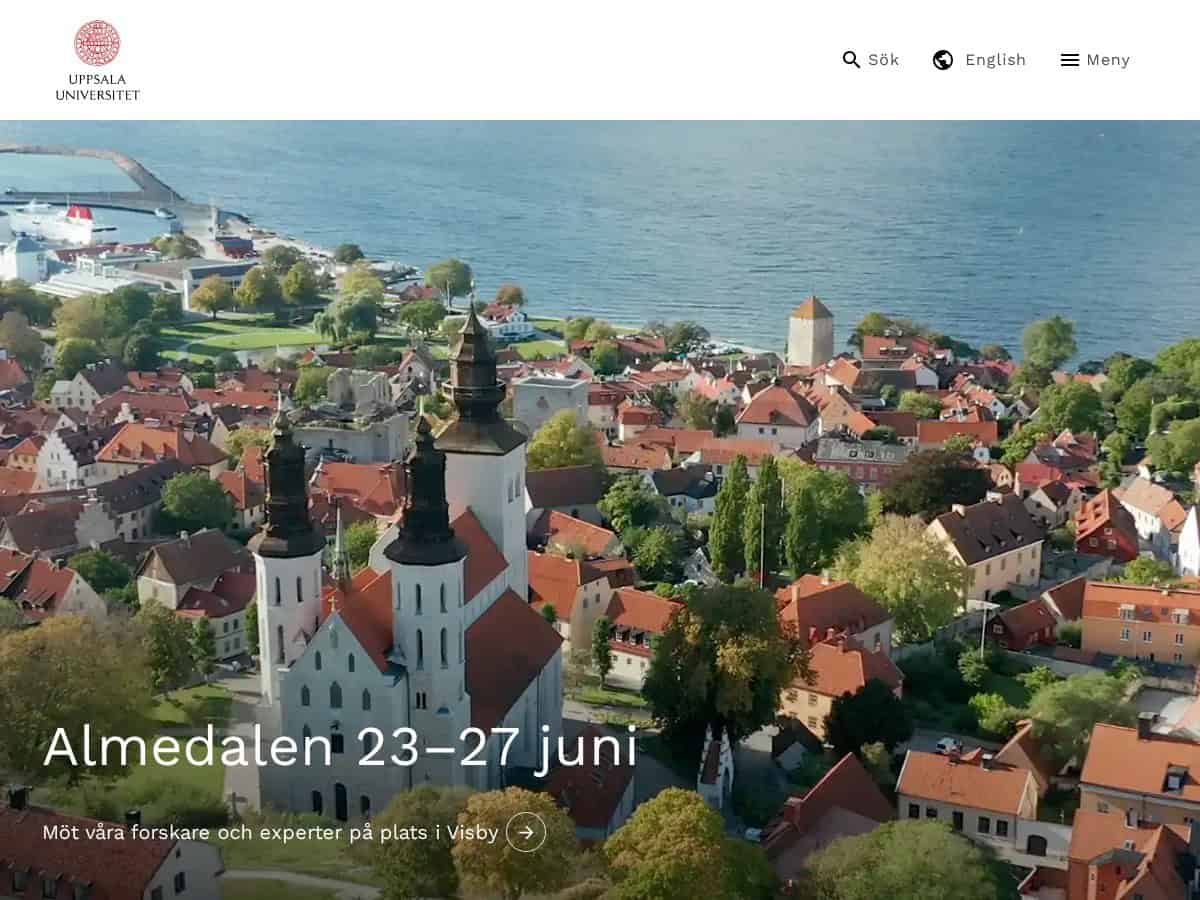
Uppsala University is the oldest university in Sweden and in the Nordic countries. It was founded in 1477, and it has about 50,000 students and 7,000 staff, with roughly one student in ten from abroad. The main building, Universitetshuset, stands on Biskopsgatan in the old town, near the cathedral and the river Fyris, and the university buildings are scattered through a compact, flat city. A campus in Visby, on the island of Gotland, belongs to the university as well.
The university library, Carolina Rediviva, holds the Codex Argenteus, the Silver Bible of the sixth century, one of the most precious manuscripts in Europe. Anders Celsius, who proposed the temperature scale that bears his name, was a professor of astronomy, and Carl Linnaeus, the founder of modern biological classification, taught medicine and botany and lived in Uppsala for decades. The Linnaean Garden, which he renewed, is preserved as a museum garden.
The list of notable people also includes Anders Ångström, a pioneer of spectroscopy, Svante Arrhenius, who studied at Uppsala before his Nobel Prize in Chemistry in 1903, and Kai Siegbahn, who received the 1981 Nobel Prize in Physics. Dag Hammarskjöld, the second Secretary-General of the United Nations, was a student. Research today is strong in physics, chemistry, life sciences, medicine, peace and conflict studies, and the humanities. The Ångström Laboratory houses much of the natural science research.
Student life revolves around the student nations, associations by region of origin that offer social events, food, housing and traditions. Tuition is free for citizens of the EU, the EEA and Switzerland, while students from other countries pay tuition fees that vary by programme. Check the current tariff and the scholarships available. Bachelor’s programmes are mostly in Swedish, while most master’s programmes are in English.
Uppsala is a small city about 40 minutes by train from Stockholm. Housing is scarce, and students are advised to apply for rooms early. Bicycles are the main way to move around.
Domains taught:
AI and Machine Learning, Bioengineering, Data Analytics, Ecology and Sustainability, Electrical and Electronics, Life Sciences, Materials, Mathematics, Physics, Software Engineering, Statistics
Diplomas*:
Bachelor, Doctor, Master
Status:
Public
Partnerships:
Uppsala University is a member of the Coimbra Group, a network of leading European research universities, and has exchange agreements with over 500 universities worldwide. The university has close collaborations with industry and the public sector, with a focus on translating research into innovation.
Research:
Uppsala University is a leading research university with a broad range of research activities. Key research areas include life sciences, materials science, and social sciences. The university is home to several world-renowned research centers, including the Rudbeck Laboratory and the Uppsala Centre for Russian and Eurasian Studies.
Famous Alumnis:
Carl Linnaeus, Anders Celsius, Dag Hammarskjöld
International recognition**:
Number of staff***:
7000
Current students***:
50000
Foreign students***:
10%
Cumulative former students***:
120000
Pros
A rich history and a strong international reputation, a wide range of study programs, and a vibrant student life in a classic university town.
Cons
The university’s traditional structure can sometimes be perceived as rigid. The housing situation in Uppsala can be competitive, particularly for international students.
Best For
Students who value a traditional and prestigious academic environment with a strong focus on research and a vibrant student life.
For students who like the bioengineering, physics and electrical and electronics focus of this university but want another option nearby, Lund University fits well: it is also a public institution, and teaches at the same levels, namely bachelor's, master's and doctoral.
Umeå University follows much the same lines as this institution, with statistics, ecology and sustainability and physics as common ground, and it covers bioinformatics and microbiology and genetics as well, and is slightly smaller, at about 34,000 students against roughly 50,000 here.
University of Gothenburg is the closest domestic counterpart for statistics, ecology and sustainability and physics; it runs the same bachelor's, master's and doctoral programmes, and covers marine science and bioinformatics as well.
In terms of fields, Stockholm University is the nearest neighbour, with statistics, ecology and sustainability and physics again at the core; it is smaller, enrolling about 33,000 students against roughly 50,000 here, and is also a public institution.
The comparison with Linnaeus University is straightforward on subjects, since both focus on bioengineering, ecology and sustainability and mathematics, and it covers marine science and engineering as well, and is slightly smaller, at about 40,000 students against roughly 50,000 here.
Most Similar Schools Abroad
University of Helsinki, in Finland, takes a similar route through statistics, ecology and sustainability and physics; it is smaller, enrolling about 31,000 students against roughly 50,000 here, and is also a public institution.
University of Copenhagen (Denmark) works on the same fields as this university, chiefly statistics, physics and mathematics; it covers bioinformatics and nanotechnologies as well, and is slightly smaller, at about 37,500 students against roughly 50,000 here.
Université Paris Cité brings a France setting to the same core fields, statistics, physics and mathematics, and it teaches at the same levels, namely bachelor's, master's and doctoral, and covers microbiology and genetics and chemistry as well.
A foreign alternative with a similar emphasis on statistics, physics and mathematics is Heinrich Heine University Düsseldorf in Germany, and it is also a public institution, and runs the same bachelor's, master's and doctoral programmes.
Zhengzhou University in China shares the statistics, mathematics and materials orientation of this institution, and it is also a public institution, and runs the same bachelor's, master's and doctoral programmes.
*our own picks (our criteria: a mix between domains, diploma delivered, reputation and size), but obviously too many criteria for an apple-to-apple ranking.
FAQ
Where is Uppsala University?
The main building is on Biskopsgatan 3 in Uppsala, Sweden. A campus in Visby is on the island of Gotland.
When was it founded?
In 1477, which makes it the oldest university in Sweden and in the Nordic countries.
How large is it?
About 50,000 students and 7,000 staff.
What is Carolina Rediviva?
The university library, which holds the Codex Argenteus, the Silver Bible of the sixth century.
Who taught there?
Anders Celsius, professor of astronomy, and Carl Linnaeus, who taught medicine and botany.
Which Nobel laureates are linked to Uppsala?
Svante Arrhenius studied there, and Kai Siegbahn received the 1981 Nobel Prize in Physics.
Which diplomat studied there?
Dag Hammarskjöld, the second Secretary-General of the United Nations.
What are student nations?
Associations by region of origin that offer social events, food and housing.
Is there tuition?
Tuition is free for citizens of the EU, the EEA and Switzerland. Other students pay fees that vary by programme. Check the current tariff and scholarships.
How far is Uppsala from Stockholm?
About 40 minutes by train.
Engineering, Environmental Impact Assessment, Innovation, Materials Science, Research and Development
*: without any judgment of the quality, readers are strongly encouraged to check the official status of the exact diploma envisioned as many universities have a mix of recognized diplomas, not recognized, “co-delivered,” “equivalent to”, “some pathways” (…), can change over time, and can be named differently from one country to another.
**: international reputation: is based on some criteria that do not mean much in some domains or specialties (number of researchers, of scientific publications, on budget ….). Our approximate 1-4 scale:
known locally
known locally and internationally
is listed in some of the world university’s classifications
is listed among the 20 firsts in some of world university’s classifications
***: estimated numbers, based on online sources and/or feedbacks. The numbers can vary greatly depending on school organisation (ex.: school is part of a group, it employs internal staff or external consultants or has public staff without employing them …). Refer to all the links provided to have accurate and updated numbers.
Innovation.world is not affiliated with this school/university. We recommend to contact them directly on their website for any special request.
To complete or correct any information here or share your opinion, please comment below or > send us a direct message <.