Product Design, Manufacturing & Innovation Resources
Home » Marx’s Theory of Capitalist Self-Annihilation

Marx’s Theory of Capitalist Self-Annihilation

1848
  • Karl Marx
  • Friedrich Engels
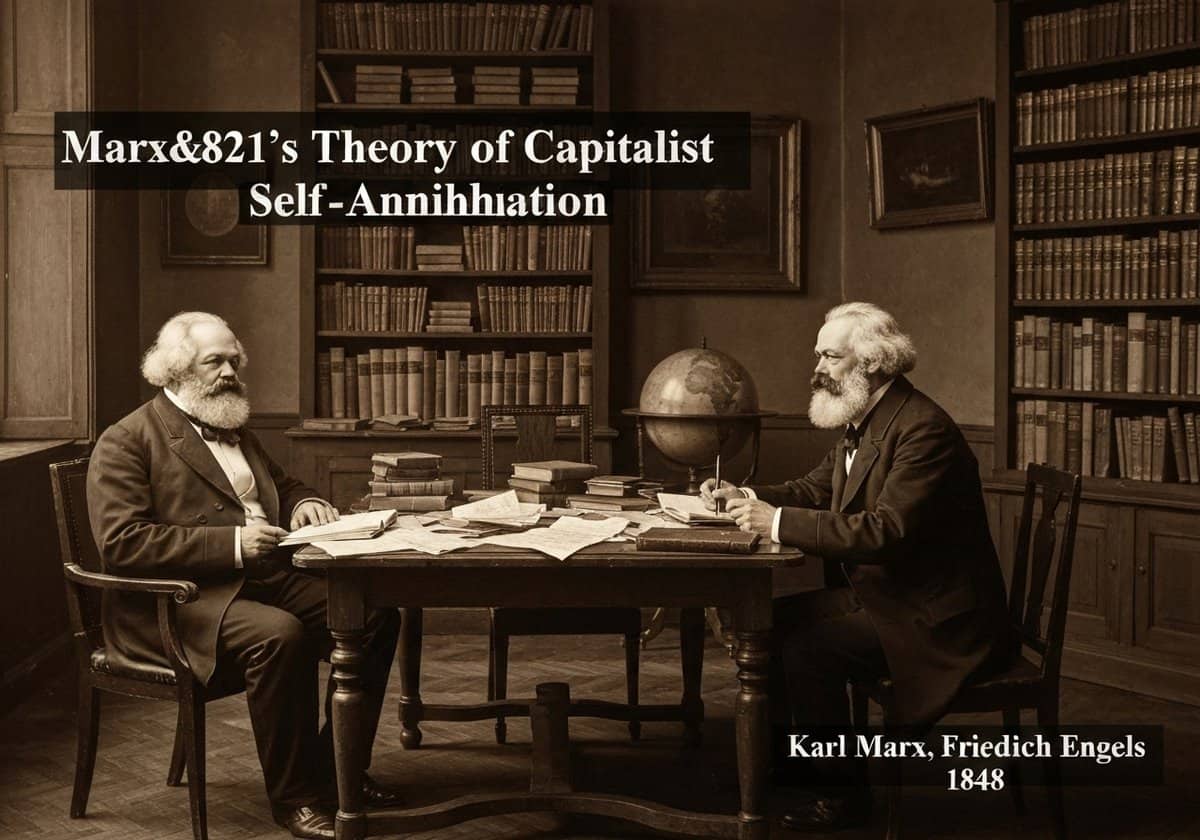
19th-century study with Marx and Engels discussing capitalist contradictions.

(generated image for illustration only)

Karl Marx’s analysis of capitalism identified a dynamic where the bourgeoisie, to expand capital, must “constantly revolutionize the instruments of production.” This process leads to periodic crises where existing products and productive forces are destroyed. This concept, articulated in “The Communist Manifesto,” foreshadowed Schumpeter’s idea but framed it as a fundamental, self-destructive contradiction of capitalism rather than a healthy growth mechanism.

Long before Schumpeter, Karl Marx and Friedrich Engels described a similar process, but with a vastly different interpretation and conclusion. For Marx, this constant upheaval was not a sign of capitalism’s vitality but of its inherent instability and internal contradictions. The relentless drive for capital accumulation and profit forces capitalists to continually improve technology and cut labor costs, leading to crises of overproduction—where the system produces more goods than the population can afford to buy.

According to Marx, these crises are resolved through the forceful destruction of productive capacity, devaluation of capital, and the creation of new markets. This is a destructive, not creative, process that intensifies class conflict. While Schumpeter saw the entrepreneur as a heroic agent of progress, Marx saw the process as an impersonal and brutal logic of capital that ultimately exploits the working class and sows the seeds of its own demise. The destruction was a symptom of a failing system, not the engine of its long-term success.

UNESCO Nomenclature: 5311
– Economic theory

Type

Abstract System

Disruption

Foundational

Usage

Widespread Use

Precursors

  • Georg Wilhelm Friedrich Hegel’s dialectical method
  • Adam Smith’s analysis of competition and capital accumulation
  • David Ricardo’s labor theory of value

Applications

  • marxist economic theory
  • crisis theory in economics
  • dependency theory in international relations
  • world-systems theory
  • critical theory and cultural studies

Patents:

NA

Potential Innovations Ideas

  • predictive models for identifying systemic risk in financial markets
  • worker cooperative platforms designed for resilience against market shocks
  • universal basic income proposals to buffer against economic disruption
  • software for mapping and analyzing global supply chain vulnerabilities
  • alternative economic indicators measuring social well-being instead of just gdp
  • decentralized finance (defi) systems aimed at reducing capital concentration
  • labor union strategies for negotiating technological transitions
  • simulations of post-capitalist economic models
  • open-source hardware movements to democratize production
  • policy frameworks for managing automation-driven job displacement
Related to: Karl Marx, capitalism, crisis theory, means of production, capital accumulation, bourgeoisie, communist manifesto, economic contradiction, historical materialism, class conflict.

Historical Context

Marx’s Theory of Capitalist Self-Annihilation

1848
1910
1914
1950
1957
1957
1960
1960
1890
1914
1942
1957
1957
1960
1960

(if date is unknown or not relevant, e.g. "fluid mechanics", a rounded estimation of its notable emergence is provided)

10th year anniversary

Full size images and downloads are only available, 100% free, for registered members.

> Login <