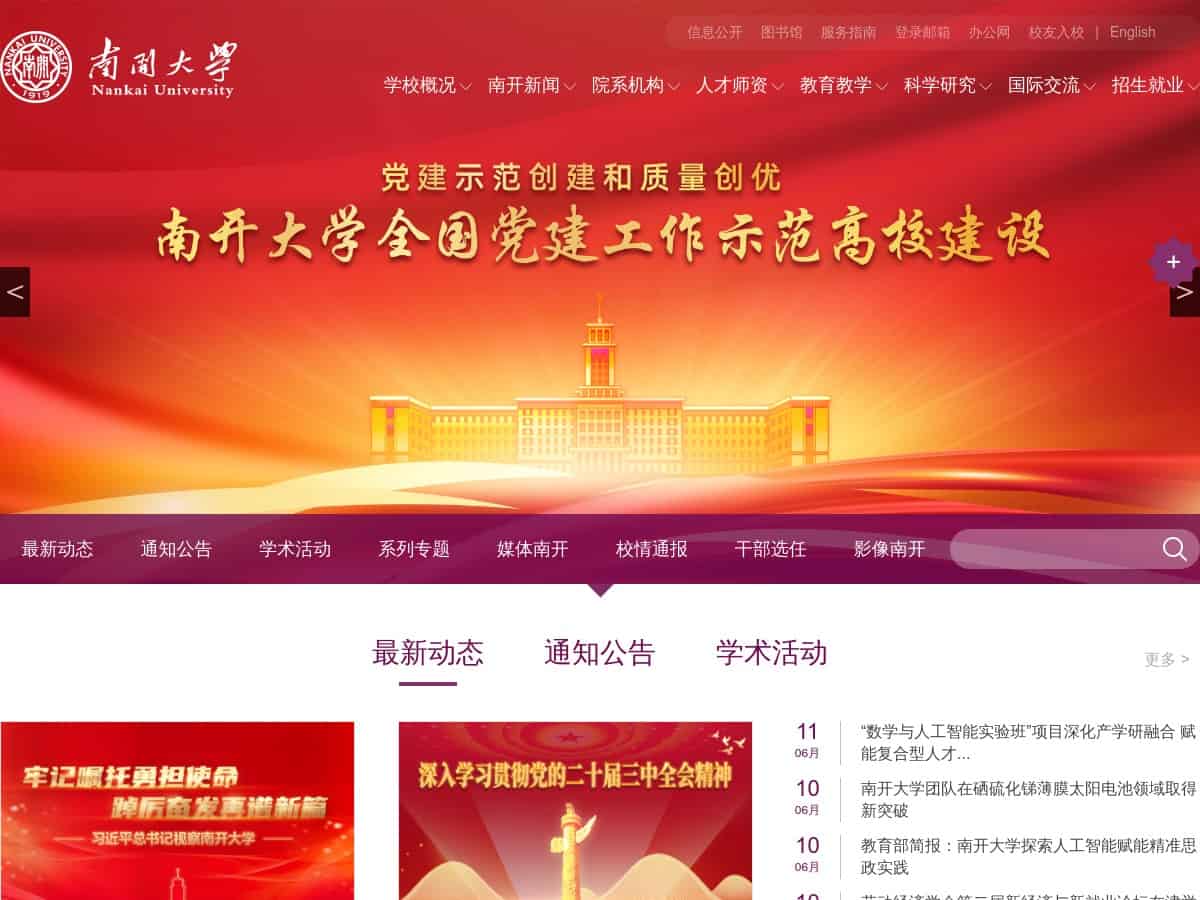
Address: 94 Weijin Road, Nankai District, 300071 Tianjin, Tianjin, China
Chemistry, Physics, Life Sciences
Nankai University stands in Tianjin and opened in 1919 under the educators Zhang Boling and Yan Xiu. Zhou Enlai, who later served as premier of China, is among its best-known alumni. Today it is a public university and takes part in China’s Double First-Class initiative, after earlier inclusion in Project 985 and Project 211.
The Second Sino-Japanese War shaped its history. In 1937 Nankai joined Peking University and Tsinghua University in a wartime university that later became the National Southwest Associated University, which worked in Kunming. After the war, in 1946, Nankai returned to Tianjin and was re-established as a national university, with Zhang Boling as its president.
The university works on three campuses that took their present layout in September 2015: Balitai, Jinnan and TEDA. Its English website speaks of more than 30,000 students on its home page, while another page of the same site gives over 36,000.
Domains taught:
AI and Machine Learning, Astroscience, Bioengineering, Bioinformatics, Chemistry, Computer Vision, Data Analytics, Ecology and Sustainability, Electrical and Electronics, Life Sciences, Materials, Mathematics, Microbiology and Genetics, Nanotechnologies, Optics, Physics, Software Engineering, Statistics, Telecommunications
Diplomas*:
Bachelor, Doctor, Master
Status:
Public
Partnerships:
Historical institution with strong academic traditions. International partnerships.
Research:
Organic Chemistry & Catalysis, Theoretical Physics & Condensed Matter, Molecular Biology & Genetics, AI & Data Science.
Famous Alumnis:
Zhou Enlai, Shiing-Shen Chern
International recognition**:
Number of staff***:
2000
Current students***:
30000
Foreign students***:
N/A%
Cumulative former students***:
N/A
Pros
Highly ranked comprehensive university, strong in basic sciences, particularly chemistry.
Cons
More known for sciences and humanities than extensive engineering programs.
Best For
Prestigious comprehensive university with exceptional strength in chemistry and mathematics.
Lanzhou University is a public university in Lanzhou whose main fields, chemistry, physics and life sciences, match the science core of Nankai almost exactly.
Nanjing University covers physics, chemistry, mathematics, earth sciences and life sciences next to humanities, law and business, which makes it a close public comprehensive peer in eastern China.
For a coastal comparison, Xiamen University is public and combines chemistry with marine science and materials science.
Peking University, a public comprehensive university in Beijing, lists physics, chemistry and life sciences among its main fields.
Tianjin University shares the city of Tianjin and is also public, but it leans towards engineering, with chemical, civil and mechanical engineering as main fields.
Most Similar Schools Abroad
Kyodai, better known as Kyoto University, is a public university in Japan whose main fields of chemistry, physics and life sciences closely echo the science profile of Nankai.
In Germany, Ruprecht-Karls-Universität Heidelberg is a public research university in Heidelberg working in physics and astronomy, chemistry and geosciences, and molecular life sciences.
Seoul National University is a public comprehensive university in South Korea, in the Gwanak-gu district of Seoul, spanning natural sciences, engineering, humanities, social sciences, law and business.
Singapore offers National University of Singapore, a public university where engineering, computing, medicine, business, law and science sit on one campus system.
Universiteit Leiden, a public university in the Netherlands, has life sciences, natural sciences and data science as main fields, so it suits readers who value Nankai for its science teaching.
*our own picks (our criteria: a mix between domains, diploma delivered, reputation and size), but obviously too many criteria for an apple-to-apple ranking.
FAQ
Who founded Nankai University and when did it open?
It opened in 1919 and is credited to the educators Zhang Boling and Yan Xiu. After the Second Sino-Japanese War it was re-established as a national university in 1946, again with Zhang Boling as president.
Where are the campuses of the university?
The university is based in Tianjin and has used a three-campus layout since September 2015: Balitai, Jinnan and TEDA. Addresses on the official website include Weijin Road in Nankai District and Tongyan Road in Jinnan District.
What happened to Nankai during the Second Sino-Japanese War?
In 1937 it joined Peking University and Tsinghua University in a wartime university that later became the National Southwest Associated University, which operated in Kunming. After the war Nankai returned to Tianjin in 1946.
How many students study at the university?
The official English website mentions more than 30,000 students on its home page and over 36,000 on another page, while Wikipedia reports 24,525 full-time students for 2018, so the exact figure depends on the date and on what is counted. Applicants who need a precise number should ask the admissions or international office.
Which famous person studied at Nankai?
Zhou Enlai, who later served as China's premier, is the best-known alumnus named by the university and by encyclopaedic sources.
Is Nankai part of a national excellence programme?
Yes. It belongs to China's Double First-Class initiative and earlier took part in Project 985 and Project 211.
*: without any judgment of the quality, readers are strongly encouraged to check the official status of the exact diploma envisioned as many universities have a mix of recognized diplomas, not recognized, “co-delivered,” “equivalent to”, “some pathways” (…), can change over time, and can be named differently from one country to another.
**: international reputation: is based on some criteria that do not mean much in some domains or specialties (number of researchers, of scientific publications, on budget ….). Our approximate 1-4 scale:
known locally
known locally and internationally
is listed in some of the world university’s classifications
is listed among the 20 firsts in some of world university’s classifications
***: estimated numbers, based on online sources and/or feedbacks. The numbers can vary greatly depending on school organisation (ex.: school is part of a group, it employs internal staff or external consultants or has public staff without employing them …). Refer to all the links provided to have accurate and updated numbers.
Innovation.world is not affiliated with this school/university. We recommend to contact them directly on their website for any special request.
To complete or correct any information here or share your opinion, please comment below or > send us a direct message <.