Address: Straße des 17. Juni 135, 10623 Berlin, Berlin, Germany
Mechanical Engineering, Computer Science & Electrical Engineering, Process Sciences
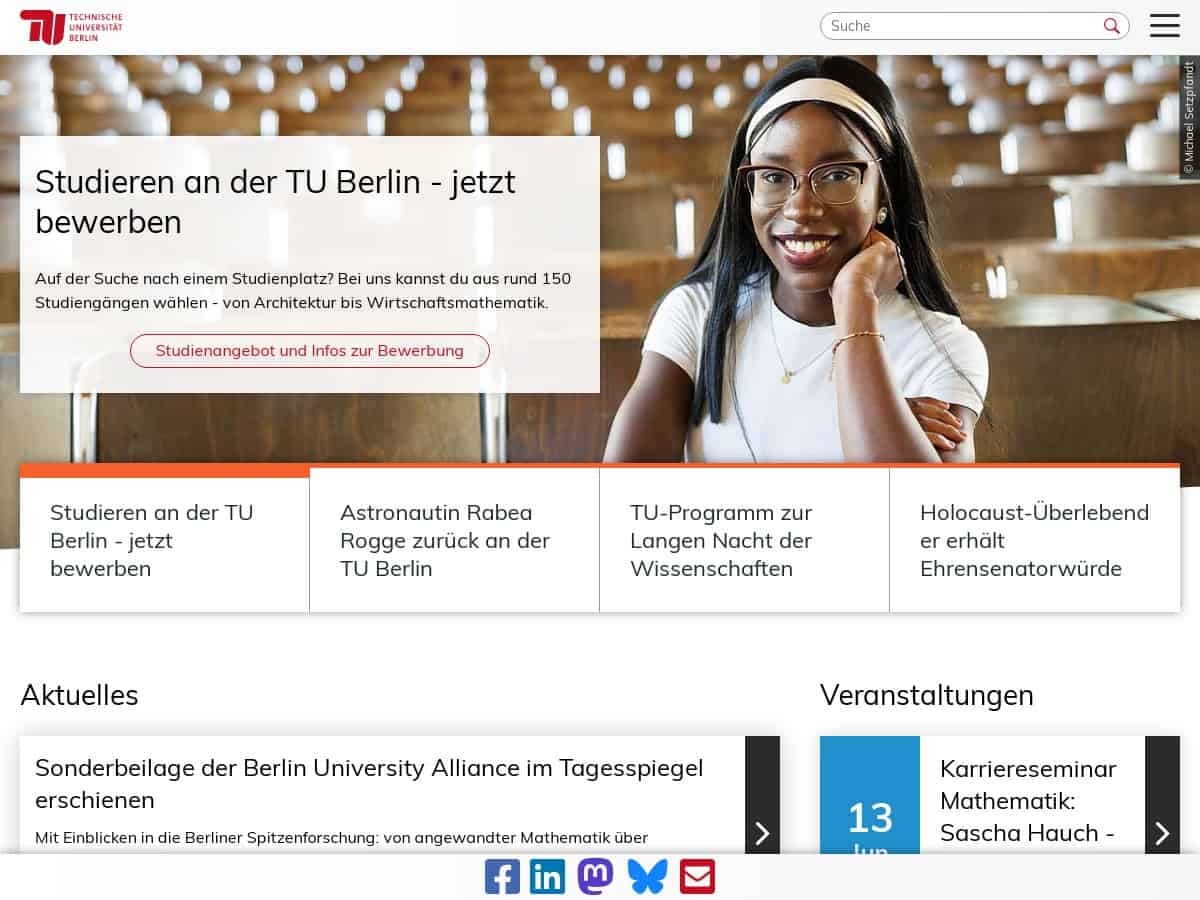
Founded in 1879 (with earlier roots), TU Berlin is one of Germany’s largest and most internationally renowned technical universities, located in the capital city.
Domains taught:
Aerospace, AI and Machine Learning, Automation, Bioengineering, Bioinformatics, Chemistry, Civil Engineering, Computer Vision, Data Analytics, Ecology and Sustainability, Electrical and Electronics, Engineering, Ergonomics and UX, Fluid Dynamics, Food Science, Geotechnics, Industrial Design, Life Sciences, Logistics, Manufacturing, Materials, Mathematics, Mechanical Engineering, Nanotechnologies, Optics, Physics, Process Control, Project Management, Quality, Robotics, Signal Processing, Software Engineering, Sound Engineering, Statistics, Structural Engineering, Telecommunications, Thermodynamics, Transportations
Diplomas*:
Bachelor, Doctor, Master
Status:
Public
Partnerships:
Member of TU9, T.I.M.E., CESAER, EUA. Numerous international partnerships and collaborations with Berlin’s research landscape and startup scene.
Research:
Digital Transformation & AI, Sustainable Energy Systems & Urban Development, Human-Machine Systems & Robotics, Materials Science & Manufacturing.
Famous Alumnis:
Carl Bosch, Gustav Hertz, Eugene Wigner, Dennis Gabor
International recognition**:
Number of staff***:
8000
Current students***:
35000
Foreign students***:
30%
Cumulative former students***:
N/A
Pros
Located in Berlin (major innovation hub), strong international profile, wide range of engineering and science programs, active entrepreneurial ecosystem.
Cons
Very large university, can be anonymous, bureaucracy, campus facilities vary in age.
Best For
Major international technical university in Berlin, strong in engineering, computer science, and process sciences.
*: without any judgment of the quality, readers are strongly encouraged to check the official status of the exact diploma envisioned as many universities have a mix of recognized diplomas, not recognized, “co-delivered,” “equivalent to”, “some pathways” (…), can change over time, and can be named differently from one country to another.
**: international reputation: is based on some criteria that do not mean much in some domains or specialties (number of researchers, of scientific publications, on budget ….). Our approximate 1-4 scale:
known locally
known locally and internationally
is listed in some of the world university’s classifications
is listed among the 20 firsts in some of world university’s classifications
***: estimated numbers, based on online sources and/or feedbacks. The numbers can vary greatly depending on school organisation (ex.: school is part of a group, it employs internal staff or external consultants or has public staff without employing them …). Refer to all the links provided to have accurate and updated numbers.
Innovation.world is not affiliated with this school/university. We recommend to contact them directly on their website for any special request.
To complete or correct any information here or share your opinion, please comment below or > send us a direct message <.