Address: 1125 Colonel By Drive, K1S 5B6 Ottawa, Ontario, Canada
Journalism and Communication, Public Affairs, Engineering
Carleton University is a public university in Ottawa, Ontario, on the Rideau River. It began in 1942 as Carleton College, a non-denominational college that offered evening university courses to people in the city, many of them working during the day. Over the following decades it grew from that evening-class beginning into a comprehensive university; the arrival of returning Second World War veterans led to day classes alongside the evening courses.
A provincial charter in 1952 gave the college the power to grant university degrees, and in 1957 it became a university. Since 1959 it has occupied its present site along the Rideau River, close to the Rideau Canal.
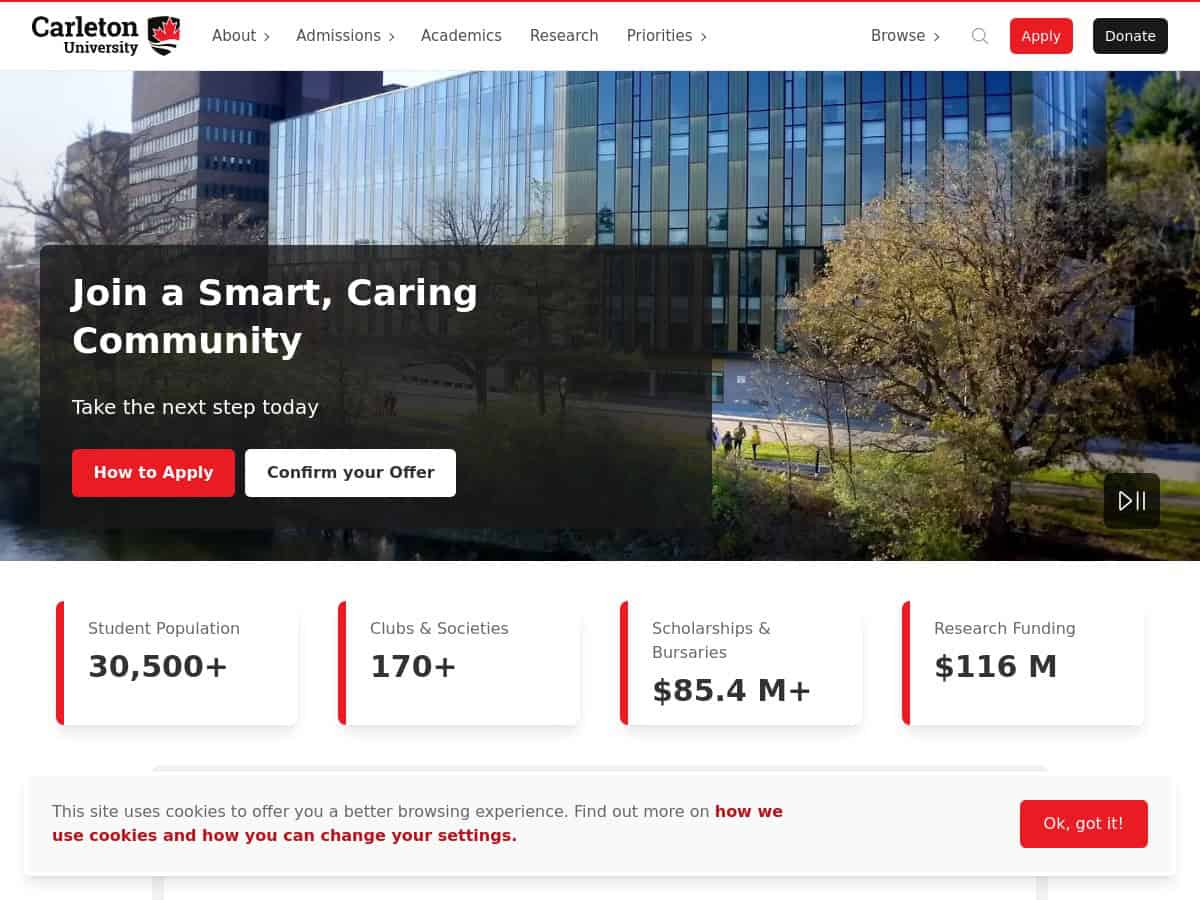
Today the university enrols more than 30,000 students, and its programmes span arts and social sciences, engineering, science, public affairs and business. The university describes its location as central, close to downtown Ottawa and reachable by public transit. Its campus address is 1125 Colonel By Drive.
Domains taught:
Aerospace, AI and Machine Learning, Data Analytics, Engineering, Life Sciences, Software Engineering, Telecommunications
Diplomas*:
Bachelor, Certificate, Diploma, Doctor, Master
Status:
Public
Partnerships:
Located in the national capital, offering partnerships with government, NGOs, and tech industry (Kanata North). Strong co-op programs.
Research:
Research strengths in public policy and administration, communication and media studies, engineering (aerospace, software), and high technology.
Famous Alumnis:
Dan Aykroyd, Rosemary Barton, Gavin McInnes, Conrad Black (attended)
International recognition**:
Number of staff***:
4500
Current students***:
32000
Foreign students***:
10%
Cumulative former students***:
170000
Pros
Strong programs in journalism, public affairs, and specific engineering fields; co-op opportunities in Ottawa; supportive campus environment.
Cons
Large commuter student population, some older campus buildings, research profile is strong but not as broad as UOttawa in some areas.
Best For
Students interested in journalism, public affairs, international relations, or engineering, often valuing co-op opportunities within Canada’s capital city.
University of Ottawa shares the city and offers public policy and international affairs, health sciences and law, making it the nearest neighbour for public-affairs interests.
Toronto Metropolitan University is a public university whose fields include media, business and engineering in an urban Toronto setting.
Concordia University is a public comprehensive university in Montreal with fine arts, business and engineering as main fields.
University of Waterloo is a public university with computer science, engineering and mathematics, including co-op study, which parallels Carleton's engineering side.
Simon Fraser University, a public university in Burnaby, British Columbia, lists computing science, criminology and environmental science among its main fields.
Most Similar Schools Abroad
City, University of London in the United Kingdom is a public university with business, journalism and law as main fields, which parallels Carleton's journalism interests.
Goldsmiths, University of London in the United Kingdom is a public institution focused on art and design, media and social sciences.
Dublin City University in Ireland is a public university in the Glasnevin district with engineering and computer science among its main fields.
Australian National University in Australia is a public university in Canberra covering science, Asia and Pacific studies, and law and policy, a national-capital counterpart to Ottawa.
Victoria University of Wellington in New Zealand is a public university in the capital with architecture and design and business among its main fields.
*our own picks (our criteria: a mix between domains, diploma delivered, reputation and size), but obviously too many criteria for an apple-to-apple ranking.
FAQ
When was Carleton founded?
It was established in 1942 as Carleton College, a non-denominational institution that offered evening courses. The name changed to Carleton University when it became a university in 1957.
When did it gain the right to award degrees?
A provincial charter in 1952 gave the college the power to grant degrees. It became a university in 1957.
Where is the campus located?
The campus lies in Ottawa along the Rideau River, and the university has used this site since 1959. It is close to downtown and to the Rideau Canal.
How many students does Carleton have?
Published figures give more than 30,000 students, with the university itself citing about 30,700. Both undergraduate and postgraduate students are included in this total.
What can students study there?
Programmes cover arts and social sciences, engineering, science, public affairs and business.
Which Carleton pages list tuition and deadlines?
Entry requirements, tuition fees and deadlines are published on the official Carleton website, with separate pages for undergraduate and graduate programmes. Applicants should consult the page of the programme they want.
Aerospace, Artificial Intelligence (AI), Engineering, Environmental Engineering, Research and Development, Sustainable Development
*: without any judgment of the quality, readers are strongly encouraged to check the official status of the exact diploma envisioned as many universities have a mix of recognized diplomas, not recognized, “co-delivered,” “equivalent to”, “some pathways” (…), can change over time, and can be named differently from one country to another.
**: international reputation: is based on some criteria that do not mean much in some domains or specialties (number of researchers, of scientific publications, on budget ….). Our approximate 1-4 scale:
known locally
known locally and internationally
is listed in some of the world university’s classifications
is listed among the 20 firsts in some of world university’s classifications
***: estimated numbers, based on online sources and/or feedbacks. The numbers can vary greatly depending on school organisation (ex.: school is part of a group, it employs internal staff or external consultants or has public staff without employing them …). Refer to all the links provided to have accurate and updated numbers.
Innovation.world is not affiliated with this school/university. We recommend to contact them directly on their website for any special request.
To complete or correct any information here or share your opinion, please comment below or > send us a direct message <.