Product Design, Manufacturing & Innovation Resources
Lar » Eficiência termodinâmica das células de combustível

Eficiência termodinâmica das células de combustível

1950
  • Josiah Willard Gibbs
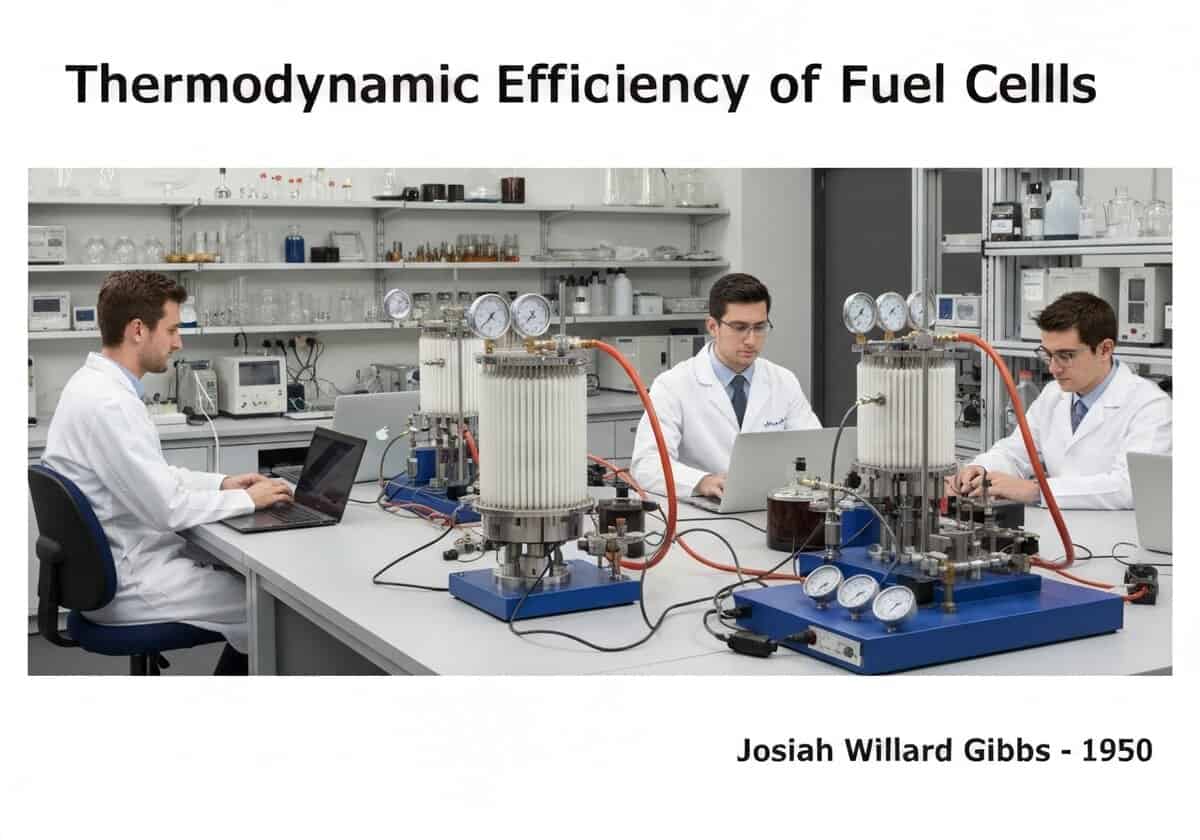
Laboratory research on thermodynamic efficiency of fuel cells with scientists and equipment.

(Imagem gerada apenas para fins ilustrativos)

A eficiência teórica máxima de um célula de combustível é governada pela razão entre a variação da energia livre de Gibbs (ΔG) e a variação da entalpia (ΔH) da reação eletroquímica. Isso é expresso como ηtermo = ΔG/ΔH. Fundamentalmente, as células a combustível não são máquinas térmicas e, portanto, não são limitadas pelo limite de eficiência de Carnot, permitindo eficiências de conversão teóricas significativamente maiores.

The Gibbs free energy, [latex]\Delta G[/latex], represents the maximum amount of non-expansion work that can be extracted from a thermodynamically closed system at constant temperature and pressure. In a fuel cell, this work is the electrical work performed. The change in enthalpy, [latex]\Delta H[/latex], represents the total heat content of the reaction, which is the energy released during combustion. The difference between these two values, [latex]T\Delta S[/latex] (where T is temperature and [latex]\Delta S[/latex] is the change in entropy), represents the unavoidable waste heat generated by the reaction even under ideal, reversible conditions.

In contrast, a heat engine’s maximum efficiency is dictated by the Carnot limit, [latex]\eta_C = 1 – \frac{T_{cold}}{T_{hot}}[/latex], which depends on the temperature difference between its hot and cold reservoirs. For a typical combustível de hidrogênio cell operating at standard conditions, the termodinâmica efficiency is around 83%, whereas practical internal combustion engines struggle to exceed 40%. While the theoretical fuel cell efficiency is high, real-world devices suffer from several irreversible losses, or ‘polarizations’, that reduce their practical efficiency. These include activation losses (energy needed to initiate the reaction), ohmic losses (resistance to ion and electron flow), and mass transport losses (failure to supply reactants to reaction sites quickly enough).

UNESCO Nomenclature: 2212
Termodinâmica

Tipo

Sistema abstrato

Interrupção

Substancial

Uso

Uso generalizado

Precursores

  • formulação do primeira lei da termodinâmica (c. 1850)
  • formulação do second law of thermodynamics and the concept of entropy by Rudolf Clausius (1850s)
  • Desenvolvimento do conceito de energia livre de Gibbs por Josiah Willard Gibbs (década de 1870)

Aplicações

  • Projeto de sistemas de cogeração (CHP) de alta eficiência
  • optimization of célula de combustível operating parameters (temperature, pressure)
  • Pesquisa em ciência dos materiais para reduzir as perdas de energia em eletrodos e eletrólitos.
  • modelagem teórica do desempenho de células a combustível de próxima geração
  • economic analysis of fuel cell viability versus combustion tecnologias

Patentes:

NA

Ideias de Inovação Potencial

  • ai algorithms to dynamically optimize fuel cell operation to minimize entropy generation
  • novel catalisadores that lower the activation energy barrier, approaching the gibbs free energy limit
  • thermally integrated fuel cell systems that use waste heat to power secondary thermodynamic cycles
  • membranes with engineered entropy characteristics for improved water management
  • pressure-swing systems that increase reactant partial pressure to boost the \Delta g of the reaction
  • fuel cells operating under supercritical fluid conditions to alter thermodynamic properties
  • quantum tunneling catalysts to bypass traditional reaction pathways and reduce activation losses
  • multi-fuel systems that switch between fuels based on thermodynamic efficiency at current operating conditions
  • self-healing materials that reduce the increase in ohmic resistance over time
  • magnetocaloric cooling systems integrated into fuel cell stacks to manage thermal gradients more efficiently
Relacionado a: energia livre de Gibbs, entalpia, entropia, eficiência de células a combustível, termodinâmica, ciclo de Carnot, polarização, perda de tensão, eletroquímica, conversão de energia.

Contexto histórico

Eficiência termodinâmica das células de combustível

1950
1950
1950
1950
1957
1957
1959-11
1950
1950
1950
1950
1950
1957
1958
1960

(Caso a data seja desconhecida ou irrelevante, por exemplo, "mecânica dos fluidos", é fornecida uma estimativa aproximada de seu surgimento notável)

10º ano aniversário

Imagens em tamanho real e downloads estão disponíveis apenas, 100% gratuitos, para membros registrados.