Did you know electric vehicles over their lifetime emit over 60% less than gas-powered cars? This fact highlights the need for accurate environmental impact evaluations. When it comes to sustainability analysis, there’s a big debate between Life Cycle Assessment (LCA) and Product Carbon Footprint (PCF). Each method has its own pros and cons that businesses must look at.
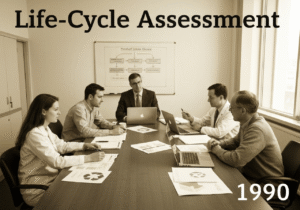
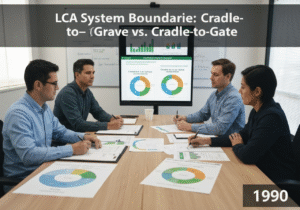
LCA examines a product’s journey from start to end. It is often required by various regulations and standards worldwide. This method looks at several impacts, like ozone harm, water use, and pollution of water bodies. It ensures a product’s environmental impact is fully understood.
On the other hand, PCF measures greenhouse gases throughout a product’s life, turning them into CO2 equivalents. This specific focus means it can be done faster, using less effort and knowledge. This makes it a go-to for companies focusing on cutting carbon emissions.
Choosing between LCA and PCF depends on what resources you have, the norms in your industry, and your goals for sustainability.
Both methods are crucial in helping companies share how green their products are. Knowing the differences and uses of LCA and PCF helps businesses make choices that match their green goals.
Key Takeaways
- Life Cycle Assessment (LCA) covers the entire life cycle of a product from cradle to grave, offering a comprehensive evaluation of environmental impacts.
- Product Carbon Footprint (PCF) focuses solely on greenhouse gas emissions, converting them into CO2 equivalents for comparison.
- LCA is often encouraged or required by various regulations, standards, and frameworks, addressing broader environmental issues beyond carbon emissions.
- PCF can be completed more quickly and with fewer resources, making it ideal for businesses focusing on carbon emission reduction.
Understanding Life Cycle Assessment (LCA)
What is Life Cycle Assessment?
A life cycle assessment looks closely at how products affect nature. It examines emissions, how much resources they use, and the waste they produce. Following global standards, like ISO 14040 and ISO 14044, it provides reliable results. LCAs make businesses aware of their impact, guiding them to reduce harm.
The Methodology of LCA
The LCA methodology goes through four steps: setting goals, gathering data, assessing impacts, and making plans to improve. First, it defines the study’s aim and scope. Then, it collects data to understand what goes in and out of a product’s lifecycle. The next step looks at the environmental effects, such as global warming.
Finally, the findings suggest how to lessen negative impacts. Tools make LCA easier by estimating carbon impacts with a single Global Warming Potential figure.
LCA vs PCF
LCA (Life Cycle Assessment) and PCF (Product Carbon Footprint) have different scopes and standards. They play unique roles in environmental reporting. The main difference is what they cover and the rules they follow.
Scope Comparison
LCA looks at many environmental and health impacts across a product’s life. It considers factors like climate change, water use, and more. LCA aims to address multiple business and sustainability goals.
PCF measures the climate impact by counting greenhouse gases during a product’s life. It focuses just on global warming potential. PCF is a faster tool for companies to meet urgent climate goals.
Both use similar life cycle stages for evaluation but differ in detail and focus. PCF can be seen as a part of LCA focusing on greenhouse gases.
Application and Regulatory Requirements
LCA and PCF follow different regulatory standards like ISO 14040/44 and ISO 14067. LCA is often required by stricter global standards. It helps in making strategic decisions on various environmental issues.
PCF is used for meeting carbon targets within simpler rules. It’s often summarized in factsheets or reports. Both methods rely on high-quality data for accuracy.
| Aspect | LCA | PCF |
|---|---|---|
| Scope | Broad (multiple environmental impacts) | Narrow (greenhouse gas emissions) |
| Focus Areas | Climate change, ozone depletion, water use, acidification, etc. | Climate impact (GHG emissions) |
| Methodology | Comprehensive analysis across life cycle stages | Specific analysis on GHG emissions |
| Regulatory Standards | ISO 14040/44, ISO 14067, PAS 2050 | ISO 14067, GHG Product Life Cycle Standard |
| Application | Strategic decisions on multiple environmental issues | Carbon-related targets and reporting |
The rest of this article is reserved for members
To limit scraping bots (currently 40,000 hits per day!),
we had to restrict access to full articles and tools to registered members only.
to access all the rest.