Product Design, Manufacturing & Innovation Resources
집 » Chemical Bonding

Chemical Bonding

1916
  • Gilbert N. Lewis
  • Linus Pauling
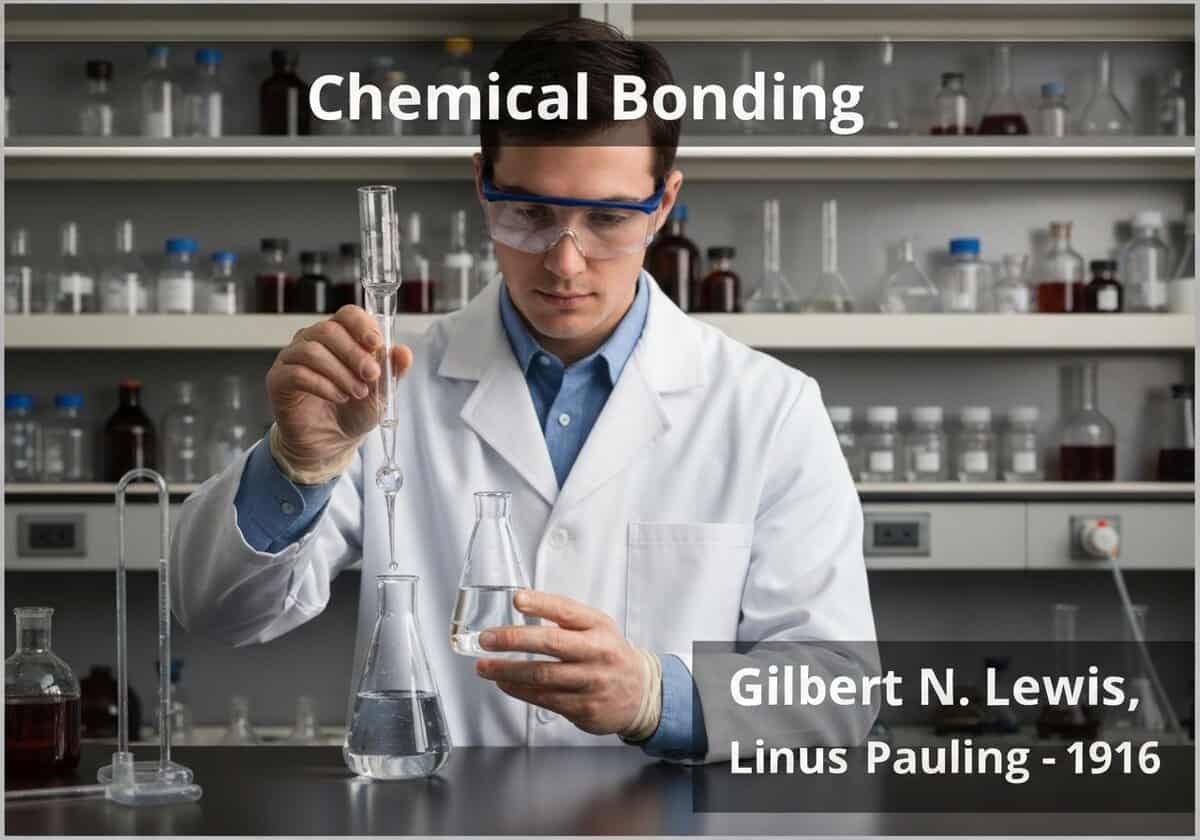
물리화학에서 화학 결합을 설명하는 실험실 장면.

(설명을 위한 생성된 이미지입니다)

A chemical bond is a lasting attraction between atoms, ions, or molecules that enables the formation of chemical compounds. Bonds result from the electrostatic force of attraction between oppositely charged ions (ionic bonds) or through the sharing of electrons (covalent bonds). The strength and type of bonds dictate the structure and properties of a substance.

화학 결합이라는 개념은 개별 원자들이 어떻게 결합하여 우리가 관찰하는 수많은 물질을 형성하는지 설명합니다. 길버트 N. 루이스가 1916년에 제안한 공유 결합은 원자들이 전자쌍을 공유하여 안정적인 전자 배치(‘옥텟 규칙’)를 이루는 결합으로, 이는 획기적인 진전이었습니다. 루이스 구조로 시각화된 이 단순하면서도 강력한 아이디어는 비이온성 화합물의 결합에 대한 최초의 명확한 그림을 제공했습니다. 이와 대조적으로, 이온 결합은 전기음성도가 낮은 원자(일반적으로 금속)에서 전기음성도가 높은 원자(비금속)로 하나 이상의 전자가 완전히 이동하여 생성되는 전하를 띤 이온들이 정전기적 인력에 의해 서로 결합함으로써 형성됩니다.

Our understanding was deepened significantly by the application of quantum mechanics. Linus Pauling’s valence bond theory, introduced in the 1930s, described covalent bonds as the result of the overlap of atomic orbitals. This theory introduced the concepts of hybridization (e.g., sp, sp2, sp3) and resonance to explain observed molecular geometries and bond properties. An alternative and often more powerful approach is molecular orbital (MO) theory, which considers electrons to be delocalized across the entire molecule in molecular orbitals formed from the combination of atomic orbitals. MO theory is essential for explaining the properties of conjugated systems, magnetism, and excited states. Beyond these primary types, there are also metallic bonds, characterized by a ‘sea’ of delocalized electrons, and weaker intermolecular forces like 수소 bonds and 반 데르 발스 액체, 고체, 그리고 DNA와 같은 생체 고분자의 특성에 매우 중요한 힘.

UNESCO Nomenclature: 2209
물리화학

유형

추상 시스템

분열

기초적인

용법

널리 사용됨

전구체

  • 원자 이론 (존 달튼)
  • 전자의 발견 (JJ 톰슨)
  • 원자핵 모형의 개발 (어니스트 러더퍼드)
  • '친화력'과 '가치'에 대한 초기 개념

응용 프로그램

  • materials science and engineering (e.g., creating alloys, 고분자)
  • 약물 설계 및 약리학
  • 새로운 화학 화합물의 합성
  • 생물학적 과정(예: 단백질 접힘)에 대한 이해
  • development of adhesives and 복합재료
  • 분자 기하학 예측 (VSEPR 이론)

특허:

NA

잠재적 혁신 아이디어

  • ‘programmable’ molecules that change shape and function in response to light or heat by altering their bonding
  • self-healing materials with reversible covalent bonds that reform after fracture
  • two-dimensional materials beyond 그래핀 with unique bonding configurations for advanced electronics
  • bio-integrated electronics using conductive polymers with biocompatible bonding properties
  • ‘mechanophores’ that change color or fluoresce when a specific chemical bond is broken by mechanical stress
  • artificial enzymes with active sites designed to form and break specific covalent bonds with high precision
  • adhesives that can be switched ‘on’ and ‘off’ using an electrical field to modulate ionic bonding
  • quantum materials where electron sharing in covalent bonds leads to exotic states like 초전도성
  • energy storage systems based on forming and breaking 고에너지 chemical bonds in ‘solar fuels’
  • computational platforms for designing novel compounds by predicting bonding from first principles
관련 개념: 화학 결합, 공유 결합, 이온 결합, 금속 결합, 길버트 N. 루이스, 라이너스 폴링, 전기음성도, 원자가 전자, 분자 궤도 이론, 분자간 힘.

역사적 맥락

Chemical Bonding

1912
1915
1915-11
1916
1918
1919-05-29
1920
1911-04-08
1913
1915
1916
1917
1918
1920
1920

(날짜를 알 수 없거나 관련이 없는 경우, 예를 들어 "유체역학"의 경우, 주목할 만한 등장 시기를 대략적으로 추정하여 제공합니다.)

10년차 기념일

고화질 이미지 및 다운로드는 등록된 회원에게만 100% 무료로 제공됩니다.

> 로그인 <