Product Design, Manufacturing & Innovation Resources
Lar » Sobrepotencial (química)

Sobrepotencial (química)

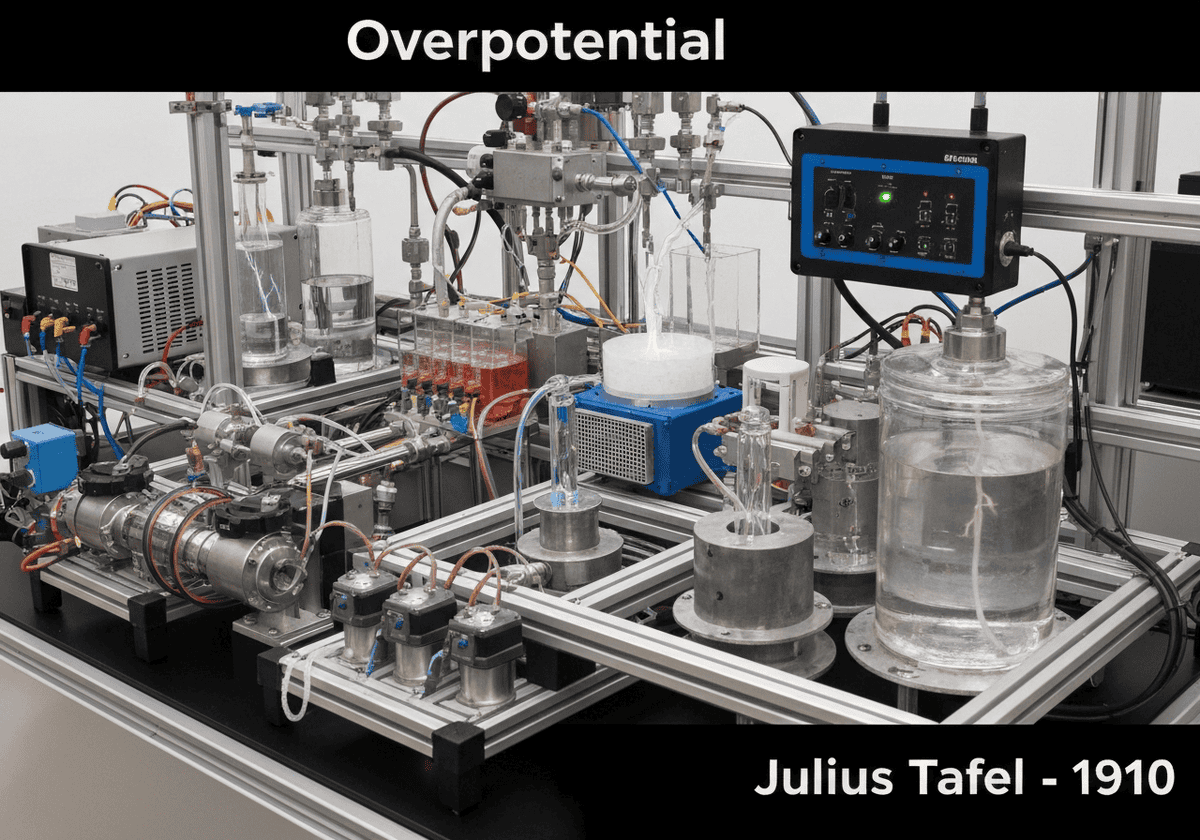
1910
  • Julius Tafel
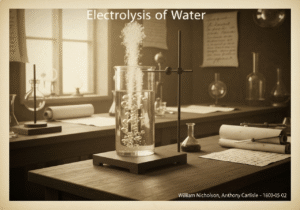
Configuração de um eletrolisador industrial que ilustra o sobrepotencial na eletroquímica.

(Imagem gerada apenas para fins ilustrativos)

A sobretensão é a diferença de potencial (voltagem) entre o potencial de redução termodinamicamente determinado de uma semirreação e o potencial no qual o evento redox é observado experimentalmente. Ela representa a energia extra necessária para superar as barreiras de ativação para que a reação no eletrodo ocorra a uma taxa significativa. É um fator chave na eficiência energética de todos os processos eletrolíticos.

In an ideal electrolytic cell, the applied voltage needed to drive a reaction would be exactly equal to the cell’s standard electrode potential ([latex]E^0_{cell}[/latex]). However, in reality, a significantly higher voltage is almost always required. This excess voltage is the overpotential ([latex]\eta[/latex]). The total cell potential ([latex]E_{cell}[/latex]) is the sum of the equilibrium potential, the overpotentials at both electrodes, and the ohmic drop (IR drop) across the electrolyte: [latex]E_{cell} = E^0_{cell} + \eta_{anode} + \eta_{cathode} + IR_{drop}[/latex].

A sobretensão surge de diversas fontes. A sobretensão de ativação está relacionada à cinética do... transferência de elétrons step at the electrode surface itself. Some reactions, like the evolution of hidrogênio or oxygen gas, have inherently slow kinetics and require a large activation overpotential. Concentration overpotential occurs when the concentration of reactants at the electrode surface differs from the bulk concentration due to slow diffusion. Resistance overpotential is caused by the resistance of the electrolyte or films on the electrode surface.

The relationship between current density (j) and activation overpotential is often described by the Tafel equation: [latex]\eta = a + b \log(j)[/latex], where ‘a’ and ‘b’ are constants (Tafel parameters) specific to the electrode reaction and material. This equation shows that to get a higher reaction rate (higher current density), a larger overpotential is required. The primary goal in designing efficient electrochemical systems is to minimize overpotential, which is typically achieved by using electrocatalysts (materials that lower the activation energy), increasing the operating temperature, or optimizing the electrode structure to enhance mass transport.

UNESCO Nomenclature: 2406
Eletroquímica

Tipo

Fenômeno físico

Interrupção

Substancial

Uso

Uso generalizado

Precursores

  • Nernst equação que descreve os potenciais de equilíbrio dos eletrodos
  • Equação de Arrhenius que relaciona a velocidade da reação com a energia de ativação.
  • desenvolvimento do conceito de cinética química
  • Faraday’s laws of electrolysis

Aplicações

  • Projetar eletrolisadores industriais eficientes (por exemplo, para produção de hidrogênio)
  • developing better catalisadores to reduce energy loss in fuel cells
  • understanding and preventing corrosão
  • Melhorar o desempenho das baterias durante o carregamento.
  • Otimização dos processos de galvanoplastia para revestimentos uniformes

Patentes:

NA

Ideias de Inovação Potencial

  • high-throughput screening of novel liga catalysts to minimize overpotential for water splitting
  • nanostructured electrodes with high surface area to reduce effective current density and concentration overpotential
  • self-healing catalysts that regenerate their active sites during operation
  • pulsed electrolysis techniques to disrupt concentration gradients at the electrode surface
  • machine learning models to predict overpotential for new materials
  • in-situ spectroscopic techniques to study reaction intermediates and understand overpotential mechanisms
  • ionic liquid electrolytes designed to lower the activation barrier for specific reactions
  • bio-inspired catalysts mimicking enzymes like hydrogenase
Related to: overpotential, electrolysis, electrochemistry, Tafel equation, activation energy, voltage efficiency, eletrocatálise, current density.

Contexto histórico

Sobrepotencial (química)

1800-05-02
1880
1900
1910
1921
1930
1930
1800
1834-01-01
1880
1902
1920
1928
1930
1940

(Caso a data seja desconhecida ou irrelevante, por exemplo, "mecânica dos fluidos", é fornecida uma estimativa aproximada de seu surgimento notável)

10º ano aniversário

Imagens em tamanho real e downloads estão disponíveis apenas, 100% gratuitos, para membros registrados.