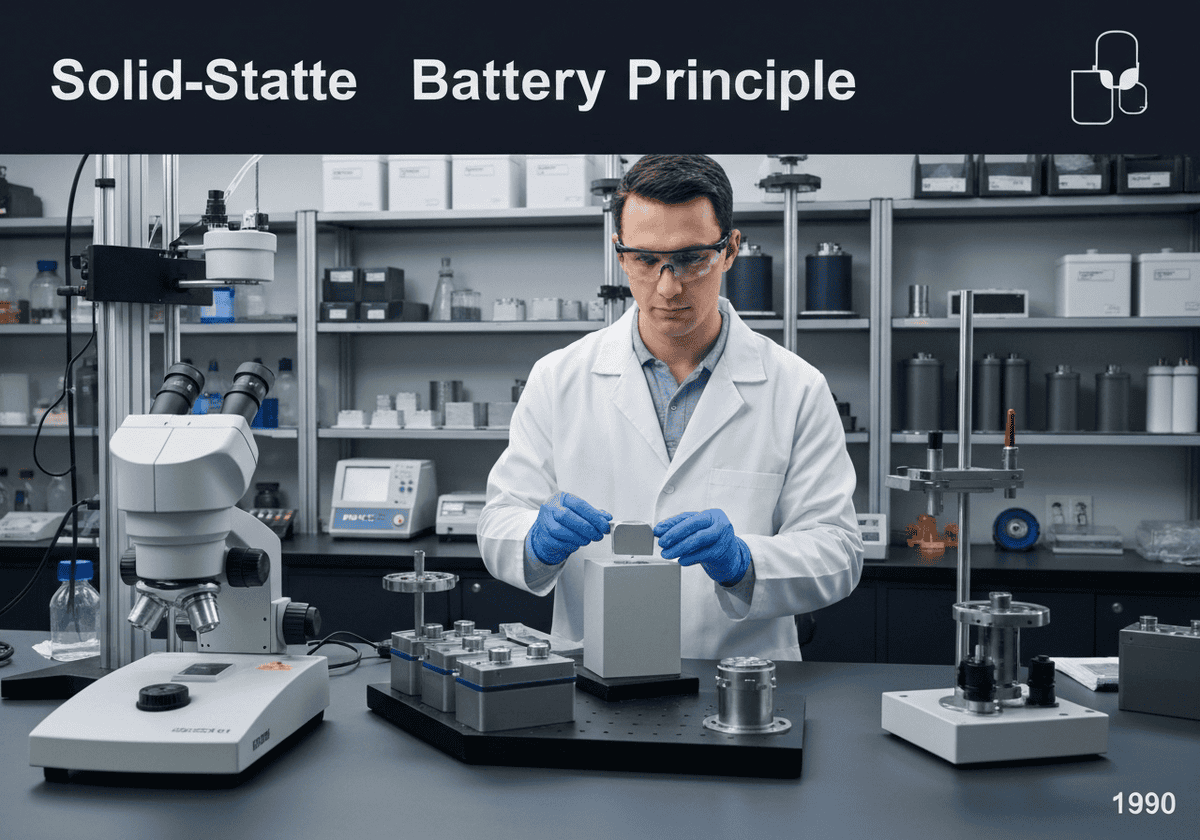
고체 배터리는 기존 배터리의 액체 또는 고분자 겔 전해질을 세라믹이나 고체 고분자와 같은 고체 이온 전도성 물질로 대체한 것입니다. 이러한 설계는 가연성 액체 전해질을 제거하여 안전성을 향상시키고, 특히 순수 리튬 금속과 같은 고용량 양극재 사용을 가능하게 하여 에너지 밀도와 수명을 늘리는 것을 목표로 합니다.
(설명을 위한 생성된 이미지입니다)
고체 배터리는 기존 배터리의 액체 또는 고분자 겔 전해질을 세라믹이나 고체 고분자와 같은 고체 이온 전도성 물질로 대체한 것입니다. 이러한 설계는 가연성 액체 전해질을 제거하여 안전성을 향상시키고, 특히 순수 리튬 금속과 같은 고용량 양극재 사용을 가능하게 하여 에너지 밀도와 수명을 늘리는 것을 목표로 합니다.

The core innovation of a solid-state battery is the solid electrolyte. This component must fulfill the challenging dual role of being an excellent conductor for ions while being a perfect electrical insulator to prevent internal short circuits. Researchers are exploring several classes of materials, including inorganic crystalline ceramics (e.g., garnet-type LLZO – Li₇La₃Zr₂O₁₂), amorphous glassy ceramics, and solid 고분자.
주된 동기는 안전입니다. 기존 방식 리튬 이온 배터리 use flammable organic liquid electrolytes, which can leak and catch fire in cases of damage or malfunction, a phenomenon known as thermal runaway. A solid, non-flammable electrolyte inherently mitigates this risk. Beyond safety, the solid electrolyte is a key enabler for next-generation anode materials. The ultimate anode is pure 리튬 metal, which offers the highest theoretical energy density. However, in liquid electrolytes, lithium metal tends to form needle-like structures called dendrites during charging. These dendrites can grow across the separator, short-circuit the cell, and cause a fire.
기계적 강도가 우수한 고체 전해질은 물리적 장벽 역할을 하여 덴드라이트 성장을 억제하고 리튬 금속 음극을 안전하게 사용할 수 있도록 합니다. 이는 에너지 밀도가 크게 향상되어(전기차의 주행 거리 증가) 수명이 연장된 배터리를 구현하는 데 기여할 수 있습니다. 하지만 상온에서 높은 이온 전도도를 달성하고, 부피 변화 시 고체 전해질과 전극 사이의 안정적인 계면을 유지하며, 비용 효율적인 제조 공정을 개발하는 것이 여전히 중요한 과제입니다.
고체 배터리 원리
(날짜를 알 수 없거나 관련이 없는 경우, 예를 들어 "유체역학"의 경우, 주목할 만한 등장 시기를 대략적으로 추정하여 제공합니다.)

고화질 이미지 및 다운로드는 등록된 회원에게만 100% 무료로 제공됩니다.
> 로그인 <