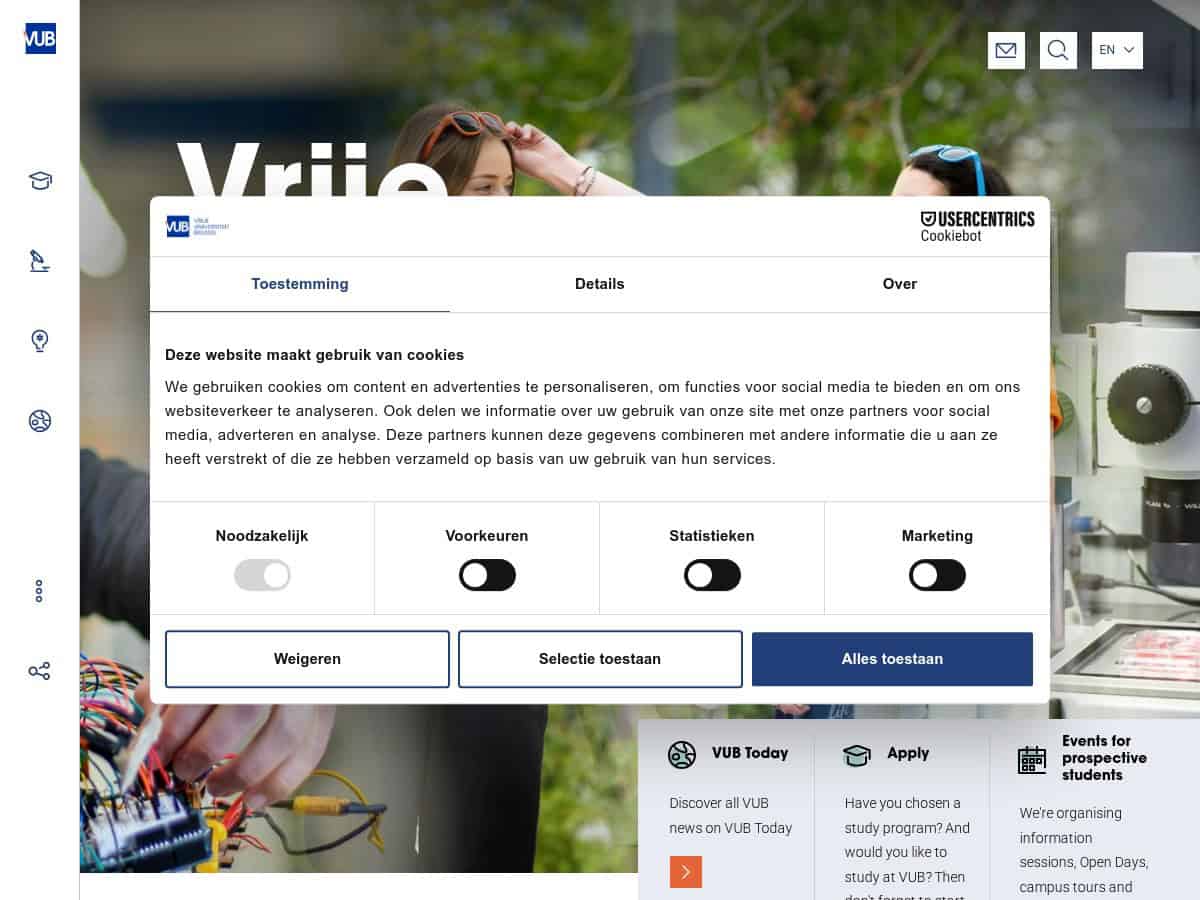
The Vrije Universiteit Brussel is a Dutch-speaking university in Brussels, established in 1970 as a split from ULB. It is known for its research, particularly in fields like photonics and AI, and its commitment to free inquiry.
The Vrije Universiteit Brussel, VUB, is the Dutch-speaking sister of ULB. Both descend from the free university founded in 1834, and the two separated in 1970 along language lines. VUB counts about 20,000 students and 3,500 staff, and around one student in five comes from abroad. The main Etterbeek campus lies next to the ULB’s Solbosch campus, and the university hospital UZ Brussel is in Jette.
Free inquiry remains the guiding principle, and the university has used it to build a distinctive international identity. Many of its master’s programmes are taught in English. The engineering programme is organised together with ULB in the Brussels Faculty of Engineering, known as Bruface, which offers joint degrees and attracts students from across Europe. The mathematician Ingrid Daubechies, known for wavelet theory, took her doctorate at VUB.
VUB is especially strong in photonics, artificial intelligence and robotics. The AI Lab, set up by Luc Steels in the 1980s, was among the first in Europe to work on evolutionary robotics and language emergence, and the Brussels Photonics group works on lasers and fibre sensing with industrial partners. Medical innovation, environmental science and sustainable chemistry are further focus areas, and the EUTOPIA alliance connects VUB with universities in Ljubljana, Warsaw, Barcelona and elsewhere.
EU students pay the regulated Flemish tuition fee, and non-EU students pay higher fees. Dutch is the main teaching language for bachelor degrees, with English increasingly present at master’s level. Brussels offers internships in the European institutions, international companies and research bodies, but rents are high, so many students look for shared flats in Ixelles or Etterbeek.
The university is compact and the Etterbeek campus has a lively student life, with associations from all linguistic communities. About 80,000 people have graduated from VUB, and its alumni network is well represented in Brussels business, media and politics.
Domains taught:
AI and Machine Learning, Bioengineering, Bioinformatics, Chemistry, Civil Engineering, Computer Vision, Data Analytics, Electrical and Electronics, Engineering, Fluid Dynamics, Materials, Mathematics, Mechanical Engineering, Nanotechnologies, Optics, Physics, Robotics, Software Engineering, Structural Engineering, Telecommunications
Diplomas*:
Bachelor, Doctor, Master
Status:
Public
Partnerships:
EUTOPIA European University. Strong European and international network, collaborations with industry in Brussels.
Research:
Fundamental research, Photonics, AI and robotics, Medical innovations, Environmental sciences, Sustainable chemistry.
Famous Alumnis:
Ingrid Daubechies, Annemie Neyts-Uyttebroeck, Kim Gevaert
International recognition**:
Number of staff***:
3500
Current students***:
20000
Foreign students***:
20%
Cumulative former students***:
80000
Pros
Located in Brussels (capital of Europe), strong research in specific niche fields, emphasis on small-group teaching and interaction.
Cons
Campus is somewhat outside the main city center, can be less internationally known than older Belgian universities in some fields.
Best For
Research in photonics, AI, and engineering in Brussels, with a focus on societal relevance.
Université libre de Bruxelles is the closest domestic counterpart for bioinformatics, nanotechnologies and optics; it covers thermodynamics and statistics as well, and is larger, enrolling about 34,000 students against roughly 20,000 here.
A good alternative in the same country is Universiteit Antwerpen, which likewise covers bioinformatics, nanotechnologies and bioengineering; it runs the same bachelor's, master's and doctoral programmes, and covers microbiology and genetics and process control as well.
For students who like the bioinformatics, nanotechnologies and optics focus of this institution but want another option nearby, Université de Liège fits well: it runs the same bachelor's, master's and doctoral programmes, and covers aerospace and food science as well.
Also strong in bioinformatics, nanotechnologies and fluid dynamics, Universiteit Gent makes a sensible second look at home; it is larger, enrolling about 49,000 students against roughly 20,000 here, and is also a public institution.
Université de Mons is the closest domestic counterpart for nanotechnologies, fluid dynamics and civil engineering; it is smaller, enrolling about 10,000 students against roughly 20,000 here, and is also a public institution.
Most Similar Schools Abroad
Technische Universiteit Eindhoven, in the Netherlands, takes a similar route through bioinformatics, nanotechnologies and optics; it is slightly smaller, at about 14,000 students against roughly 20,000 here, and is also a public institution.
Abroad, Technische Universiteit Delft (the Netherlands) covers bioinformatics, nanotechnologies and optics in a comparable way, and it is slightly larger, at about 27,500 students against roughly 20,000 here, and is also a public institution.
Beyond national borders, Peking University stands out as a comparable school for bioinformatics, nanotechnologies and optics; it covers astroscience and geotechnics as well, and is larger, enrolling about 45,000 students against roughly 20,000 here.
Looking internationally, Osaka University in Japan is where bioinformatics, nanotechnologies and optics get a comparable treatment; it is slightly larger, at about 23,000 students against roughly 20,000 here, and is also a public institution.
Eidgenössische Technische Hochschule Zürich (Switzerland) works on the same fields as this institution, chiefly bioinformatics, nanotechnologies and fluid dynamics; it teaches at the same levels, namely bachelor's, master's and doctoral, and covers metrology and astroscience as well.
*our own picks (our criteria: a mix between domains, diploma delivered, reputation and size), but obviously too many criteria for an apple-to-apple ranking.
FAQ
Where is VUB?
The main campus is at Pleinlaan 2 in Etterbeek, Brussels. The university hospital UZ Brussel is in Jette.
How large is VUB?
About 20,000 students and 3,500 staff.
How is VUB related to ULB?
Both descend from the free university of 1834. They separated in 1970, and VUB became the Dutch-speaking institution.
What language are courses in?
Dutch for most bachelor programmes, with many master's programmes in English.
How much does it cost?
EU students pay the regulated Flemish tuition fee, while non-EU students pay higher fees. Check the current tariff.
What is Bruface?
It is the Brussels Faculty of Engineering, a joint programme of VUB and ULB offering engineering degrees in English and French.
What is VUB known for in research?
Photonics, artificial intelligence and robotics, medical innovation, environmental sciences and sustainable chemistry.
Who are notable alumni?
Ingrid Daubechies, who developed wavelet theory, took her doctorate at VUB.
Which alliance does VUB belong to?
The EUTOPIA European University alliance.
Is Brussels expensive for students?
Rents are higher than in many Belgian cities, so students often share flats in Ixelles or Etterbeek, near the campus.
Artificial Intelligence (AI), Engineering, Environmental Engineering, Innovation, Medical Devices, Robotics, Sustainable Development
*: without any judgment of the quality, readers are strongly encouraged to check the official status of the exact diploma envisioned as many universities have a mix of recognized diplomas, not recognized, “co-delivered,” “equivalent to”, “some pathways” (…), can change over time, and can be named differently from one country to another.
**: international reputation: is based on some criteria that do not mean much in some domains or specialties (number of researchers, of scientific publications, on budget ….). Our approximate 1-4 scale:
known locally
known locally and internationally
is listed in some of the world university’s classifications
is listed among the 20 firsts in some of world university’s classifications
***: estimated numbers, based on online sources and/or feedbacks. The numbers can vary greatly depending on school organisation (ex.: school is part of a group, it employs internal staff or external consultants or has public staff without employing them …). Refer to all the links provided to have accurate and updated numbers.
Innovation.world is not affiliated with this school/university. We recommend to contact them directly on their website for any special request.
To complete or correct any information here or share your opinion, please comment below or > send us a direct message <.