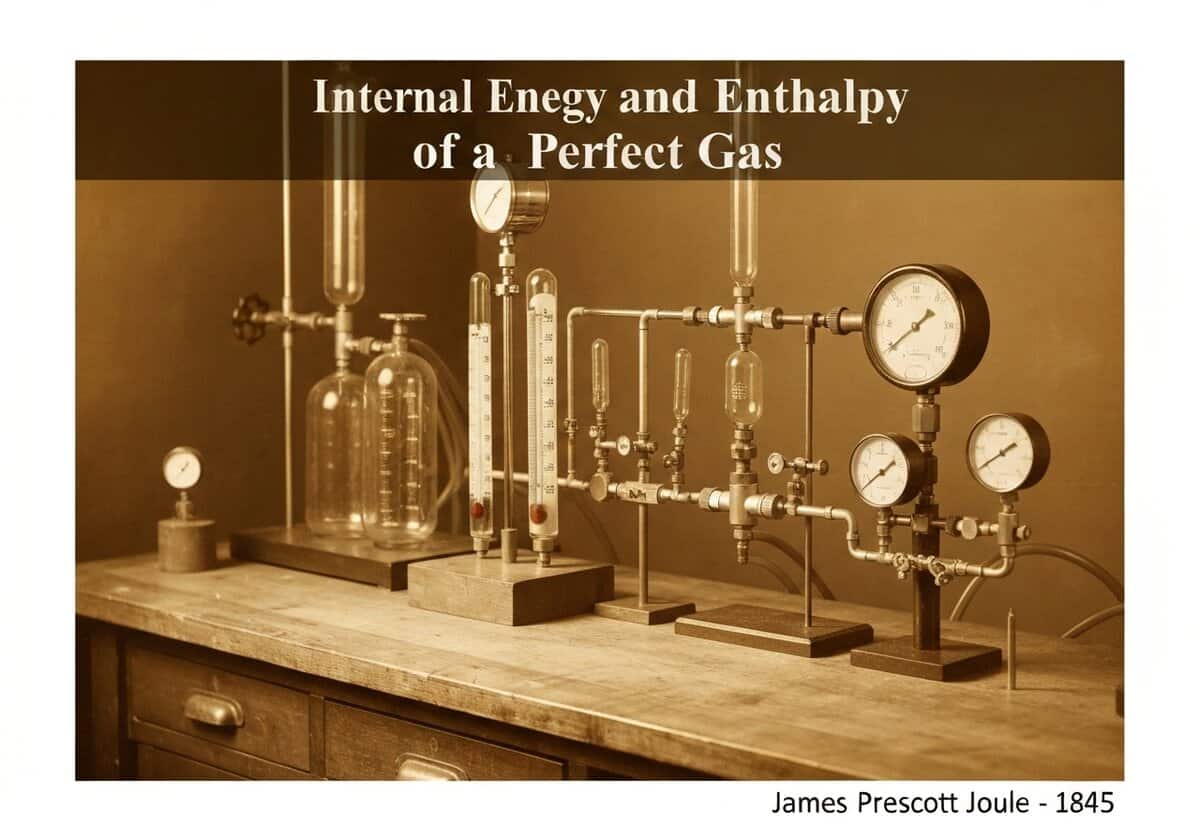
对于完全气体,内能([latex]U[/latex])和焓([latex]H[/latex])仅是温度的函数。它们的变化由 [latex]\Delta U = m c_v \Delta T[/latex] 和 [latex]\Delta H = m c_p \Delta T[/latex] 给出,其中 [latex]c_v[/latex] 和 [latex]c_p[/latex] 分别是恒容和恒压下的比热,并假定为常数。.

(图片仅供参考)
对于完全气体,内能([latex]U[/latex])和焓([latex]H[/latex])仅是温度的函数。它们的变化由 [latex]\Delta U = m c_v \Delta T[/latex] 和 [latex]\Delta H = m c_p \Delta T[/latex] 给出,其中 [latex]c_v[/latex] 和 [latex]c_p[/latex] 分别是恒容和恒压下的比热,并假定为常数。.

A cornerstone of the 完美气体 model is the principle that its internal energy depends solely on its temperature. This was experimentally demonstrated by James Prescott Joule in his expansion experiments. For an ideal gas, internal energy is the sum of the kinetic energies of its constituent molecules. Since temperature is a measure of the average kinetic energy, internal energy is a function of temperature. The perfect gas model simplifies this further by assuming a linear relationship through a constant specific heat at constant volume, [latex]c_v[/latex]. Thus, the change in specific internal energy is [latex]\Delta u = c_v \Delta T[/latex].
焓([latex]H[/latex])是一个 热力学 势能定义为[latex]H = U + PV[/latex]。对于理想气体,使用 理想气体定律 (PV = nRT),焓变为 H = U(T) + nRT,它也仅是温度的函数。类似地,比焓的变化由 Δh = c_p ΔT 给出,其中 c_p 是恒压比热容。这种简化在工程领域非常强大,因为它无需复杂的表格或状态方程即可直接计算压缩、膨胀和加热等过程中的能量变化,为分析发动机、冰箱和发电厂奠定了基础。
理想气体的内能和焓
(如果日期未知或不相关,例如“流体力学”,则提供其显著出现的近似估计)

只有注册会员才能免费获取完整尺寸的图片和下载内容。
> 登录 <