Product Design, Manufacturing & Innovation Resources
Heim » Der Photovoltaik-Effekt

Der Photovoltaik-Effekt

1839-01-01
  • Alexandre-Edmond Becquerel
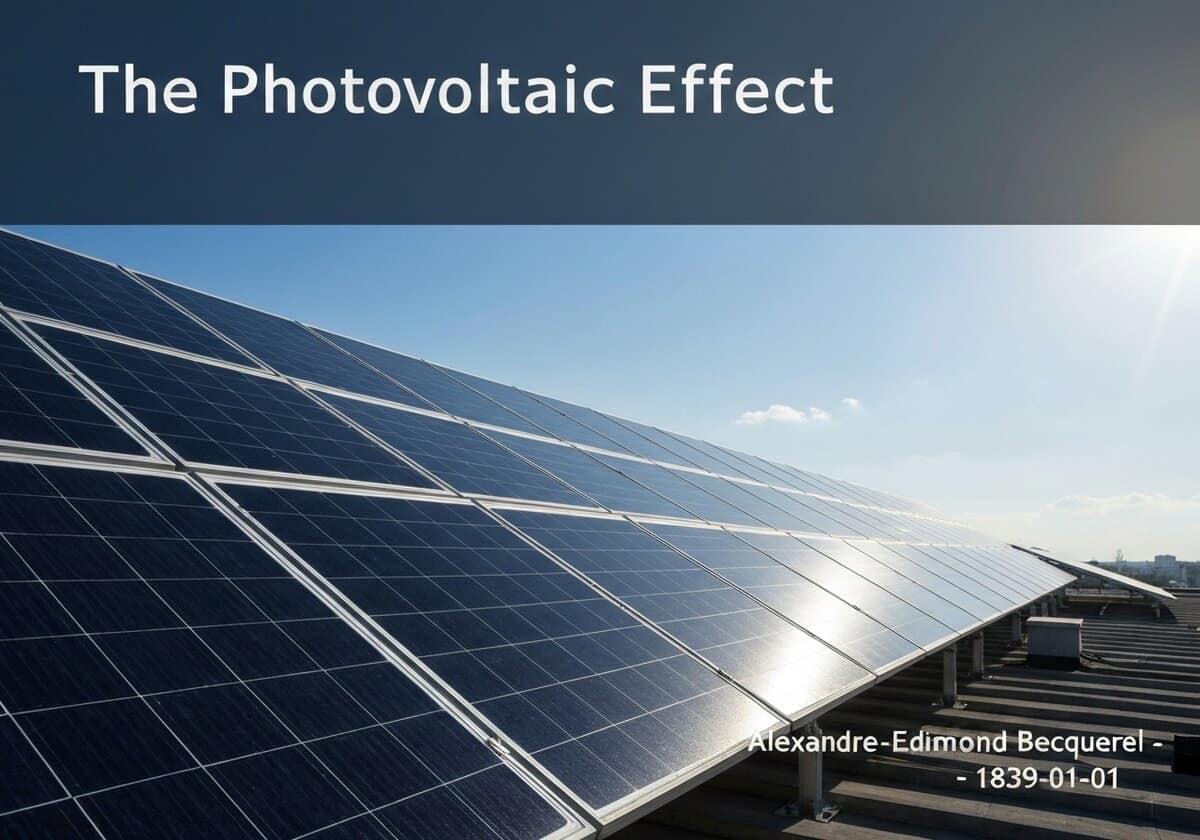
Sonnenkollektoranlage zur Demonstration des photovoltaischen Effekts in der Festkörperphysik.

(Abbildung dient nur zur Veranschaulichung)

Der Photovoltaikeffekt ist die Erzeugung von Spannung und elektrischem Strom in einem Material bei Lichteinwirkung. Es handelt sich um ein physikalisches und chemisches Phänomen. Eine häufige Anwendung ist die Solarzelle, die diesen Effekt nutzt, um Sonnenlicht direkt in Strom umzuwandeln. Der Effekt beruht darauf, dass Lichtphotonen Elektronen in einen höheren Energiezustand versetzen.

Der Fotovoltaik effect was first observed by French physicist Alexandre-Edmond Becquerel in 1839. He discovered that a voltage developed when a silver chloride electrode in an acidic solution was illuminated. The effect remained a scientific curiosity for decades. The modern understanding is rooted in semiconductor physics. When a photon with sufficient energy strikes a semiconductor material, it can excite an electron, moving it from the valence band to the conduction band. This creates an electron-hole pair. In a photovoltaic device, an internal electric field, typically created by a p-n junction, separates these charge carriers. The electrons are swept to the n-side and the holes to the p-side. This separation of charge creates a voltage across the junction. If an external circuit is connected, the free electrons will flow through the circuit, creating a direct current (DC). The energy of the photon must be greater than the band gap of the semiconductor material for this process to occur. Photons with energy less than the band gap pass through the material without being absorbed, while photons with energy much greater than the band gap will have their excess energy converted into heat, reducing the overall efficiency of the cell.

The first solid-state photovoltaic cell was created by Charles Fritts in 1883, who coated selenium with a thin layer of gold. However, its efficiency was less than 1%. The breakthrough came in 1954 at Bell Labs, where Daryl Chapin, Calvin Fuller, and Gerald Pearson developed the first practical silicon Solar cell, achieving an efficiency of around 6%. This invention marked the beginning of the modern era of Solarenergie Diese Technologie wurde ursprünglich für Nischenanwendungen wie die Stromversorgung von Satelliten im Weltraum eingesetzt.

UNESCO Nomenclature: 2211
- Festkörperphysik

Typ

Physikalisches Phänomen

Störung

Grundlegendes

Verwendung

Weitverbreitete Verwendung

Vorläufer

  • später bestätigt durch die Entdeckung des Elektrons durch JJ Thomson (1897)
  • später Einsteins Erklärung des photoelektrischen Effekts (1905)
  • Entwicklung der Halbleiterphysik und der pn-Übergangstheorie (1940er Jahre)
  • Entdeckung der Lichtleitfähigkeit von Selen durch Willoughby Smith (1873)

Anwendungen

  • Solarmodule für die Stromerzeugung im privaten und gewerblichen Bereich
  • Photovoltaikkraftwerke
  • solarbetriebene Taschenrechner und Uhren
  • Energiesysteme für Raumfahrzeuge
  • Fernerkundung und Telekommunikation

Patente:

NA

Potenzielle Innovationsideen

  • transparente Solarzellen in Fenster integriert
  • flexible, leichte Solarfolien für tragbare Elektronik und Kleidung
  • Perowskit-Tandem-Solarzellen mit Wirkungsgraden über 30 %
  • Agrivoltaik: co-locating solar panels and agricultural crops
  • solarbetriebene Wasseraufbereitungssysteme für Entwicklungsregionen
  • Photovoltaik-Straßen und -Wege
  • gebäudeintegrierte Photovoltaik (BIPV) als Bauelemente
  • solarbetriebene Drohnen für Langstreckenflüge
  • selbstheilende Solarzellenmaterialien
  • weltraumgestützte Solarstromsatelliten, die Energie zur Erde senden
Related to: photovoltaic effect, solar cell, semiconductor, p-n junction, electron-hole pair, photons, direct current, band gap, Becquerel, erneuerbare Energie.

Historischer Kontext

Der Photovoltaik-Effekt

1833
1834
1836
1839-01-01
1842
1847
1850
1832
1834
1835
1838
1841
1845
1850
1850

(wenn das Datum unbekannt oder nicht relevant ist, z. B. „Strömungsmechanik“, wird eine gerundete Schätzung seines bemerkenswerten Auftretens bereitgestellt)

10. Jahr Jubiläum

Bilder in voller Größe und Downloads sind ausschließlich für registrierte Mitglieder kostenlos verfügbar.

> Login <