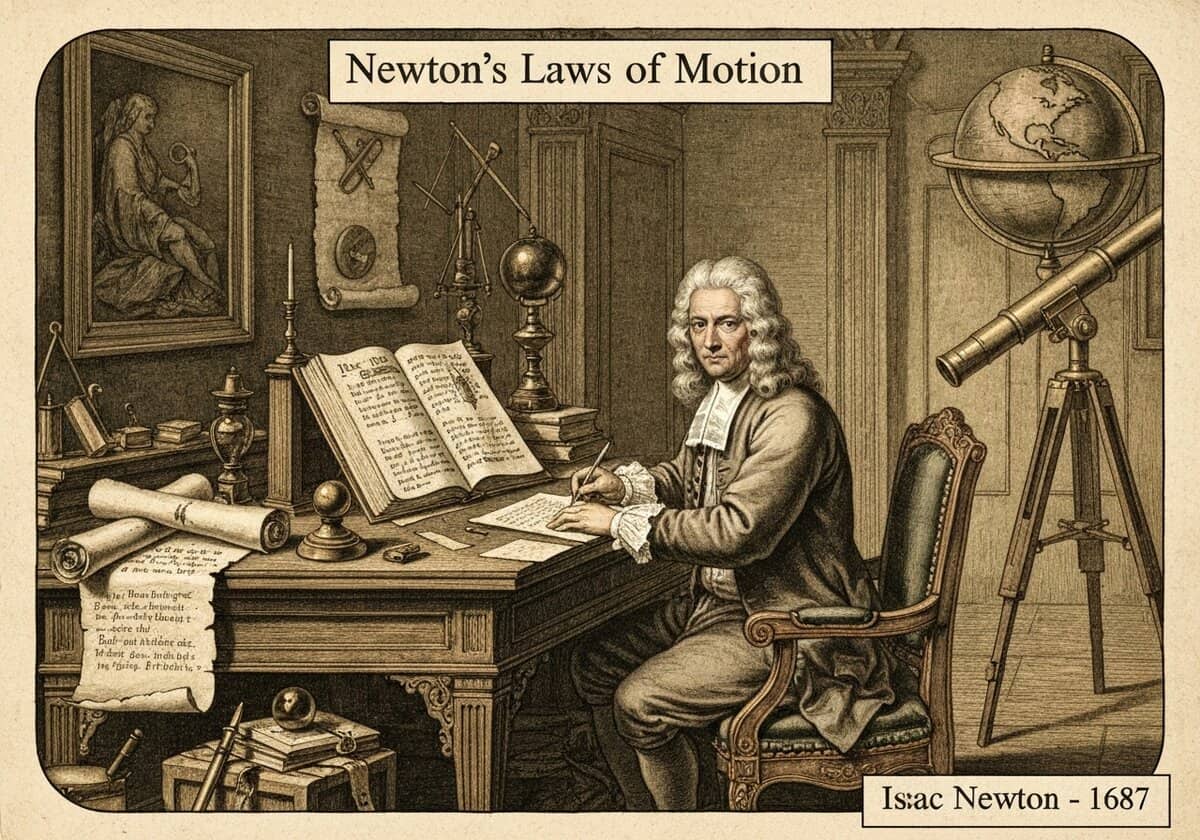
古典力学の基礎となる3つの物理法則。第一法則(慣性の法則)は、物体は外部からの正味の力が作用しない限り、静止状態または等速運動を続けると述べている。第二法則は、力を質量と加速度の積として定量化する[latex]vec{F} = mvec{a}[/latex]。第三法則は、すべての作用には、それと等しく反対向きの反作用が存在すると述べている。


(画像はイメージです)
古典力学の基礎となる3つの物理法則。第一法則(慣性の法則)は、物体は外部からの正味の力が作用しない限り、静止状態または等速運動を続けると述べている。第二法則は、力を質量と加速度の積として定量化する[latex]vec{F} = mvec{a}[/latex]。第三法則は、すべての作用には、それと等しく反対向きの反作用が存在すると述べている。

1687年に出版されたニュートンの『自然哲学の数学的原理』に記された運動の3法則は、科学に革命をもたらした。これらの法則は、日常的な物体の運動を記述するための完全な枠組みを提供し、現在古典力学として知られるものの基礎を築いた。
の 第一法則, the law of inertia, defines an inertial reference frame—a frame of reference where the law holds true. It states that an object’s velocity is constant unless a net force acts upon it. This was a departure from the Aristotelian idea that motion required a continuous force.
の 第二法則 is the quantitative core of classical dynamics. It states that the net force on an object is equal to the rate of change of its momentum. For an object with constant mass [latex]m[/latex], this simplifies to the famous equation [latex]\vec{F} = m\vec{a}[/latex], where [latex]\vec{F}[/latex] is the net force vector and [latex]\vec{a}[/latex] is the resulting acceleration vector. This is a differential equation, and solving it allows for the prediction of an object’s trajectory through time.
の Third Law, the law of action and reaction, states that forces always occur in pairs. If object A exerts a force on object B, then object B simultaneously exerts a force on object A that is equal in magnitude and opposite in direction. This principle is fundamental to understanding interactions and directly leads to the law of conservation of momentum.
これらの法則は、光速よりもはるかに遅い速度の巨視的な世界においては驚くほど正確である。しかし、特殊相対性理論(高速領域)や量子力学(原子および亜原子スケール)の領域ではその妥当性が失われ、より一般的な理論に置き換えられる。
ニュートンの運動法則
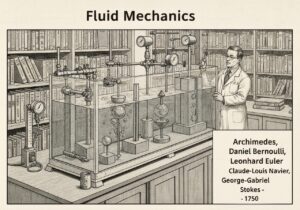
(日付が不明または関連性がない場合、例えば「流体力学」などでは、その注目すべき出現時期の概算値が提示されます。)

フルサイズの画像とダウンロードは、登録会員のみが100%無料で利用できます。
> ログイン <