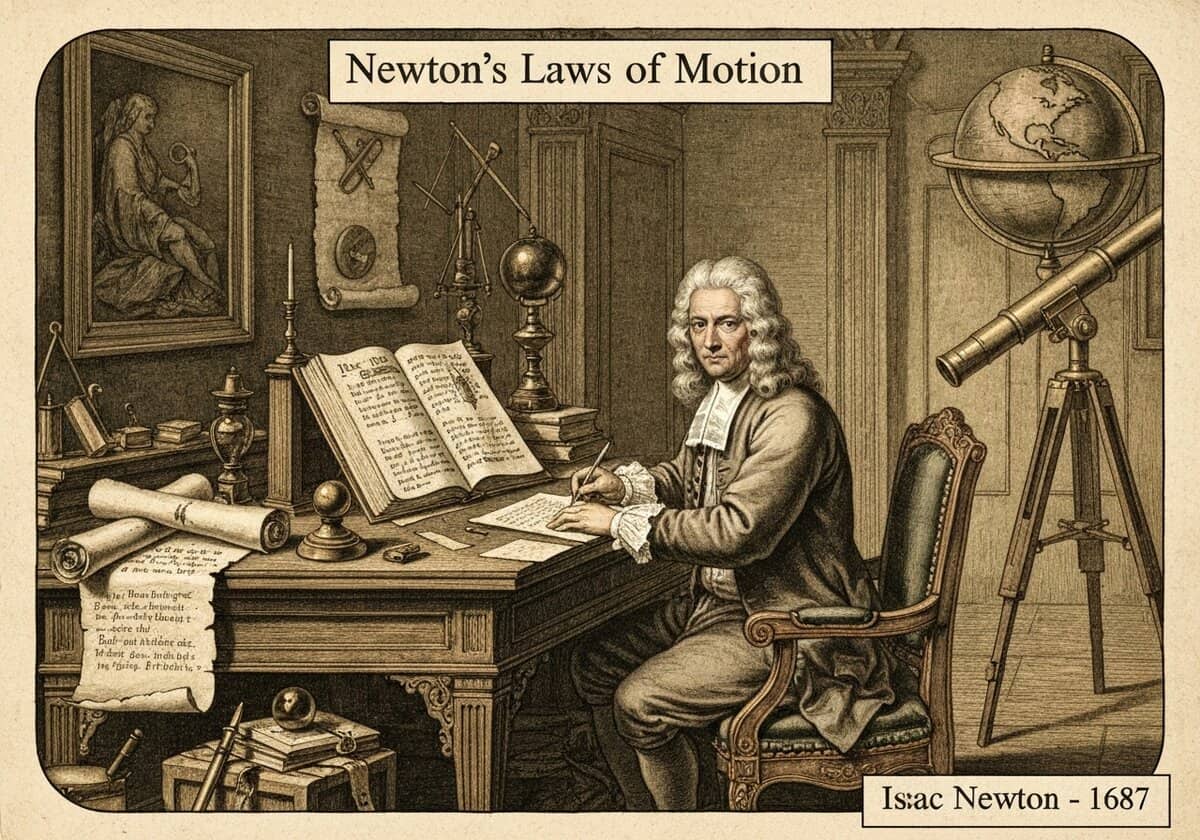
这 第一定律, the law of inertia, defines an inertial reference frame—a frame of reference where the law holds true. It states that an object’s velocity is constant unless a net force acts upon it. This was a departure from the Aristotelian idea that motion required a continuous force.
这 第二定律 is the quantitative core of classical dynamics. It states that the net force on an object is equal to the rate of change of its momentum. For an object with constant mass [latex]m[/latex], this simplifies to the famous equation [latex]\vec{F} = m\vec{a}[/latex], where [latex]\vec{F}[/latex] is the net force vector and [latex]\vec{a}[/latex] is the resulting acceleration vector. This is a differential equation, and solving it allows for the prediction of an object’s trajectory through time.
这 Third Law, the law of action and reaction, states that forces always occur in pairs. If object A exerts a force on object B, then object B simultaneously exerts a force on object A that is equal in magnitude and opposite in direction. This principle is fundamental to understanding interactions and directly leads to the law of conservation of momentum.