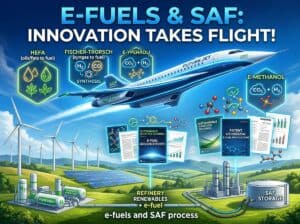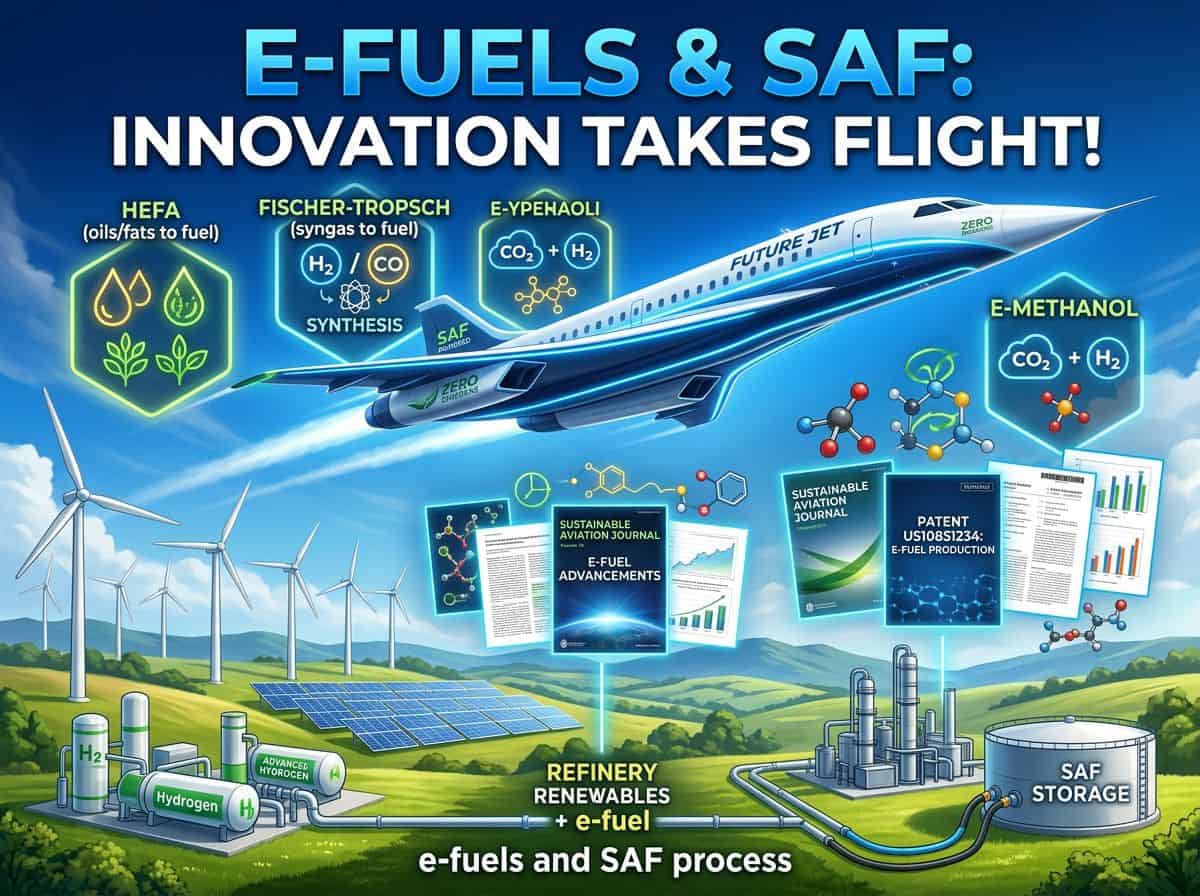

E-연료는 재생 가능한 전력, 물, 그리고 포집된 이산화탄소로부터 생산되는 합성 탄화수소 및 화학 운반체입니다. 먼저 전기분해를 통해 수소를 생산하고, 이를 역수성가스전환 반응이나 피셔-트로프쉬 합성법을 통해 이산화탄소와 결합시키거나, 메탄올 합성 후 제트 연료로 전환합니다. 지속 가능한 항공 연료(SAF)에는 HEFA, 알코올-제트 연료 전환, 바이오매스 가스화와 같은 바이오 기반 생산 방식도 포함됩니다. 두 가지 방식 모두 기존 엔진 및 인프라와 호환되는 드롭인 연료를 생산합니다.
에너지 효율성과 비용은 여전히 핵심적인 문제입니다. 각 변환 단계에서 에너지 손실이 발생하므로 전체적인 전력-액체 변환 효율은 직접 전기화 방식보다 훨씬 낮으며, 연료 가격은 전기 요금과 CO2 공급량에 크게 좌우됩니다. 촉매 내구성, 고체 산화물 전기분해 통합, 공정 열 관리 및 규모 확장은 엔지니어링 위험을 증가시킵니다. ASTM D7566 인증 및 ReFuelEU Aviation과 같은 의무 규정이 시장을 형성합니다. 아래에 색인된 논문과 특허는 합성 경로, 촉매, 반응기, CO2 포집, 연료 품질 검증 및 수명주기 평가를 다룹니다.
항공업계는 장거리 노선에 사용할 수 있는 전기 연료가 제한적이기 때문에 이산화탄소와 수소로 만든 액체 연료에 관심이 집중되고 있습니다. 원료 공급은 현재 진행 중입니다. 녹색 수소 그리고 직접 공기 포집항공기 쪽은... 항공학정직한 탄소 회계에는 다음이 필요합니다. 수명주기 평가.
본 자료는 다양한 온라인 과학 저널에 게재된 E-연료 및 지속가능 항공 연료(SAF) 관련 최신 영문 논문 및 특허를 선별하여 정리한 것으로, e-연료, 파워투리액화, 파워투X, 지속가능 항공 연료, 합성 등유, 피셔-트로프쉬 합성, 역수증기 개질 반응, CO2 수소화 반응, e-메탄올, 메탄올-제트 연료, 알코올-제트 연료, 수소처리 에스테르 및 지방산, HEFA, e-암모니아, 암모니아 합성, 고체 산화물 전기분해, 바이오매스 가스화, 드롭인 연료, 연료 인증 및 ASTM D7566 등의 주제를 중점적으로 다룹니다.
Processes for use of ammonia synthesis catalysts and related systems
Patent published on the 2026-10-29 in WO under Ref WO2026226822 by COPERNIC CATALYSTS INC [US] (Ramkrishnan Aruna [us], Grose Jacob [us], Radaelli Guido [us])
Abstract: Methods and related systems for producing ammonia are described. The methods and systems may include use of a base metal catalyst (e.g., containing substantially no platinum group metals). The base metal catalyst may facilitate production of ammonia at relatively high conversion percentages and/or capacities at relatively low temperatures and/or pressures. In some instances, a preliminary reactor (e.g., a bolt-on interstage reactor), which may include the base metal catalyst in some instances, i[...]
Our summary: Methods for ammonia production utilize base metal catalysts for high conversion rates at low temperatures. Preliminary reactors may be used upstream of primary reactors to enhance efficiency. The systems described minimize the use of platinum group metals.
ammonia synthesis, base metal catalyst, conversion efficiency, reactor systems
Patent
Energy-saving and high-efficiency biomass gasification and catalytic conversion device
Patent published on the 2026-10-28 in EP under Ref EP4831265 by BEIJING APTBLAZE TECH CO LTD [CN] (Zhang Yanguo [cn], Zhou Hui [cn], Bie Xuan [cn], Chen Xuan [cn])
Abstract: The present disclosure discloses an energy-saving and high-efficiency biomass gasification and catalytic conversion device, and is used to solve the problems of complex process, low conversion efficiency, and thermal energy waste in biomass gasification in existing technologies. The gasification and catalytic conversion device of the present disclosure comprises a feeding unit, a gasifier, a high-temperature dust removal bag, a decomposition furnace, and air distribution components. The discharg[...]
Our summary: The device improves biomass gasification efficiency and reduces thermal energy waste. It includes a feeding unit, gasifier, high-temperature dust removal bag, and decomposition furnace. The design addresses complex processes and low conversion efficiency in existing technologies.
biomass gasification, catalytic conversion, energy efficiency, thermal management
Patent
Coral-reef-like bifunctional catalyst for biomass gasification to produce green hydrogen with simultaneous decarbonization, and preparation method and
Patent published on the 2026-10-08 in US under Ref US20260307057 by SOUTHEAST UNIV [CN] (Zhang Huiyan [cn], Lu Qiuxiang [cn], Su Yinhai [cn], Xiao Rui [cn])
Abstract: A coral-reef-like bifunctional catalyst for biomass gasification to co-produce green hydrogen and achieve decarbonization. Active metal site regulation optimizes the matching between active phases and supports to enhance catalytic activity and stability. The unique coral-reef-like structure builds a confined space for bond cleavage and CO2 conversion. Dual active sites respectively drive directional bond cleavage for high-purity green hydrogen production and in-situ CO2 adsorption and conversion[...]
Our summary: A coral-reef-like bifunctional catalyst enables biomass gasification for green hydrogen production and decarbonization. The structure enhances catalytic activity through active metal site regulation and bond cleavage. The catalyst demonstrates excellent stability and efficiency in producing high-purity syngas with CO2 conversion.
bifunctional catalyst, biomass gasification, green hydrogen, decarbonization
Patent
Catalysis aids for direct co2 hydrogenation to methanol, methods and products thereof
Patent published on the 2026-10-08 in WO under Ref WO2026207616 by VOLTA ENERGY INC [CA] (Zou Fenglou [ca], Singh Gursaran [ca])
Abstract: The present application relates to CO2 utilization. More specifically, the present application relates to catalysis aids for direct CO2 hydrogenation to methanol and methods using the same. Included is a catalysis aid for use in a catalytic CO2 hydrogenation, the catalysis aid comprising at least one component selected from superabsorbent polymers, silica gels, clay-based absorbents, cellulose-based materials and hydrogels.[...]
Our summary: The application focuses on catalysis aids for direct CO2 hydrogenation to methanol. It includes various materials such as superabsorbent polymers and silica gels. The methods aim to enhance CO2 utilization and improve product yield.
Catalysis, CO2 hydrogenation, methanol production, superabsorbent polymers
Patent
Ammonia production apparatus
Patent published on the 2026-10-01 in WO under Ref WO2026204931 by IDEMITSU KOSAN CO [JP] (Jia Qingxin [jp], Matsumoto Hiroto [jp], Yabukami Minoru [jp], Gong Bo [jp], Shinohara Yuki [jp])
Abstract: The purpose of the present disclosure is to provide an ammonia production apparatus capable of efficiently producing ammonia and suppressing production cost. The present disclosure relates to an ammonia production apparatus comprising: an anode chamber which has an anode electrode having a water electrolysis catalyst and to which water is supplied; a cathode chamber which has a cathode electrode having an ammonia synthesis catalyst and to which gaseous nitrogen is supplied; a diaphragm provided [...]
Our summary: The ammonia production apparatus efficiently synthesizes ammonia using a water electrolysis catalyst and an ammonia synthesis catalyst. It features an anode chamber for water supply and a cathode chamber for nitrogen supply. A diaphragm separates the chambers, and a drying mechanism is included for the cathode electrode.
Ammonia production, electrolysis, synthesis catalyst, cost efficiency
Patent
Process for preparing a catalyst for the production of syngas by the reverse water-gas shift reaction
Patent published on the 2026-09-30 in EP under Ref EP4813513 by CO2CO S R L [IT] (Milanese Marco [it], Rizzo Alessio [it], De Risi Arturo [it])
Abstract: [0001] The present invention relates to a catalyst comprising stainless steel elements, to the process for preparing said catalyst and to the catalyst obtainable by said process. In particular, the catalyst is generated on the surface of stainless steel elements through a thermochemical process at 850°C, by interaction with cerium oxide nanoparticles (ceria, CeO) under a flow of CO, capable of modifying the surface elemental chemical composition and the specific surface area, thereby maximising[...]
Our summary: The invention describes a catalyst made from stainless steel elements for syngas production via the reverse water-gas shift reaction. It is prepared through a thermochemical process at 850°C using cerium oxide nanoparticles. The process enhances the catalyst s performance and selectivity by modifying its surface composition and area.
catalyst preparation, syngas production, reverse water-gas shift, cerium oxide
Patent
Feasibility and Characteristics Study on Direct Ignition of High-Temperature Biomass Gasification Syngas with Ambient Air
Published on 2026-01-29 by Yao Xu, Yejian Qian, Yu Zhang, Taotao Zhou, Juye Wan, Ming Zhai @MDPI
Abstract: To advance the engineering application of the fusion decoupling combustion technology previously proposed by our research group, this work focuses on its second stage—the high-temperature syngas combustion stage—and specifically addresses the critical issue of whether high-temperature gasified syngas can achieve direct and stable ignition when mixed with ambient air. For this purpose, a high-temperature syngas combustion experimental system was established, utilizing [...]
Our summary: This study investigates the direct ignition of high-temperature biomass gasification syngas mixed with ambient air. A high-temperature combustion experimental system was established to analyze the effects of syngas temperature and composition on ignition limits. Results show that increased syngas temperature and H2 content broaden the ignition range, while CO narrows it, confirming the feasibility of direct ignition for engineering applications.
Biomass Gasification, Syngas Combustion, Ignition Limits, Reaction Kinetics
Publication
Electro-Reforming of Biomass Gasification Tar with Simultaneous Hydrogen Evolution
Published on 2026-01-27 by Umberto Calice, Francesco Zimbardi, Nadia Cerone, Vito Valerio @MDPI
Abstract: In this study, an electrochemical valorization strategy on liquid byproducts from hazelnut shell gasification was developed to couple waste remediation with energy-efficient hydrogen production. The aqueous phase, rich in organic compounds, is processed in an anion exchange membrane (AEM) cell, where pure hydrogen evolved at the cathode while organic pollutants are oxidized at the anode. First, the feedstock is thoroughly characterized using gas chromatography–mass spectrometry (GC[...]
Our summary: This study presents an electrochemical method for valorizing liquid byproducts from hazelnut shell gasification while producing hydrogen. The process utilizes an anion exchange membrane cell, optimizing conditions with Nickel oxide-hydroxide electrodes. Results show significant organic compound reduction and efficient hydrogen generation at low energy consumption.
Electro-Reforming, Biomass Gasification, Hydrogen Production, Anion Exchange Membrane
Publication