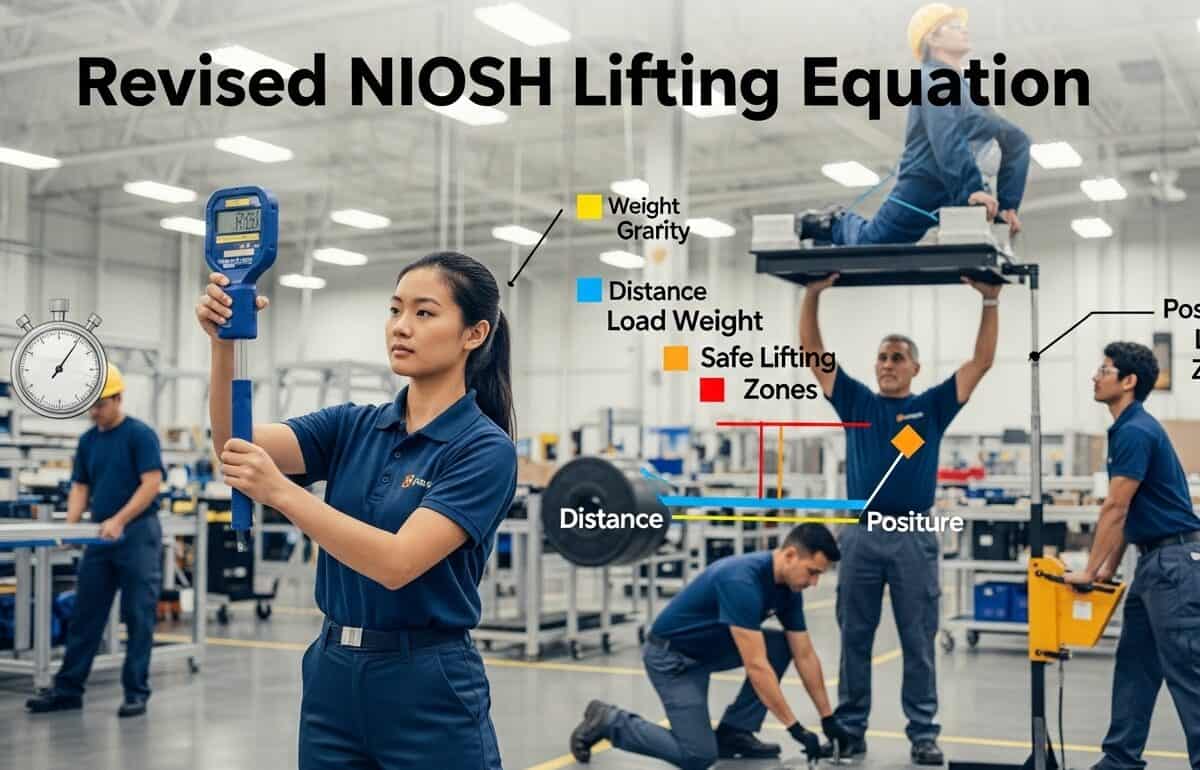
Overexertion injuries account for approximately 33% of all worker injuries, highlighting the need for effective lifting assessment tools such as the Revised NIOSH Lifting Equation. This comprehensive article will detail into the purpose and background of this equation, breaking down its individual components to provide a clearer understanding of how it enhances safety across varied industries such as manufacturing, healthcare, and construction. Readers will gain insights into data collection and measurement techniques for accurate assessments, how to calculate the Recommended Weight Limit (RWL), and the importance of the Lifting Index (LI) in risk assessment. We also will discuss implementing 人間工学に基づいた controls and redesigning tasks to elevate workplace safety, while also addressing the limitations and scope of this equation in practical applications.
主なポイント

- Revised NIOSH equation improves assessment of two-handed lifting tasks.
- Key components include weight, distance, and posture.
- Accurate data collection enhances lifting evaluations.
- RWL calculation ensures safe lifting limits per task.
- Lifting Index indicates risk levels for workers.
- Task redesign and flows redesign is a しなければならない to mitigate ergonomic risks effectively.
About the NIOSH Institute
The National Institute for Occupational Safety and Health (NIOSH) is a federal agency in the United States that focuses on researching and providing recommendations to avert work-related injuries, illnesses, and fatalities. Established under the Occupational Safety and Health Act of 1970, NIOSH operates as part of the Centers for Disease Control and Prevention (CDC) and is dedicated to ensuring safe and healthy working environments for all employees. The agency generates new insights in occupational safety and health and applies this knowledge to enhance worker protection. NIOSH employs a diverse team of over 1,300 professionals, including specialists in areas such as epidemiology, medicine, industrial hygiene, and safety.
Background of the NIOSH Equation
The Revised NIOSH Lifting Equation was developed to provide a scientifically grounded method for evaluating and predicting the risk of injury associated with manual lifting tasks in various work environments. This evolution reflects advancements in ergonomic research, emphasizing not only the weight lifted but also factors such as lifting height, distance, frequency, and duration.
Prior to the revision, the original NIOSH Lifting Equation was often criticized for its oversimplification of lifting tasks. The updated equation addresses this by including an array of variables that affect lifting conditions, thus enhancing the predictive accuracy of potential risk.
Utilizing this comprehensive approach has been shown to reduce workplace injuries by as much as 25% in industries that implement ergonomic assessments based on this equation.
ヒント: conducting a thorough ergonomic assessment using the Revised NIOSH Lifting Equation before implementing lifting tasks can significantly mitigate injury risks and enhance worker efficiency.
The Revised NIOSH (National Institute for Occupational Safety and Health) Lifting Equation is a tool used to assess the risk of low back injuries associated with two-handed manual lifting tasks.
The equation calculates the Recommended Weight Limit (RWL), which is the maximum weight that most healthy workers can lift over an 8-hour shift without increasing their risk of musculoskeletal disorders of the lower back.
方程式とその構成要素
改訂版NIOSHリフティング方程式は、両手での持ち上げ作業における推奨重量制限(RWL)を計算するための式を提供する。 as この方程式の主要な出力。 この式は、持ち上げ能力に影響を与える複数の要素を組み込んでおり、人間工学的評価の精度をさらに高めることができます。RWLの基本式は次のように定義されます。
式は次のとおりです。[latex]RWL = LC*HM*VM*DM*AM*FM*CM[/latex]
関連する指標として、リフティングインデックス(LI)があります。 これは、実際に持ち上げた重量と推奨使用重量(RWL)の比率です。リフティングインデックスが1.0以下であれば安全とみなされます。
The value of each multiplier ranges from 0 to 1 and is determined using tables that correspond to the measured value of each variable. Here is a breakdown of each parameter in the equation:
| パラメータ | 説明 | Units |
LC Load Constant | This is the maximum recommended weight for lifting under ideal conditions. | 23 kg (or 51 lbs) |
HM Horizontal Multiplier | This factor accounts for the horizontal distance of the hands from the midpoint between the ankles: the horizontal distance (H) is the distance from the point projected on the floor directly below the midpoint of the hands grasping the object, to the midpoint of the ankles. | The horizontal distance (H) is measured in centimeters. |
VM Vertical Multiplier | This factor is determined by the vertical height of the hands from the floor at the start of the lift. | The vertical distance (V) is measured in centimeters. |
DM Distance Multiplier | This multiplier accounts for the vertical distance the load travels during the lift, i.e. the vertical distance the hands move between the start and end of the lift. | The vertical travel distance (D) is measured in centimeters. |
AM Asymmetric Multiplier | This factor is determined by the degree of twisting or turning of the body during the lift: The asymmetry angle (A) is the angle between the asymmetry line and the sagittal line. The asymmetry line is the horizontal line that joins the midpoint between the ankles and the point projected on the floor directly below the midpoint of the hands grasping the object. The sagittal line is the line going through the midpoint between the ankles and extending straight forward from the body. | The angle of asymmetry (A) is measured in degrees. |
FM Frequency Multiplier | This factor accounts for the frequency of lifting, including the number of lifts per minute and the duration of the lifting task.The lifting frequency (F) is the average number of lifts per minute over a 15-minute period. | This is determined by the number of lifts per minute and the duration of the work in hours. |
CM Coupling Multiplier | This multiplier assesses the quality of the hand-to-object grip (coupling). The coupling quality is determined by the type of grip, surface, shape and size on the object. A “good” coupling has handles or cut-outs, a “fair” coupling might involve gripping a box with no handles, and a “poor” coupling would be an awkward, bulky, or slippery object. | The quality of the grip is classified as “good,” “fair,” or “poor”. |
The NIOSH ratio to use
Horizontal Multiplier (HM):
| H = Horizontal Distance (cm) | HM Factor |
|---|---|
| 25 or less | 1.00 |
| 30 | 0.83 |
| 40 | 0.63 |
| 50 | 0.50 |
| 60 | 0.42 |
Vertical Multiplier (VM):
| V = Starting Height (cm) | VM Factor |
|---|---|
| 0 | 0.78 |
| 30 | 0.87 |
| 50 | 0.93 |
| 70 | 0.99 |
| 100 | 0.93 |
| 150 | 0.78 |
| 175 | 0.70 |
| >175 | 0.00 |
Distance Multiplier (DM):
| D = Lifting Distance (cm) | DM Factor |
| 25 or less | 1.00 |
| 40 | 0.93 |
| 55 | 0.90 |
| 100 | 0.87 |
| 145 | 0.85 |
| 175 | 0.85 |
| >175 | 0.00 |
Asymmetric Multiplier (AM):
| A = Angle (degrees) | AM Factor |
| 90° | 0.71 |
| 60° | 0.81 |
| 45° | 0.86 |
| 30° | 0.90 |
| 0° | 1.00 |
Frequency Multiplier (FM):
| F = Time Between Lifts | FM Factor | |||
|---|---|---|---|---|
| Lifting While Standing: | OR Lifting While Stooping: | |||
| One Hour or Less | Over One Hour | One Hour or Less | Over One Hour | |
| 5 min | 1.00 | 0.85 | 1.00 | 0.85 |
| 1 min | 0.94 | 0.75 | 0.94 | 0.75 |
| 30 sec | 0.91 | 0.65 | 0.91 | 0.65 |
| 15 sec | 0.84 | 0.45 | 0.84 | 0.45 |
| 10 sec | 0.75 | 0.27 | 0.75 | 0.27 |
| 6 sec | 0.45 | 0.13 | 0.45 | – |
| 5 sec | 0.37 | – | 0.37 | – |
Coupling Multiplier (CM): (usually one of the low hanging fruit)
| C = Grasp | CM Factor: | |
|---|---|---|
| Standing | Stooping | |
| Good (handles) | 1.00 | 1.00 |
| Fair | 1.00 | 0.95 |
| Poor | 0.90 | 0.90 |
Source of these tables: Canadian Centre for Occupational Health And Safety (CCOHS), based on original NIOSH tables
Summary: close to the body, the most in front as possible, as similar height as possible to the height of hands when elbows is at 90°.
As the lift distance and body orientation change, the distance multiplier (DM) is applied to recognize the potential risk associated with how far loads are moved. This factor is essential in environments like warehouses, where heavy loads may need to be moved over varying distances.
ヒント: when applying the equation, consistently gather accurate data for each lifting condition to ensure reliability in assessment outcomes and ergonomic interventions.
NIOSH Example: an Assembly Line Worker
シナリオ: a 30-year-old male worker is standing on an assembly line. One of is his task is to lift a car battery from a conveyor belt and place it into a chassis. He has been performing this task for the last two hours.
Applied Values

- Load Weight (L): the car battery weighs 18 kg.
- Load Constant (LC): the maximum recommended weight for lifting under ideal conditions is a constant 23 kg.
- Horizontal Location (H): the worker reaches out to pick up the battery. The horizontal distance from the midpoint between his ankles to his hands is 40 cm. The corresponding Horizontal Multiplier (HM) for 40 cm is 0.63.
- Vertical Location (V): the conveyor belt is at a height of 70 cm from the floor. This is the starting height of the lift. The corresponding Vertical Multiplier (VM) for 70 cm is 0.96.
- Vertical Travel Distance (D): the worker lifts the battery from the conveyor belt (70 cm) and places it into the chassis at a height of 110 cm. The vertical travel distance is 110 cm – 70 cm = 40 cm. The corresponding Distance Multiplier (DM) for 40 cm is 0.93.
- Asymmetric Angle (A): the worker has to twist his body slightly to move the battery from the conveyor to the chassis. The angle of the twist is 30 degrees. The corresponding Asymmetric Multiplier (AM) for 30 degrees is 0.90.
- Lifting Frequency (F): the assembly line is moving at a steady pace, and the worker performs this lift 4 times per minute. Since he has been working for 2 hours, the Frequency Multiplier (FM) for 4 lifts/minute over a duration of more than 1 hour but less than 2 hours is 0.84.
- Coupling (C): the car battery has built-in handles, which allows for a firm and comfortable grip. This is considered a “Good” coupling. The corresponding Coupling Multiplier (CM) for a good grip is 1.00.
Calculation: using the formula above with these values, the Recommended Weight Limit (RWL) is RWL = 23 kg x 0.63 x 0.96 x 0.93 x 0.90 x 0.84 x 1.00 = 9.79 kg
Next, the Lifting Index (LI) is calculated to assess the risk of the lifting task: [latex]LI = \frac{\text{Load Weight (L)}}{\text{Recommended Weight Limit (RWL)}}[/latex]
LI = 18 kg / 9.79 kg = 1.84
Conclusion of this Study
The Recommended Weight Limit (RWL) for this specific lifting task is 9.79 kg. This is the maximum weight that a healthy worker could safely lift under these exact conditions. The actual weight of the battery is 18 kg, which is significantly higher than the RWL.
The Lifting Index (LI) is 1.84. A Lifting Index greater than 1.0 indicates that the task is hazardous and poses an increased risk of low back injury to the worker.
An LI of 1.84 suggests a high risk, and that the task should be redesigned.
Possible modifications could include
By decreasing priority order (our view):
- Bringing the object closer to the worker to reduce the horizontal distance, decreasing the twist angle, and reducing the delta height: bench 人間工学, done at start if possible, once for all.
- Implementing mechanical lifting aids: likely possible. Either special tools, or polyvalents tools, depending on the line and factory.
- Reducing the lifting frequency: possible, but as reducing the production is probably not the goal, that means spreading among more workers; but better suppress the problem at the root rather than creating special shifts and spreading a bad task to many. Note that in very critical and urgent cases, there may be no other option as a last resort (Tchernobyl, Fukushima …).
- Reducing the weight of the object: probably not an easy option here, if at all, unless redesign the product or the car in the first place -what should have been done but we are in a too-late-scenario here-.

Data Collection and Measurement Techniques for Ergonomic Study

Data collection and measurement, as in most ergonomic studies, involve the systematic observation of lifting activities to identify critical parameters such as weight, height, distance, and the frequency of the lift. Real-time observations can be recorded through direct monitoring or by employing tools such as video analysis, which allows for precise measurements of body 力学 during lifting. Factors such as grip type and load characteristics should also be noted, as they affect ergonomic risks. Accurate documentation is paramount to ensure comprehensive assessments.
| Measurement Method | 長所 | 短所 |
|---|---|---|
| Video Analysis | Highly accurate; visual feedback | Time-consuming; requires software |
| Force Gauges | Direct weight measurement | Limited to point of lift; user handling |
| Surveys | Captures subjective feedback | Potential bias in responses |
| Accelerometers | Tracks body movement dynamically | Requires calibration; may need expertise |
Surveys can supplement these efforts by gathering worker feedback on perceived exertion and discomfort levels.
The evaluation process must quantify fatigue, which can significantly influence lifting capabilities. Tools such as the Borg Rating of Perceived Exertion Scale provide valuable insights into this aspect. A common recommendation is to track lifting activities over a set period, for instance, analyzing a week’s worth of lifting to identify trends and peak fatigue periods. Implementing this empirical approach leads to more informed decisions regarding workload adjustments.
ヒント: in high volumes industries (consumer goods, car industry …) integrating automated data logging systems can streamline the tracking process, reducing human error and improving overall data reliability.
Next Steps
A calculated LI value greater than 1 signifies that the lifting conditions present a potential risk for the worker, necessitating further assessment and interventions. For instance, in warehouse environments, lifts with an LI above 3 are considered high-risk, potentially leading to musculoskeletal disorders if not addressed.
Risk assessment strategies must incorporate both individual and task-related factors. Variables such as the worker’s experience, body mechanics, and environmental conditions must be considered. Employers should also monitor aggregate data to identify trends, such as increased injury reports linked to specific tasks or loads. By analyzing these datasets, corrective actions can be prioritized effectively.
ヒント: conduct regular ergonomic assessments and 従事する with employees for continuous improvement in lifting methods.
A full ergonomic study is beyond the scope of this article, but common correctives measures include:
- organizing the circuit of parts vs workers position (spaghettis diagram among other flow methods).
- ergonomic equipment such as adjustable lift tables or hoists minimizes the need to lift heavy objects.
- training programs play a significant role in enhancing employee awareness and adherence to safe lifting practices. Employees should be educated not only on how to lift correctly but also on recognizing when to seek assistance or use equipment.

Limitations of the Revised NIOSH Lifting Equation
The Revised NIOSH Lifting Equation provides a guideline for lifting tasks, but it does have limitations that vary across different industries. This equation primarily focuses on straightforward lifting scenarios without considering dynamic conditions such as lifting from awkward body postures, the presence of multiple lifts, or the need for frequent changes in task orientation. For example, in the healthcare sector, the shift from lifting weights directly to transferring patients with varying sizes complicates the applicability of the equation, potentially leading to higher injury rates.
The equation assumes ideal conditions that may not always be present in various settings. For instance, construction environments typically involve uneven surfaces and shifting loads. As a result, the application of the Revised NIOSH Lifting Equation becomes less certain in these contexts.
結論

The significant statistic that overexertion injuries account for approximately 33% of all worker injuries underscores the pressing need for effective lifting assessment tools, such as the Revised NIOSH Lifting Equation. By providing a structured framework for evaluating and understanding lifting tasks across a variety of industries -ranging from manufacturing to healthcare- the equation serves as a robust guide in promoting worker safety and reducing injury risks. Through careful data collection, accurate weight limit calculations, and thoughtful implementation of ergonomic controls, organizations can significantly enhance the safety and well-being of their employees during manual lifting operations.
Incorporating the Revised NIOSH Lifting Equation into workplace practices is not just about compliance; it’s a commitment to a safer environment for all workers involved, which should be the number #1 priority in any company, and ultimately leading to lower injury rates and improved productivity.
よくある質問
改訂版NIOSH持ち上げ方程式の目的は何ですか?
改訂版NIOSH持ち上げ計算式は、持ち上げ作業による腰痛のリスクを評価するために使用されるツールです。この計算式は、作業関連の筋骨格系疾患を予防するために、推奨重量制限(RWL)と呼ばれる安全な持ち上げ限度を定めます。また、職場における手作業による持ち上げ作業の安全性を設計・改善するための指針としても役立ちます。
推奨体重制限(RWL)はどのように計算されますか?
算出された推奨重量制限(RWL)は、作業者が怪我のリスクを最小限に抑えるために扱うべき最大重量の目安となります。推奨重量制限(RWL)は、荷重定数に6つの異なる乗数を掛けることで算出されます。これらの乗数は、持ち上げ作業に伴うさまざまなリスク要因、例えば、持ち上げる水平方向および垂直方向の距離、持ち上げる頻度、持ち上げる際の非対称性などを表しています。
リフティングインデックス(LI)とは何ですか?また、リスク評価においてどのように使用されますか?
リフティングインデックス(LI)は、身体能力のレベルを相対的に推定するツールです。 ストレス 持ち上げ作業に伴う怪我のリスクを示す指標です。持ち上げる物の実際の重量を推奨重量制限(RWL)で割って算出されます。持ち上げ指数(LI)の値が1.0以下であれば安全とみなされますが、1.0を超える場合は一部の作業者にとってリスクが高まり、LI値が高くなるにつれて怪我のリスクも高まります。
改訂版NIOSH持ち上げ力方程式の限界と適用範囲は何ですか?
改訂版NIOSH持ち上げ計算式には、適用範囲といくつかの制限があります。この計算式は両手での持ち上げ作業のリスクを評価するために設計されていますが、片手での持ち上げ、座った状態や膝をついた状態での持ち上げ、運搬、押す、引く作業には適用されません。また、持ち上げ作業が主要な作業活動であると想定しており、その他の重要なエネルギー消費は考慮されていません。さらに、この計算式は温度や湿度の低い環境には適用できず、個々の作業者の特性や環境要因も考慮されていません。
Related Readings
- 人間工学: 人間の能力と限界が設計とタスクの実行にどのように影響するかを理解すること。
- タスク分析方法: 危険を特定し、安全性を向上させるために、作業を体系的に調査する。
- 姿勢評価ツール: 持ち上げ作業中の身体姿勢に関連する人間工学的リスクを判断するための評価手法。
- 力測定技術: 持ち上げ力を定量化し、確立された閾値と比較する方法。
- Workstation design principles: 安全な持ち上げ作業を促進し、怪我のリスクを軽減する作業ステーションを構築するためのガイドライン。
- 危険源特定プロセス: 職場環境における潜在的な持ち上げ作業の危険性を認識するための手順。
- 人間工学に基づいたトレーニングプログラム: 従業員に安全な持ち上げ作業方法を周知させることを目的とした教育活動。
- 人間工学に基づいた機器設計: 身体的な負担を軽減するツールや機械の設計 strain 持ち上げ作業中。
- Job rotation strategies: そもそも改善が不可能な場合、反復性ストレス障害を最小限に抑えるために作業員が作業を切り替えるシステムを導入する。
- 人間工学における統計分析: 統計的手法を用いて、持ち上げ作業が労働者の健康と安全に及ぼす影響を評価する。
- 負傷報告システム: 持ち上げ作業に関連する負傷を記録・分析し、改善策に役立てるための枠組み。
- 安全文化の醸成: 安全性と人間工学的配慮を最優先する組織環境を育成する。
- プロトタイピングとシミュレーション: 本格的な導入前に、モデルやソフトウェアを使用して人間工学に基づいたソリューションをテストし、改良する。
- リーン生産方式 テクニック: 廃棄物の削減を目的とした手法。これには、持ち上げ作業における人間工学的改善も含まれる。
- 職業上の健康監視: 作業員の健康状態を継続的に監視し、持ち上げ作業が長期的に及ぼす影響を検出する。
External Links on Revised NIOSH Equation
国際規格
(リンクにカーソルを合わせると、コンテンツの説明が表示されます)
用語集
Contract Manufacturer (CM): 他社に代わって製品を製造する会社で、通常は特定の設計および品質仕様に従って製造を行う。この仕組みにより、依頼企業はマーケティングや製品開発といった中核事業に集中できる一方、製造工程は外部委託することができる。