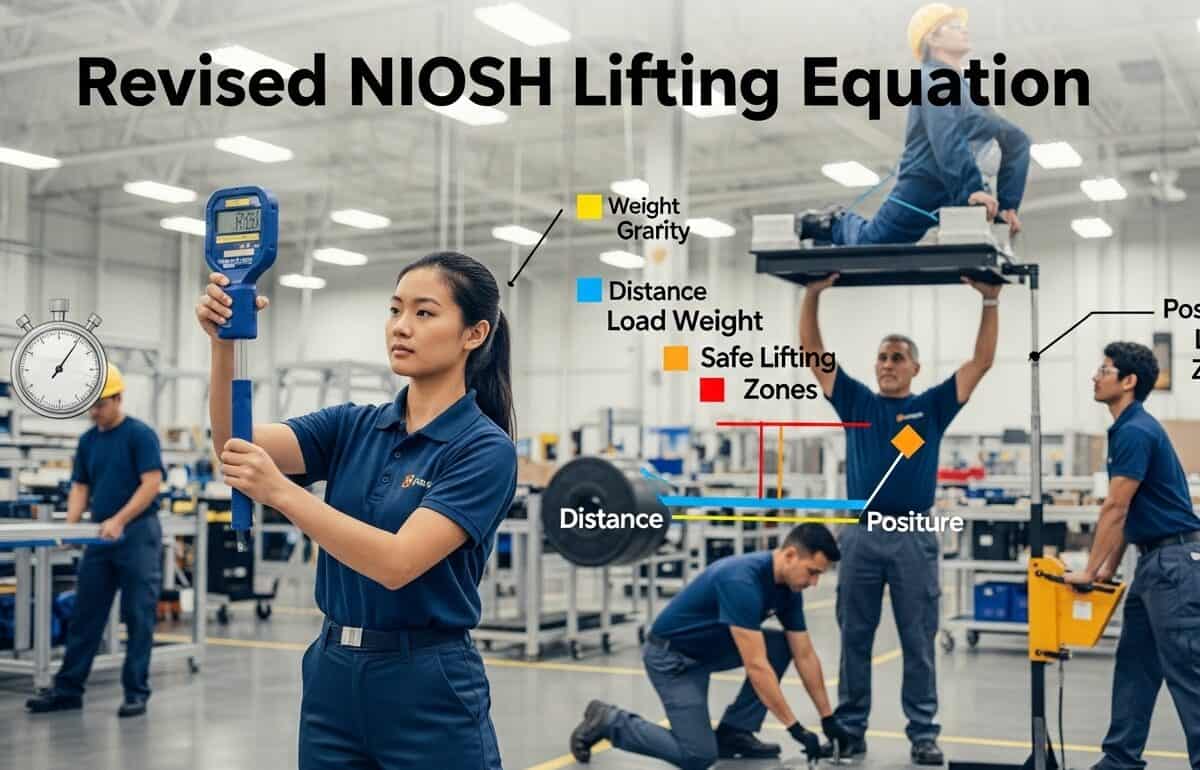
Overexertion injuries account for approximately 33% of all worker injuries, highlighting the need for effective lifting assessment tools such as the Revised NIOSH Lifting Equation. This comprehensive article will detail into the purpose and background of this equation, breaking down its individual components to provide a clearer understanding of how it enhances safety across varied industries such as manufacturing, healthcare, and construction. Readers will gain insights into data collection and measurement techniques for accurate assessments, how to calculate the Recommended Weight Limit (RWL), and the importance of the Lifting Index (LI) in risk assessment. We also will discuss implementing ergonomic Controles e reformulação de tarefas para aumentar a segurança no local de trabalho, abordando também as limitações e o alcance dessa equação em aplicações práticas.
Principais conclusões

- A equação revisada do NIOSH aprimora a avaliação de tarefas de levantamento com as duas mãos.
- Os principais componentes incluem peso, distância e postura.
- A coleta precisa de dados aprimora as avaliações de elevação.
- O cálculo da RWL garante limites de elevação seguros para cada tarefa.
- O Índice de Elevação indica os níveis de risco para os trabalhadores.
- Task redesign and flows redesign is a deve to mitigate ergonomic risks effectively.
Sobre o Instituto NIOSH
O Instituto Nacional de Segurança e Saúde Ocupacional (NIOSH) é uma agência federal dos Estados Unidos que se dedica à pesquisa e à elaboração de recomendações para prevenir lesões, doenças e fatalidades relacionadas ao trabalho. Criado pela Lei de Segurança e Saúde Ocupacional de 1970, o NIOSH opera como parte dos Centros de Controle e Prevenção de Doenças (CDC) e se dedica a garantir ambientes de trabalho seguros e saudáveis para todos os funcionários. A agência gera novos conhecimentos em segurança e saúde ocupacional e aplica esse conhecimento para aprimorar a proteção dos trabalhadores. O NIOSH conta com uma equipe diversificada de mais de 1.300 profissionais, incluindo especialistas em áreas como epidemiologia, medicina, higiene industrial e segurança.
Contexto da equação NIOSH
A Equação de Levantamento Revisada do NIOSH foi desenvolvida para fornecer um método cientificamente fundamentado para avaliar e prever o risco de lesões associadas a tarefas de levantamento manual em diversos ambientes de trabalho. Essa evolução reflete os avanços na pesquisa ergonômica, enfatizando não apenas o peso levantado, mas também fatores como altura, distância, frequência e duração do levantamento.
Antes da revisão, a equação original de levantamento de peso do NIOSH era frequentemente criticada por simplificar demais as tarefas de levantamento. A equação atualizada resolve esse problema ao incluir uma série de variáveis que afetam as condições de levantamento, aumentando assim a precisão preditiva do risco potencial.
A utilização dessa abordagem abrangente demonstrou reduzir os acidentes de trabalho em até 25% em setores que implementam avaliações ergonômicas baseadas nessa equação.
Dica: conducting a thorough avaliação ergonômica using the Revised NIOSH Lifting Equation before implementing lifting tasks can significantly mitigate injury risks and enhance worker efficiency.
A Equação de Levantamento Revisada do NIOSH (Instituto Nacional de Segurança e Saúde Ocupacional) é uma ferramenta utilizada para avaliar o risco de lesões na região lombar associadas a tarefas de levantamento manual com as duas mãos.
A equação calcula o Limite de Peso Recomendado (LPR), que é o peso máximo que a maioria dos trabalhadores saudáveis consegue levantar durante um turno de 8 horas sem aumentar o risco de distúrbios musculoesqueléticos na região lombar.
A equação e seus componentes
A Equação de Levantamento Revisada do NIOSH fornece uma fórmula para calcular o limite de peso recomendado (RWL) para tarefas de levantamento com as duas mãos. as o resultado principal da equação. A equação incorpora múltiplos fatores que influenciam a capacidade de levantamento, permitindo maior precisão nas avaliações ergonômicas. A fórmula básica para RWL é definida da seguinte forma:
A equação é a seguinte: [latex]RWL = LC*HM*VM*DM*AM*FM*CM[/latex]
Uma métrica relacionada é o Índice de Elevação (LI): É a relação entre o peso real levantado e a Carga Máxima Recomendada (CMR). Um Índice de Levantamento de 1,0 ou menos é considerado seguro.
The value of each multiplier ranges from 0 to 1 and is determined using tables that correspond to the measured value of each variable. Here is a breakdown of each parameter in the equation:
| Parâmetro | Descrição | Units |
LC Load Constant | This is the maximum recommended weight for lifting under ideal conditions. | 23 kg (or 51 lbs) |
HM Horizontal Multiplier | This factor accounts for the horizontal distance of the hands from the midpoint between the ankles: the horizontal distance (H) is the distance from the point projected on the floor directly below the midpoint of the hands grasping the object, to the midpoint of the ankles. | The horizontal distance (H) is measured in centimeters. |
VM Vertical Multiplier | This factor is determined by the vertical height of the hands from the floor at the start of the lift. | The vertical distance (V) is measured in centimeters. |
DM Distance Multiplier | This multiplier accounts for the vertical distance the load travels during the lift, i.e. the vertical distance the hands move between the start and end of the lift. | The vertical travel distance (D) is measured in centimeters. |
AM Asymmetric Multiplier | This factor is determined by the degree of twisting or turning of the body during the lift: The asymmetry angle (A) is the angle between the asymmetry line and the sagittal line. The asymmetry line is the horizontal line that joins the midpoint between the ankles and the point projected on the floor directly below the midpoint of the hands grasping the object. The sagittal line is the line going through the midpoint between the ankles and extending straight forward from the body. | The angle of asymmetry (A) is measured in degrees. |
FM Frequency Multiplier | This factor accounts for the frequency of lifting, including the number of lifts per minute and the duration of the lifting task.The lifting frequency (F) is the average number of lifts per minute over a 15-minute period. | This is determined by the number of lifts per minute and the duration of the work in hours. |
CM Coupling Multiplier | This multiplier assesses the quality of the hand-to-object grip (coupling). The coupling quality is determined by the type of grip, surface, shape and size on the object. A “good” coupling has handles or cut-outs, a “fair” coupling might involve gripping a box with no handles, and a “poor” coupling would be an awkward, bulky, or slippery object. | The quality of the grip is classified as “good,” “fair,” or “poor”. |
The NIOSH ratio to use
Horizontal Multiplier (HM):
| H = Horizontal Distance (cm) | HM Factor |
|---|---|
| 25 or less | 1.00 |
| 30 | 0.83 |
| 40 | 0.63 |
| 50 | 0.50 |
| 60 | 0.42 |
Vertical Multiplier (VM):
| V = Starting Height (cm) | VM Factor |
|---|---|
| 0 | 0.78 |
| 30 | 0.87 |
| 50 | 0.93 |
| 70 | 0.99 |
| 100 | 0.93 |
| 150 | 0.78 |
| 175 | 0.70 |
| >175 | 0.00 |
Distance Multiplier (DM):
| D = Lifting Distance (cm) | DM Factor |
| 25 or less | 1.00 |
| 40 | 0.93 |
| 55 | 0.90 |
| 100 | 0.87 |
| 145 | 0.85 |
| 175 | 0.85 |
| >175 | 0.00 |
Asymmetric Multiplier (AM):
| A = Angle (degrees) | AM Factor |
| 90° | 0.71 |
| 60° | 0.81 |
| 45° | 0.86 |
| 30° | 0.90 |
| 0° | 1.00 |
Frequency Multiplier (FM):
| F = Time Between Lifts | FM Factor | |||
|---|---|---|---|---|
| Lifting While Standing: | OR Lifting While Stooping: | |||
| One Hour or Less | Over One Hour | One Hour or Less | Over One Hour | |
| 5 min | 1.00 | 0.85 | 1.00 | 0.85 |
| 1 min | 0.94 | 0.75 | 0.94 | 0.75 |
| 30 sec | 0.91 | 0.65 | 0.91 | 0.65 |
| 15 sec | 0.84 | 0.45 | 0.84 | 0.45 |
| 10 sec | 0.75 | 0.27 | 0.75 | 0.27 |
| 6 sec | 0.45 | 0.13 | 0.45 | – |
| 5 sec | 0.37 | – | 0.37 | – |
Coupling Multiplier (CM): (usually one of the low hanging fruit)
| C = Grasp | CM Factor: | |
|---|---|---|
| Standing | Stooping | |
| Good (handles) | 1.00 | 1.00 |
| Fair | 1.00 | 0.95 |
| Poor | 0.90 | 0.90 |
Source of these tables: Canadian Centre for Occupational Health And Safety (CCOHS), based on original NIOSH tables
Summary: close to the body, the most in front as possible, as similar height as possible to the height of hands when elbows is at 90°.
As the lift distance and body orientation change, the distance multiplier (DM) is applied to recognize the potential risk associated with how far loads are moved. This factor is essential in environments like warehouses, where heavy loads may need to be moved over varying distances.
Dica: when applying the equation, consistently gather accurate data for each lifting condition to ensure reliability in assessment outcomes and ergonomic interventions.
NIOSH Example: an Assembly Line Worker
Cenário: a 30-year-old male worker is standing on an assembly line. One of is his task is to lift a car battery from a conveyor belt and place it into a chassis. He has been performing this task for the last two hours.
Applied Values

- Load Weight (L): the car battery weighs 18 kg.
- Load Constant (LC): the maximum recommended weight for lifting under ideal conditions is a constant 23 kg.
- Horizontal Location (H): the worker reaches out to pick up the battery. The horizontal distance from the midpoint between his ankles to his hands is 40 cm. The corresponding Horizontal Multiplier (HM) for 40 cm is 0.63.
- Vertical Location (V): the conveyor belt is at a height of 70 cm from the floor. This is the starting height of the lift. The corresponding Vertical Multiplier (VM) for 70 cm is 0.96.
- Vertical Travel Distance (D): the worker lifts the battery from the conveyor belt (70 cm) and places it into the chassis at a height of 110 cm. The vertical travel distance is 110 cm – 70 cm = 40 cm. The corresponding Distance Multiplier (DM) for 40 cm is 0.93.
- Asymmetric Angle (A): the worker has to twist his body slightly to move the battery from the conveyor to the chassis. The angle of the twist is 30 degrees. The corresponding Asymmetric Multiplier (AM) for 30 degrees is 0.90.
- Lifting Frequency (F): the assembly line is moving at a steady pace, and the worker performs this lift 4 times per minute. Since he has been working for 2 hours, the Frequency Multiplier (FM) for 4 lifts/minute over a duration of more than 1 hour but less than 2 hours is 0.84.
- Coupling (C): the car battery has built-in handles, which allows for a firm and comfortable grip. This is considered a “Good” coupling. The corresponding Coupling Multiplier (CM) for a good grip is 1.00.
Calculation: using the formula above with these values, the Recommended Weight Limit (RWL) is RWL = 23 kg x 0.63 x 0.96 x 0.93 x 0.90 x 0.84 x 1.00 = 9.79 kg
Next, the Lifting Index (LI) is calculated to assess the risk of the lifting task: [latex]LI = \frac{\text{Load Weight (L)}}{\text{Recommended Weight Limit (RWL)}}[/latex]
LI = 18 kg / 9.79 kg = 1.84
Conclusion of this Study
The Recommended Weight Limit (RWL) for this specific lifting task is 9.79 kg. This is the maximum weight that a healthy worker could safely lift under these exact conditions. The actual weight of the battery is 18 kg, which is significantly higher than the RWL.
The Lifting Index (LI) is 1.84. A Lifting Index greater than 1.0 indicates that the task is hazardous and poses an increased risk of low back injury to the worker.
An LI of 1.84 suggests a high risk, and that the task should be redesigned.
Possible modifications could include
By decreasing priority order (our view):
- Bringing the object closer to the worker to reduce the horizontal distance, decreasing the twist angle, and reducing the delta height: bench ergonomia, done at start if possible, once for all.
- Implementing mechanical lifting aids: likely possible. Either special tools, or polyvalents tools, depending on the line and factory.
- Reducing the lifting frequency: possible, but as reducing the production is probably not the goal, that means spreading among more workers; but better suppress the problem at the root rather than creating special shifts and spreading a bad task to many. Note that in very critical and urgent cases, there may be no other option as a last resort (Tchernobyl, Fukushima …).
- Reducing the weight of the object: probably not an easy option here, if at all, unless redesign the product or the car in the first place -what should have been done but we are in a too-late-scenario here-.

Data Collection and Measurement Techniques for Ergonomic Study

Data collection and measurement, as in most ergonomic studies, involve the systematic observation of lifting activities to identify critical parameters such as weight, height, distance, and the frequency of the lift. Real-time observations can be recorded through direct monitoring or by employing tools such as video analysis, which allows for precise measurements of body mecânica during lifting. Factors such as grip type and load characteristics should also be noted, as they affect ergonomic risks. Accurate documentation is paramount to ensure comprehensive assessments.
| Measurement Method | Prós | Contras |
|---|---|---|
| Video Analysis | Highly accurate; visual feedback | Time-consuming; requires software |
| Force Gauges | Direct weight measurement | Limited to point of lift; user handling |
| Surveys | Captures subjective feedback | Potential bias in responses |
| Accelerometers | Tracks body movement dynamically | Requires calibration; may need expertise |
Surveys can supplement these efforts by gathering worker feedback on perceived exertion and discomfort levels.
The evaluation process must quantify fatigue, which can significantly influence lifting capabilities. Tools such as the Borg Rating of Perceived Exertion Scale provide valuable insights into this aspect. A common recommendation is to track lifting activities over a set period, for instance, analyzing a week’s worth of lifting to identify trends and peak fatigue periods. Implementing this empirical approach leads to more informed decisions regarding workload adjustments.
Dica: in high volumes industries (consumer goods, car industry …) integrating automated data logging systems can streamline the tracking process, reducing human error and improving overall data reliability.
Next Steps
A calculated LI value greater than 1 signifies that the lifting conditions present a potential risk for the worker, necessitating further assessment and interventions. For instance, in warehouse environments, lifts with an LI above 3 are considered high-risk, potentially leading to musculoskeletal disorders if not addressed.
Risk assessment strategies must incorporate both individual and task-related factors. Variables such as the worker’s experience, body mechanics, and environmental conditions must be considered. Employers should also monitor aggregate data to identify trends, such as increased injury reports linked to specific tasks or loads. By analyzing these datasets, corrective actions can be prioritized effectively.
Dica: conduct regular ergonomic assessments and envolver with employees for continuous improvement in lifting methods.
A full ergonomic study is beyond the scope of this article, but common correctives measures include:
- organizing the circuit of parts vs workers position (spaghettis diagram among other flow methods).
- ergonomic equipment such as adjustable lift tables or hoists minimizes the need to lift heavy objects.
- training programs play a significant role in enhancing employee awareness and adherence to safe lifting practices. Employees should be educated not only on how to lift correctly but also on recognizing when to seek assistance or use equipment.

Limitations of the Revised NIOSH Lifting Equation
The Revised NIOSH Lifting Equation provides a guideline for lifting tasks, but it does have limitations that vary across different industries. This equation primarily focuses on straightforward lifting scenarios without considering dynamic conditions such as lifting from awkward body postures, the presence of multiple lifts, or the need for frequent changes in task orientation. For example, in the healthcare sector, the shift from lifting weights directly to transferring patients with varying sizes complicates the applicability of the equation, potentially leading to higher injury rates.
The equation assumes ideal conditions that may not always be present in various settings. For instance, construction environments typically involve uneven surfaces and shifting loads. As a result, the application of the Revised NIOSH Lifting Equation becomes less certain in these contexts.
Conclusão

The significant statistic that overexertion injuries account for approximately 33% of all worker injuries underscores the pressing need for effective lifting assessment tools, such as the Revised NIOSH Lifting Equation. By providing a structured framework for evaluating and understanding lifting tasks across a variety of industries -ranging from manufacturing to healthcare- the equation serves as a robust guide in promoting worker safety and reducing injury risks. Through careful data collection, accurate weight limit calculations, and thoughtful implementation of ergonomic controls, organizations can significantly enhance the safety and well-being of their employees during manual lifting operations.
Incorporating the Revised NIOSH Lifting Equation into workplace practices is not just about compliance; it’s a commitment to a safer environment for all workers involved, which should be the number #1 priority in any company, and ultimately leading to lower injury rates and improved productivity.
Perguntas frequentes
Qual é a finalidade da Equação de Elevação Revisada do NIOSH?
A Equação de Levantamento Revisada do NIOSH é uma ferramenta utilizada para avaliar o risco de lesões nas costas decorrentes de tarefas de levantamento. Ela estabelece limites seguros de levantamento, conhecidos como Limite de Peso Recomendado (LPR), para prevenir distúrbios musculoesqueléticos relacionados ao trabalho. A equação também serve como guia para o planejamento e aprimoramento da segurança de tarefas de levantamento manual no ambiente de trabalho.
Como é calculado o Limite de Peso Recomendado (RWL)?
O Limite de Peso Recomendado (RWL, na sigla em inglês) calculado fornece uma diretriz para o peso máximo que um trabalhador deve manusear para minimizar o risco de lesões. O RWL é calculado multiplicando-se uma constante de carga por seis multiplicadores diferentes. Esses multiplicadores representam vários fatores de risco associados ao levantamento de peso, como a distância horizontal e vertical do levantamento, a frequência do levantamento e a assimetria do mesmo.
O que é o Índice de Elevação (LI) e como ele é usado na avaliação de riscos?
O Índice de Levantamento (IL) é uma ferramenta que fornece uma estimativa relativa do nível de esforço físico. stress e o risco de lesões associado a uma tarefa de levantamento manual. É calculado dividindo-se o peso real do objeto a ser levantado pelo Limite de Peso Recomendado (LPR). Um Índice de Levantamento (IL) de 1,0 ou menos é considerado seguro, enquanto um valor maior que 1,0 indica um risco aumentado para alguns trabalhadores, com o risco de lesões crescendo à medida que o valor do IL aumenta.
Quais são as limitações e o alcance da Equação de Elevação Revisada do NIOSH?
A Equação de Levantamento Revisada do NIOSH possui um escopo específico e diversas limitações: ela foi projetada para avaliar o risco de tarefas de levantamento com as duas mãos, mas não se aplica a levantamentos com uma mão, levantamento sentado ou ajoelhado, ou atividades de carregar, empurrar e puxar. A equação pressupõe que o levantamento seja a principal atividade de trabalho e não leva em consideração outros gastos energéticos significativos. Além disso, a equação não é aplicável em ambientes com temperaturas ou umidade desfavoráveis e não considera as características individuais do trabalhador ou fatores ambientais.
Related Readings
- Engenharia de fatores humanos: Compreender como as capacidades e limitações humanas afetam o projeto e a execução de tarefas.
- Métodos de análise de tarefas: Análise sistemática das tarefas para identificar riscos e melhorar a segurança.
- Ferramentas de avaliação postural: Técnicas de avaliação para determinar o risco ergonômico relacionado às posições do corpo durante o levantamento de peso.
- Técnicas de medição de força: Métodos para quantificar as forças de sustentação e compará-las com os limites estabelecidos.
- Workstation design principles: Diretrizes para a criação de estações de trabalho que promovam o levantamento seguro de cargas e reduzam o risco de lesões.
- Processos de identificação de perigos: Procedimentos para reconhecer potenciais riscos de levantamento de peso em ambientes de trabalho.
- Programas de treinamento em ergonomia: Iniciativas educativas destinadas a informar os funcionários sobre práticas seguras de levantamento de peso.
- Projeto de equipamentos com foco em ergonomia: Projetar ferramentas e máquinas que reduzam os esforços físicos strain durante tarefas de levantamento.
- Job rotation strategies: Implementar um sistema em que os trabalhadores alternem tarefas para minimizar lesões por esforço repetitivo - quando nenhuma melhoria inicial é possível.
- Análise estatística em ergonomia: Utilizando métodos estatísticos para avaliar o impacto do levantamento de peso na saúde e segurança dos trabalhadores.
- Sistemas de notificação de lesões: Estruturas para documentar e analisar lesões relacionadas ao levantamento de peso, visando aprimorar o processo.
- Desenvolvimento da cultura de segurança: Promover um ambiente organizacional que priorize a segurança e as considerações ergonômicas.
- Prototipagem e simulação: Utilizando modelos ou softwares para testar e aprimorar soluções ergonômicas antes da implementação em larga escala.
- Manufatura enxuta técnicas: Metodologias destinadas a reduzir o desperdício, incluindo melhorias ergonômicas nos processos de elevação.
- Vigilância da saúde ocupacional: Monitoramento contínuo da saúde dos trabalhadores para detectar o impacto das tarefas de levantamento de peso ao longo do tempo.
External Links on Revised NIOSH Equation
Normas internacionais
(Passe o cursor sobre o link para ver nossa descrição do conteúdo)
Glossário de termos utilizados
Contract Manufacturer (CM): Uma empresa que produz bens para outra, geralmente seguindo especificações de design e qualidade específicas. Esse tipo de acordo permite que a empresa contratante se concentre em suas competências essenciais, como marketing e desenvolvimento de produtos, enquanto terceiriza os processos de fabricação.