Product Design, Manufacturing & Innovation Resources
بيت » الإجهاد والتوتر

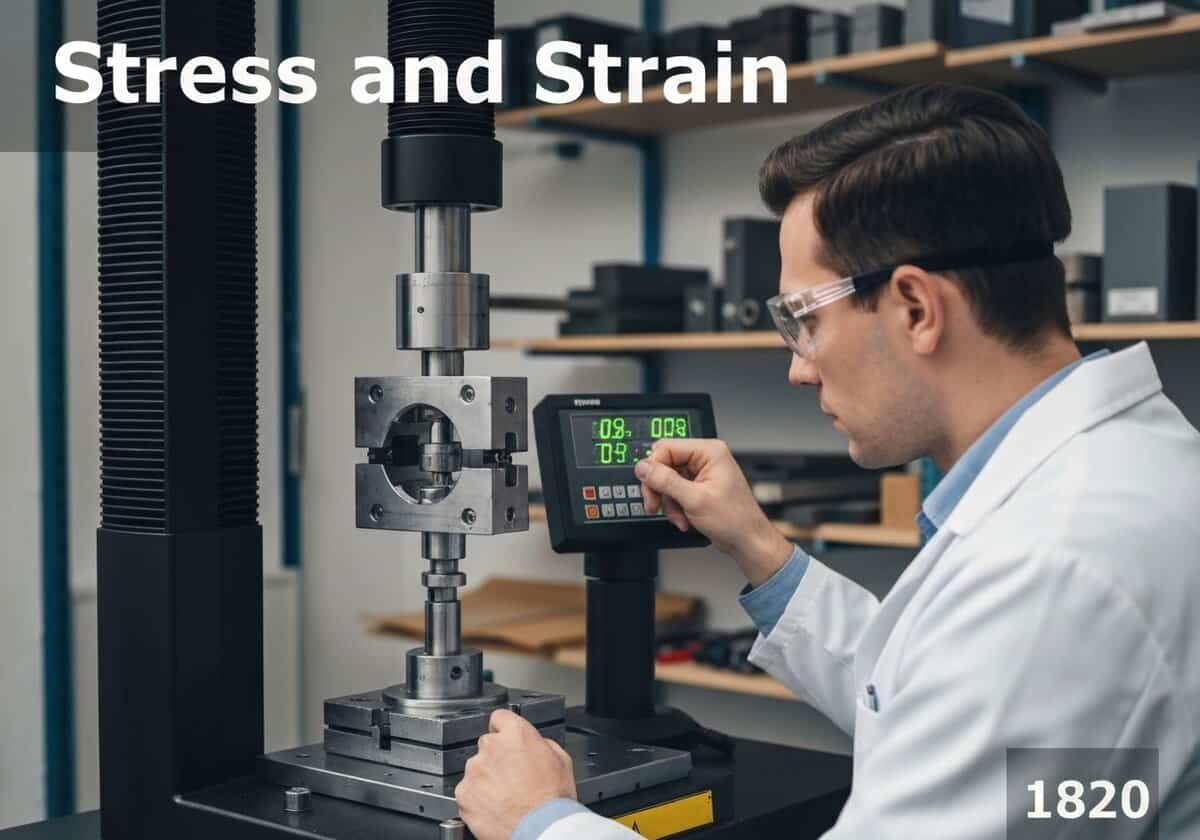
الإجهاد والتوتر

1820
آلة اختبار الشد لقياس الإجهاد والانفعال في فيزياء الحالة الصلبة.

(صورة توضيحية فقط)

Engineering stress ([latex]\sigma[/latex]) is the applied load divided by the original cross-sectional area ([latex]A_0[/latex]), while engineering strain ([latex]\epsilon[/latex]) is the change in length ([latex]\Delta L[/latex]) divided by the original length ([latex]L_0[/latex]). These definitions, [latex]\sigma = \frac{F}{A_0}[/latex] and [latex]\epsilon = \frac{\Delta L}{L_0}[/latex], are fundamental for plotting stress-strain curves but assume the specimen’s dimensions remain constant during the test.


Engineering stress and strain are foundational concepts in materials science and mechanics, providing a simplified yet powerful way to characterize a material’s response to external forces. The assumption that the cross-sectional area remains constant ([latex]A_0[/latex]) is valid for small deformations, particularly within the elastic region. However, as a material undergoes significant plastic deformation, its cross-sectional area changes—a phenomenon known as necking in tensile tests. This change means engineering stress no longer represents the true stress experienced by the material at its narrowest point. Similarly, engineering strain is based on the original length, which can be less accurate for large deformations compared to an instantaneous strain measure.

Despite these limitations, the engineering stress-strain curve is widely used in industry and academia. Its key features, such as the قوة الخضوع and ultimate tensile strength (UTS), are standard parameters for material specification and design. The curve is relatively easy to generate from a standard tensile test, where a specimen is pulled apart at a constant rate while force and elongation are measured. The initial linear portion of this curve is particularly important as it defines the material’s elastic behavior, governed by Hooke’s Law.

UNESCO Nomenclature: 2211
– Solid state physics

يكتب

نظام مجرد

خلل

أساسيات

الاستخدام

استخدام واسع النطاق

مقدمات

  • Galileo Galilei’s studies on the strength of materials (17th century)
  • Robert Hooke’s law of elasticity (1678)
  • Thomas Young’s definition of the modulus of elasticity (1807)
  • تطوير مفهوم الإجهاد على يد كوشي (أوائل القرن التاسع عشر)

التطبيقات

  • التحليل الهيكلي للمباني والجسور
  • تصميم المكونات الميكانيكية مثل التروس والأعمدة
  • مراقبة الجودة في التصنيع
  • اختيار المواد لتطبيقات الهندسة المختلفة

براءات الاختراع:

NA

أفكار ابتكارية محتملة

  • تطوير بروتوكولات اختبار المواد الموحدة (على سبيل المثال، astm e8)
  • creation of العناصر المحدودة analysis (FEA) software using simplified material models
  • تصميم مواد مركبة خفيفة الوزن مع أوضاع فشل يمكن التنبؤ بها
  • أنظمة مراقبة الجودة الآلية في خطوط التصنيع باستخدام بيانات الشد
  • خوارزميات الصيانة التنبؤية للمكونات الهيكلية بناءً على مراقبة الإجهاد
  • تحسين معلمات الطباعة ثلاثية الأبعاد بناءً على اختبار الخصائص الميكانيكية
  • biomaterial design for الغرسات الطبية with specific stress-strain requirements
  • تطوير مواد ذاتية الشفاء مع مراقبة السلامة الميكانيكية
  • المنسوجات الذكية التي تقيس وتستجيب للإجهاد المطبق
  • محاكيات الواقع الافتراضي لتحليل فشل المواد
Related to: engineering stress, engineering strain, tensile test, material properties, mechanics of materials, deformation, load, cross-sectional area, elongation, solid mechanics.

السياق التاريخي

الإجهاد والتوتر

1810
1816
1816-11-16
1820
1820
1822
1824
1808
1811
1816-11-16
1820
1820
1821
1822
1827

(إذا كان التاريخ غير معروف أو غير ذي صلة، على سبيل المثال "ميكانيكا الموائع"، يتم توفير تقدير تقريبي لظهوره الملحوظ)

أحدث الإضافات

أهم المنشورات والمقالات

أفضل الأدوات الأصلية

السنة العاشرة عيد

الصور والتنزيلات بالحجم الكامل متاحة فقط، ومجانية تمامًا، للأعضاء المسجلين.